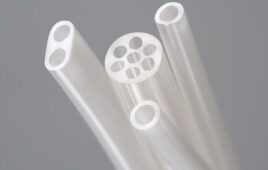
Zeus PFX-Flex catheter liners have been certified as PFAS-free. [Image courtesy of Zeus]
The news comes as medical device developers look to reduce their use of these “forever chemicals” in their products due to increasing scrutiny from regulators and customers.
While the FDA has declined to restrict the use of PFAS in medical devices, that decision could change after the Trump presidency when the agency comes under new leadership. And a ban seems likely in the EU, especially for applications where there are suitable PFAS-free alternatives.
“Even if there’s no regulatory ban on the use of PFAS-based materials in medical devices today, our customers are already evaluating alternatives rather than waiting for one,” Zeus Chief Commercial Officer Jim O’Connell said. “Our aim is to give them options that perform, backed by testing and certification, no matter where regulations may land.”
Zeus says the Intertek certification confirms its PFX Flex liners contain total organic fluorine levels below 20 ppm and targeted PFAS below 25 ppb, meeting Intertek’s published criteria for PFAS-free certification.

Zeus CEO Paddy O’Brien [Photo courtesy of Zeus]
Intertek Sustainability Certification Manager Faye Ricker said its certification includes testing, material documentation and ongoing oversight that gives “manufacturers and their customers confidence that PFAS-free claims are supported by a rigorous, science-based evaluation.”
The certification is valid until June 21, 2027, at which point it needs to be renewed for extension.
Zeus launched its PFX Flex catheter liner portfolio in January 2026. They’re made using a non-fluorinated polymer resin alternative to PTFE and without the intentional addition of any per- or polyfluoroalkyl substances. PFX Flex catheter liners are manufactured over either PEEK or silver-plated copper (SPC) mandrels and are designed to match the performance of PTFE in a non-fluorinated construction.
PFAS are called “forever chemicals ”because they don’t easily break down in the body or the environment. PFAS exposure has been linked to chronic health effects including cancers and organ and tissue damage.
However, there are some medical device applications where patient exposure is limited or where there are no alternative materials that work as well.

Zeus Chief Technology Officer Suresh Sainath [Photo courtesy of Zeus]
More from Zeus: Bioresorbable vascular scaffolds (BRS) polymer microstructure: micro details with macro impact