Engineers at Spinal USA, a manufacturer and distributor of advanced surgical spinal products in Flowood, MS, have designed spinal implants called vertebral body replacement (VBR) devices. Because surgeons insert these implants into patients’ spines during spinal fusion procedures, FDA approval is required. Rather than risk the cost and time for testing physical prototypes, though, the engineers investigated whether FEA software could provide adequate test results for FDA approval. 
FEA analysis of vertebral body replacement devices helped eliminate the need for physical laboratory testing to prove their safety and function. The analysis was sufficient to obtain FDA approval.
The engineers contracted Saba Metallurgical and Plant Engineering Services (SMPES) in Baton Rouge, LA to perform the finite element analysis of the various VBR designs. “When bringing multiple devices to market at once, prototyping and physical laboratory testing can be time-consuming and expensive, costing in the tens of thousands of dollars for each shape and size,” said Brent Saba, owner and principal engineer of SMPES. “Hence, it is desirable to reduce the number of physical laboratory tests by using FEA.”
The titanium VBR devices treat patients with leg or back pain caused by spinal trauma, tumors or degenerative disc disease. During a spinal fusion procedure, a surgeon removes the damaged disc and replaces it with the VBR device and bone graft material. This realigns the vertebral bones, lifting pressure from pinched nerve roots. Over time, the bone graft will grow through and around the implants, fusing the vertebra above and below to stabilize the spine.
The FDA required three types of physical laboratory testing for each device: axial compression load rating, axial fatigue and torsion (bending) fatigue. “In general, the FDA requires that new VBR devices be equal to or greater in all three categories than comparable devices presently on the market,” explained Saba.
Saba performed comparative FEA analyses for all designs under all test conditions. The FEA results told him which designs were the weakest; so long as these designs passed the physical laboratory tests, then FEA analyses could be used to demonstrate that the other designs were stronger and thus did not need physical laboratory testing.
Simulating physical tests
Saba created solid models of the VBR devices using Alibre Design and IronCAD computer-aided design (CAD) software. Then, he opened the CAD models in Algor FEA software and performed Mechanical Event Simulation (MES) and linear static stress analysis (LSSA) to simulate the FDA required tests.

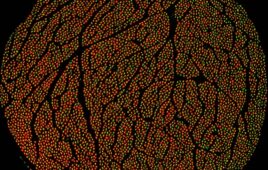
Engineer Brent Saba performed Mechanical Event Simulation (MES) and linear static stress analysis (LSSA) to simulate the FDA required tests on the vertebral replacement devices. Limit load analysis determined axial compression load rating. A plastic collapse analysis tested axial fatigue using a load of 3,000 N for 5-million cycles.
The axial compression load rating and axial fatigue tests were simulated using MES, which provides nonlinear, multi-body dynamics with large-scale motion, large deformation and large strain with body-to-body contact. “A nonlinear FEA technique called limit load analysis determined axial compression load rating,” said Saba. “Then, a plastic collapse analysis was run for the axial fatigue test using a load of 3,000 N for 5-million cycles.” Saba used Algor’s result probes to identify the maximum stresses for each VBR and then compared them. “The VBR with the lower maximum stress value had the longer fatigue life.”
The torsion fatigue test was simulated using linear static stress analysis with
surface forces totaling 200 N in the bending direction. “Because anticipated stresses were within the elastic range of the titanium material under the applied bending load, we could use linear elastic FEA,” said Saba. To compare the analysis results for various VBR designs, it was imperative to have nearly identical mesh intensity and quality and exact loading and constraints. Analyses were run for the VBRs and the results were compared. “Here again, the lower the alternating stress range, the higher the fatigue life,” noted Saba.
In place of prototyping and lab testing
Saba also modeled a VBR device with two types of plate systems. He performed comparative analyses of the VBR-device-and-plate assemblies, which showed that one was stronger than the other. The stronger version was not laboratory tested because FEA was accepted as evidence of its compliance with FDA requirements.
“With FEA” noted Saba, “multiple shapes and height-varying sizes could be compared against each other to determine the weakest shape and size combination. Given that the weakest shape-size VBR passed FEA simulation and laboratory testing, further laboratory testing was not required. However, if any of the VBRs failed to meet the FDA criteria during FEA simulation, then design changes could be made and retested using FEA. The ability to catch potential design flaws during the design stage instead of machining devices that would fail during physical laboratory testing saved cost and time.” The VBR devices have obtained FDA approval, and surgeons have successfully used them to help patients with spinal disorders.
Future changes of VBR products can be compared to the original version using FEA. If the new design is weaker, then changes can be made to make the device stronger or more flexible. If the new design is better than the old design, then the results can be documented and show that physical laboratory testing of the new device is not necessary.”
Saba plans to continue using Algor FEA to test spinal implants as well as his other engineering applications. “Algor is an integral part of my business, which has been advanced mechanical designs following ASME VIII Division 2, as well as pressure vessel/tank/piping fitness-for-service applications according to API 579.”
Algor Inc.
www.algor.com
:: Design World ::