Medical Design and Outsourcing

  • Home
  • Medical Device Business
    • Mergers & Acquisitions
    • Financial
    • Regulatory
  • Applications
    • Cardiovascular
    • Devices
    • Imaging
    • Implantables
    • Medical Equipment
    • Orthopedic
    • Surgical
  • Technologies
    • Supplies and Components Index
    • Contract Manufacturing
    • Components
    • Electronics
    • Extrusions
    • Materials
    • Motion Control
    • Prototyping
    • Pumps
    • Tubing
  • MedTech Resources
    • Medtech Events in 2026
    • The 2026 Medtech Big 100
    • Medical Device Handbook
    • MedTech 100 Index
    • Subscribe to Print Magazine
    • DeviceTalks
    • Digital Editions
    • eBooks
    • Educational Assets
    • Manufacturer Search
    • Podcasts
    • Webinars / Digital Events
    • Whitepapers
    • Voices
    • Views
    • Video
  • 2026 Leadership
    • 2025 Winners
    • 2024 Winners
    • 2023 Winners
    • 2022 Winners
    • 2021 Winners
  • Women in Medtech
  • Advertise
  • Subscribe

MIT engineers develop wearable, stamp-sized ultrasound stickers for continuous imaging

July 29, 2022 By Jim Hammerand

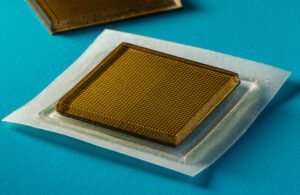
A small, square transducer array with an adhesive layer

MIT engineers have developed a postage-stamp-sized, wearable ultrasound device. [Photo by Felice Frankel]

A team of MIT engineers is working to make getting an ultrasound as simple as buying a book of stamps.

They’ve developed a postage-stamp-sized ultrasound device that can be stuck to the skin and worn for continuous imaging of internal organs over 48 hours.

Once the engineers work out wireless connectivity, the ultrasound stickers could be worn by patients at home or on the go, even during exercises like jogging, biking and lifting weights, they said as they presented their work in Science. The ultrasound stickers could be used to monitor internal organs, tumor progression, fetal development or even the point of a workout regimen where further exertion will lead to muscle overuse and soreness.

“We envision a few patches adhered to different locations on the body, and the patches would communicate with your cellphone, where AI algorithms would analyze the images on demand,” Xuanhe Zhao, a professor of mechanical engineering and civil and environmental engineering at MIT, said in a news release. “We believe we’ve opened a new era of wearable imaging: With a few patches on your body, you could see your internal organs.”

Zhao was the study’s senior author, joined by lead authors Chonghe Wang and Xiaoyu Chen, and co-authors Liu Wang, Mitsutoshi Makihata, and Tao Zhao at MIT, plus Mayo Clinic’s Hsiao-Chuan.

A wearable ultrasound imaging tool “would have huge potential in the future of clinical diagnosis,” Wang said in the release. “However, the resolution and imaging duration of existing ultrasound patches is relatively low, and they cannot image deep organs.”

The MIT ultrasound sticker is about 3 mm thick and has a stretchy adhesive layer with a rigid array of transducers, which allows the device to conform to the skin so it can generate clearer, more precise images, Wang said. Two layers of elastomer in the adhesive layer encapsulate a middle layer of solid, water-based hydrogel for sound wave transmission.

“The elastomer prevents dehydration of hydrogel,” Chen said. “Only when hydrogel is highly hydrated can acoustic waves penetrate effectively and give high-resolution imaging of internal organs.”

The researchers used their prototypes on healthy individuals and watched their blood vessels change diameter when seated and standing, saw the stomach stretching and shrinking as volunteers drank and passed juice, observed the heart changing shape during exercise and even spotted bright patterns indicating microdamage in muscles during workouts.

In addition to the wireless efforts underway, the team is developing software algorithms to interpret the ultrasound imagery and offer diagnoses.

“We imagine we could have a box of stickers, each designed to image a different location of the body,” Zhao said. “We believe this represents a breakthrough in wearable devices and medical imaging.”


About The Author

Jim Hammerand

Jim Hammerand is the managing editor of Arrowfly's Medical Design & Outsourcing, where he leads coverage of medtech innovation, design, engineering and manufacturing. He also reports breaking news at Arrowfly's MassDevice and contributes to our DeviceTalks podcasts and live events. Hammerand has more than two decades of journalism experience spanning newspapers, magazines, websites, live events, radio and TV news. For nearly a decade, Hammerand reported and edited business news for American City Business Journals as a reporter and digital editor at the Minneapolis/St. Paul Business Journal and then as managing editor of the Puget Sound Business Journal in Seattle. He holds degrees in journalism and management from the University of Minnesota and has won journalism awards from the Society of Professional Journalists, American Society of Business Publication Editors, and Trade, Association, Business Publications International. Connect with him on LinkedIn or by email at [email protected].

Related Articles Read More >

A photo of a Steris facility Alajuela, Costa Rica.
Steris expands in Costa Rica and the Netherlands
An image of the Medical Design & Outsourcing 2026 Medtech Big 100 ranking of the world's largest medical device companies by annual revenue.
The 2026 Medtech Big 100 breaks $500 billion
The most innovative medical devices of 2026
A photo of PTFE coating delamination.
Passing the tape test doesn’t mean your coating is reliable
“mdo
EXPAND YOUR KNOWLEDGE AND STAY CONNECTED
Get the latest medical device business news, application and technology trends.

DeviceTalks Weekly

See More >

MDO Digital Edition

Digital Edition

Subscribe to Medical Design & Outsourcing. Bookmark, share and interact with the leading medical design engineering magazine today.

MEDTECH 100 INDEX

Medtech 100 logo
Market Summary > Current Price
The MedTech 100 is a financial index calculated using the BIG100 companies covered in Medical Design and Outsourcing.

New MedTech Resource

Medical Tubing

MassDevice

Mass Device

The Medical Device Business Journal. MassDevice is the leading medical device news business journal telling the stories of the devices that save lives.

Visit Website
MDO ad
Medical Design and Outsourcing
  • MassDevice
  • DeviceTalks
  • MedTech100 Index
  • Medical Tubing + Extrusion
  • Medical Design Sourcing
  • Drug Delivery Business News
  • Drug Discovery & Development
  • Pharmaceutical Processing World
  • R&D World
  • About Us/Contact
  • Advertise With Us
  • Subscribe to Print Magazine
  • Subscribe to our E-Newsletter
  • Listen to our Weekly Podcasts
  • Join our DeviceTalks Tuesdays Discussion

Copyright © 2026 Arrowfly, LLC. All Rights Reserved. The material on this site may not be reproduced, distributed, transmitted, cached or otherwise used, except with the prior written permission of Arrowfly LLC. Site Map | Privacy Policy | RSS

Search Medical Design & Outsourcing

  • Home
  • Medical Device Business
    • Mergers & Acquisitions
    • Financial
    • Regulatory
  • Applications
    • Cardiovascular
    • Devices
    • Imaging
    • Implantables
    • Medical Equipment
    • Orthopedic
    • Surgical
  • Technologies
    • Supplies and Components Index
    • Contract Manufacturing
    • Components
    • Electronics
    • Extrusions
    • Materials
    • Motion Control
    • Prototyping
    • Pumps
    • Tubing
  • MedTech Resources
    • Medtech Events in 2026
    • The 2026 Medtech Big 100
    • Medical Device Handbook
    • MedTech 100 Index
    • Subscribe to Print Magazine
    • DeviceTalks
    • Digital Editions
    • eBooks
    • Educational Assets
    • Manufacturer Search
    • Podcasts
    • Webinars / Digital Events
    • Whitepapers
    • Voices
    • Views
    • Video
  • 2026 Leadership
    • 2025 Winners
    • 2024 Winners
    • 2023 Winners
    • 2022 Winners
    • 2021 Winners
  • Women in Medtech
  • Advertise
  • Subscribe