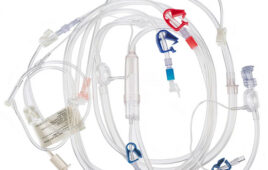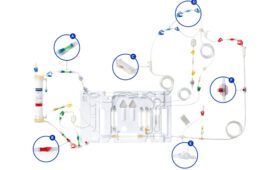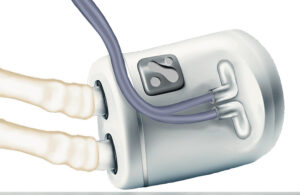
Nephrodite designed the Holly implantable continuous dialysis system patients with end-stage kidney disease. [Image courtesy of Nephrodite]
That was the nickname of a former pediatric patient of Nephrodite SVP of Science and Technology Dr. Hiep “Bob” Nguyen. The girl had lost her kidneys and was on dialysis as she waited for a transplant.
By the time she got a donor kidney, her vascular system and her other organs had suffered too much damage and her body rejected the transplant, said Nguyen’s co-founder, Nephrodite CEO Nikhil Shah.
“She ultimately succumbed to her disease. [Her name] has a lot of meaning for us,” Shah said.
Her nickname lives on as Nephrodite’s novel dialysis technology, which now has FDA Breakthrough Device Designation after successful preclinical tests in sheep.
Nephrodite designed the system for patients with end-stage kidney disease and envision it as a bridge for patients awaiting new kidneys and a treatment for dialysis patients who aren’t transplant candidates. The co-founders also see potential for the technology to be used as a liver filtering device, pancreas filtering device or even filtering for blood-borne pathogens and have had discussions with the Department of Defense and NASA.
But they haven’t said much about their proprietary technology until now, giving an exclusive interview to Medical Design & Outsourcing and MassDevice to share news of their Breakthrough Device Designation.
How Nephrodite developed the implantable Holly continuous dialysis system
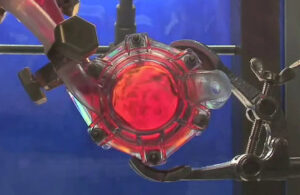
Nephrodite’s co-founders had developed this Holly dialysis implant prototype by 2020 when they won a National Academy of Medicine Healthy Longevity Catalyst Award. [Photo courtesy of Nephrodite]
They set off “to take the best of hemodialysis — through the arm with grafts and shunts — and the best of peritoneal dialysis, because that had never really taken off in the U.S. but had taken off in Europe and other places,” Shah said.
Nephrodite developed an implant for filtration with a proprietary membrane cascade, a filter cartridge, two vascular conduits (an arterial inflow and a venous outflow), and dialysate inflow and outflow on the top of the device.
“As dialysate is going one way, blood’s going the other way,” Shah said. “It’s a countercurrent exchange. The intermediary there is the membrane and that’s pulling out the toxins, the urea, the middle metabolites, as well as water, which will flow as well.”
“We started our journey more than 10 years ago,” Shah later continued, “and a a bulk of our time has been specifically addressing the membrane. It is the core competency of our device and probably the biggest breakthrough for us.”
The implant is placed in the extraperitoneal space, outside the abdomen. The abdomen “can be a very difficult place to put things,” Shah said. “It gets dirty pretty easily.”
The extraperitoneal space, on the other hand, has more room and is a known space for surgeons, especially those who perform transplant, urology, or vascular surgery.
At night, Holly patients would connect to a external dialysis exchange module and let that portable device do ultrafiltration for eight to ten hours, ideally at night while sleeping. Nephrodite’s system uses algorithms to time the dialysate flow according to the patient’s own hemodynamics.
“If we go too fast, we don’t remove anything,” Shah said. “If we go too slow, we remove too much. … Patients on dialysis or chronically ill patients, their blood pressures are either really high or really low. They’re rarely right where we want them to be. We really needed to be mindful of building a device that would adjust to those pressures properly.”
Another challenge for the Nephrodite team was developing an implant housing that would reduce the amount of blood interactions that would have a risk of blood clotting and hemolysis. Infections — particularly blood infections — are a serious risk for hemodialysis patients.
“The tubing that comes out is never connected to the blood space, so the ability for infections is markedly reduced,” Shah said.
Eventually, the filter cartridge inside the implant will need to be replaced through an outpatient procedure. Shah said patient polling indicated they’d accept that compared to the hemodialysis routine and complications from those treatments.
What’s next for Nephrodite
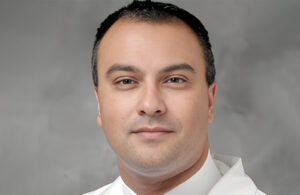
Nephrodite co-founder and CEO Nikhil Shah [Photo courtesy of Nephrodite]
Shah hopes to win regulatory approval as soon as early 2028, though the company hasn’t decided yet whether to take the de novo or premarket approval (PMA) pathway, or even whether the first regulatory approval will be in the U.S., European Union or India, where the company has a software development team.
“We are pursuing strategies that would fall across all three and see how that permeates,” Shah said. “What will really end up happening is submitting to all three entities and seeing how they play out, because if there’s a delay in one, we might proceed and then have data from from one to give to the other and and share it that way.
The biggest challenge facing the team and their technology from here is funding, Shah said.
“I practiced for a living, and it was actually very hard for me to even go to somebody and ask them to write a check. I had to get over that pretty quickly,” Shah said.
“Outside of raising the money to get our work done, we’re technically derisked so the challenges now are more about … do we have the right roadmap to get the things done that we need to get done? Are we partnering with the right hospitals, with the right KOLs (key opinion leaders)? … Breakthrough Device [Designation} and more access to the FDA allows us to make sure we’re checking all the right boxes.”
“The quality and safety guidelines and implementing that properly into our device and and getting it to where it needs to be is our is not our greatest obstacle, but is our greatest effort right now,” he continued.
As for the company’s name, Shah and Nguyen were once talking about Aphrodite, the ancient Greek goddess of love, and they figured the goddess of kidneys would be called Nephrodite.
“We hope that the gods are looking down on us, and we think they are, at least with Breakthrough,” Shah said.