This article is part of Qosina’s “The Engineer’s Guide” recurring series covering practical component selection guidance for medical device design engineers.
By Stephanie Alwais, Qosina

Stephanie Alwais is an applications engineer at Qosina, a global supplier of OEM single-use components for the medical and pharmaceutical industries. [Photo courtesy of Qosina]
Luer connectors are so common in medical device design that they can become invisible. Engineers reach for them early, lock in a spec and move on. But that familiarity makes them worth examining carefully.
The basics: slip, lock and what they actually mean for your design
Luer connectors are small-bore fittings governed by a 6% taper, a geometry in use since it was patented by Hermann Wülfing Lüer in 1894. They come in two primary configurations.
Luer slip connectors (also called Luer taper) use friction to hold mating components together. They connect and disconnect quickly, which makes them well-suited to low-pressure applications where ease of use matters: diagnostic devices, sampling assemblies, bench-scale flow circuits. The limitation is pull-out resistance. Under vibration, repeated handling or any lateral stress, a slip connection can disengage.
Luer lock connectors add a threaded collar to the outside of the male fitting. The female receives that thread, and once engaged, the connection resists both pull-out and rotation. Luer lock is typically the default for any application where unintended disconnection carries clinical risk, such as IV therapy, drug delivery, and interventional devices .
Both exist in male and female configurations. When sourcing mating components from different suppliers, tolerance stack-up at the interface is a more common issue than engineers expect. Engineers should always test connectors and how they mate when creating their design.

When a rotating male Luer lock is paired with a female Luer lock, the swivel joint prevents tubing twist and torque during connection. [Photo courtesy of Qosina]
ISO 80369 is the standard that changed how you should think about Luers
The ISO 80369 series replaced the older ISO 594 standard with a specific goal: eliminate misconnections based on application in patient care settings. The approach was to create application-specific connector geometries that cannot physically mate with connectors from a different clinical application.
The series is organized by clinical application:
- ISO 80369-3 covers enteral applications (revised May 2023)
- ISO 80369-6 covers neuraxial applications (revised May 2025)
- ISO 80369-5 covers limb cuff inflation (released March 2016, remains unrevised)
- ISO 80369-2 covers respiratory and driving gas applications (released June 2025)
- ISO 80369-4 covers urethral and urinary applications (release postponed)
- ISO 80369-7 covers intravascular and hypodermic applications (revised May 2021)
For the majority of engineers working on drug delivery, infusion or vascular access devices, ISO 80369-7 is the operative standard. It preserves the traditional Luer geometry while adding more rigorous dimensional and performance requirements, which means not all legacy Luer-compliant components automatically satisfy it.
ISO 80369-2 (respiratory connectors) deserves a specific note here. The standard was published in 2024 and was released in June 2025, but market adoption remains slow. Engineers working on respiratory, anesthesia or ventilator-adjacent devices are likely to encounter this standard in regulatory conversations, particularly as device-specific standards are revised to reference the ISO 80369 series directly. It is worth monitoring even if it does not currently govern your component selection.
Material selection
Luer connectors are available in polycarbonate (PC), polypropylene (PP), polyvinylidene fluoride (PVDF), acrylic (PMMA), nylon (polyamide), acrylonitrile butadiene styrene (ABS) and cyclic olefin copolymers (COC/COP), among others. The choice is not purely mechanical.
Polycarbonate offers high strength, optical clarity and gamma sterilization compatibility, making it a common choice for applications where visual fluid inspection matters.
Polypropylene provides good chemical resistance, handles a range of sterilization methods, and is generally less expensive than PC.
Polyvinylidene difluoride is used in applications where even more resistance to solvents is needed and purity is of the highest importance. Combining the purity of polycarbonate and enhanced solvent resistance beyond polypropylene, PVDF is often more expensive than other materials.
Other traditional materials like acrylic, nylon and ABS offer a variety of material properties that should be matched with the intended application and sterilization method.
COC/COP materials are increasingly relevant for sensitive biological applications due to their low extractable and leachable profiles. This is quite important for biologics delivery and combination products.
Material traceability is a non-negotiable consideration. Any component in a finished device needs full documentation of the polymer used, additives or colorants and the supplier’s regulatory file. Verify this at the sourcing stage, not during design validation.
Specialty variants
Standard Luer lock and slip connectors cover a large share of applications, but several specialized configurations address specific engineering constraints.
Valved Luers contain an internal check valve that prevents backflow when the connector is not engaged. These are common in IV assemblies and any application where the open Luer port would otherwise allow fluid ingress or leakage.
Color-coded Luers and Luer rings facilitate line identification in multi-line setups relevant wherever cross-connection risk needs to be managed at the point of care rather than at the connector geometry level.
Swivel Luers rotate freely during engagement for easier alignment, then lock once fully seated, making them useful in tight geometries where torque on the tubing creates stress.
Rotating male Luers remain free to rotate even when fully connected, which reduces torsional stress on attached tubing. These are relevant for wearable or ambulatory devices where the patient moves the assembly, and line twisting or kinking is possible.
Closed Luer lock valves (Luer-activated valves/LAVs) are needle-free connectors that open on engagement and close when separated. ANSI/AAMI CN27:2021 now provides a baseline standard for this category, which had previously relied on manufacturer-specific controls. A more recent version of these Luer-activated valves designed the valve to extend to the surface of the Luer, preventing microbial ingress on sampling and injection points clinically. Those are often called swabbables.
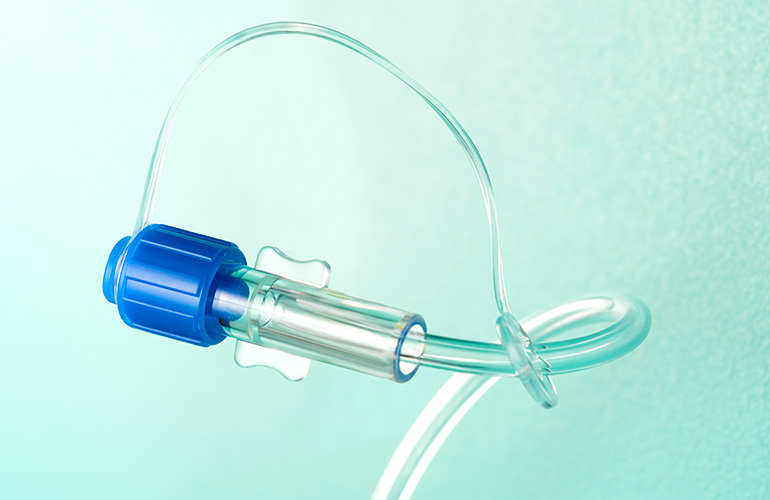
This female Luer lock connector with tubing port is a common interface for securing fluid-line connections in medical device assemblies. [Photo courtesy of Qosina]
Design and integration considerations
A few factors that regularly surface during connector qualification:
- Mating tolerance across suppliers: ISO 80369-7 dimensional requirements provide a baseline, but components sourced from different manufacturers may behave differently at the interface. Verify fit under the full range of expected assembly conditions, including when wet.
- Pressure rating: Luer lock connections typically handle up to 45 psi for standard fluid delivery applications. High-pressure injection applications (power injection for contrast media, for example) require connectors rated specifically for those conditions.
- Sterilization compatibility: EtO, gamma and autoclave all interact differently with connector materials. Get the full sterilization data from your supplier before finalizing material selection, but always plan to do sterilization testing on your completed device as design can affect sterilizability.
- Regulatory documentation: FDA and ISO standards require biocompatibility data, material traceability and dimensional testing records. Confirm what your supplier can provide before the component goes into your design history file.
- Second sourcing: Given ongoing supply chain variability, engineers should evaluate at qualification whether alternative sources for a given Luer configuration exist, and whether the dimensional and material profiles are close enough to qualify against the same test protocol.
Questions to ask your supplier
Before adding a Luer connector to your approved vendor list, get these questions answered in writing:
What are the full material constituents, including colorants and additives, and is there a regulatory support file available?
What sterilization methods has this connector been validated for, and are there material lot-to-lot consistency controls in place?
What dimensional tolerance data is available for the Luer taper geometry?
Is there an extractables/leachables profile available, and has it been generated with clinically relevant solvents?
Is second-source availability documented, and are there known dimensional differences between sources that would require separate qualification?
What comes next
The Luer has been a stable standard for small bore connections for decades, and for most applications that stability is a feature, not a limitation. The engineering decisions — material, variant, source, documentation — are where the real work happens. A choice of Luer connector greatly depends on the application and the key features necessary for functionally including it.
The ongoing rollout of ISO 80369 across additional application areas means that regulatory and standard implementation conversations about small-bore connectors are not going away. Engineers who understand the standard architecture now are better positioned to navigate those conversations.
Stephanie Alwais is an applications engineer at Qosina, a global supplier of OEM single-use components for the medical and pharmaceutical industries.
Read more MDO Contributions and learn how to submit your own.
The opinions expressed in this blog post are the author’s only and do not necessarily reflect those of Medical Design & Outsourcing or its employees.