Medical Design and Outsourcing

  • Home
  • Medical Device Business
    • Mergers & Acquisitions
    • Financial
    • Regulatory
  • Applications
    • Cardiovascular
    • Devices
    • Imaging
    • Implantables
    • Medical Equipment
    • Orthopedic
    • Surgical
  • Technologies
    • Supplies and Components Index
    • Contract Manufacturing
    • Components
    • Electronics
    • Extrusions
    • Materials
    • Motion Control
    • Prototyping
    • Pumps
    • Tubing
  • MedTech Resources
    • Medtech Events in 2026
    • The 2026 Medtech Big 100
    • Medical Device Handbook
    • MedTech 100 Index
    • Subscribe to Print Magazine
    • DeviceTalks
    • Digital Editions
    • eBooks
    • Educational Assets
    • Manufacturer Search
    • Podcasts
    • Webinars / Digital Events
    • Whitepapers
    • Voices
    • Views
    • Video
  • 2026 Leadership
    • 2025 Winners
    • 2024 Winners
    • 2023 Winners
    • 2022 Winners
    • 2021 Winners
  • Women in Medtech
  • Advertise
  • Subscribe

Body Heat Could Electrically Power IoT Devices, Medical Monitors Using a Woven, Thermoelectric Flexible Fabric

April 6, 2017 By Phys.org

(Credit: Getty Images)

A Purdue University-developed technology that can be woven into a specially designed fabric could help harness human body heat and provide energy to power Internet of things (IoT) devices including heart and respiration monitors and fulfill other uses.

Kazuaki Yazawa, a research associate professor at Discovery Park’s Birck Nanotechnology Center at Purdue University, developed the flexible thermoelectric generator technology, which uses semiconductor strings woven into a fabric. The generator takes heat from any type of complex surface it meets and converts it into a small amount of electricity.

Yazawa says the new technology addresses the limitations of conventional thermoelectric generators.

“The human body provides a significantly low-heat flux which requires thicker thermoelectric elements. Optimum size should be larger than one inch in order to generate high power output,” he says. “These characteristics limit the technologies use as it is very rigid and cannot effectively fit the three-dimensional form of the body.”

Yazawa says the unique woven semiconductor strings used in this novel technology promise to replace conventional thermoelectric generators by making them more flexible and easier to manage.

“The only way to reduce the thickness of the module is by designing the thermoelectric generator using a weaving technique. This allows the technology to be very flexible and dense,” Yazawa says. “Lengthening the threads and using a unique combination of insulation makes the generator more flat and manageable, which makes it ideal for use in clothing or any shape that can be wrapped in a flexible fabric that has waste heat such as a chimney or coffee cup.

“Additionally, these semiconductor strings are able to harness the maximum amount of heat from the body or other ambient heat sources, providing reliable power for internet of things devices. This can eliminate the need for batteries.”

Yazawa says the technology could greatly benefit tech wearables like those in the medical and healthcare industry.

“Heart monitors, respiration and perspiration monitors are very useful for the elderly or those recovering from a trauma. There also is a huge market for wearables in sports to optimize human performance,” he says. “If you have a patient or an athlete who is overheating, real-time information of their vitals could be used by coaches and medical professionals to better monitor and treat their players or patients. These types of devices need energy to be actively charged so they can be used continually.”

Yazawa says the technology also could provide a cooling effect.

“Anything that takes heat and converts it to another form of energy is also providing a cooling effect. Therefore, this technology also could provide a continuous cooling treatment,” he says. “This could be especially beneficial from a sports or military perspective. The flexible substrate could be applied to undergarments and when athletes are running the technology could help give that little bit of charge.

Related Articles Read More >

The most innovative medical devices of 2026
Reconstructed 3D fluorescence image of the stained biohybrid mesh-tissue integration. The red, green, and blue colors correspond to the mesh, F-actin, and nuclei, respectively.
Researchers mesh electronics with human cells to develop living battery
A photo of the Paradromics Connexus brain-computer interface on a fingertip.
How Paradromics designed its Connexus brain-computer interface system
A photo of the wearable gait sensors used in the study.
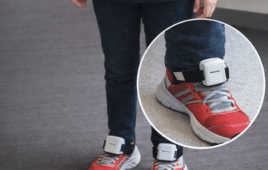
Yale-led study finds wearable sensors match motion capture for gait tracking in knee osteoarthritis
“mdo
EXPAND YOUR KNOWLEDGE AND STAY CONNECTED
Get the latest medical device business news, application and technology trends.

DeviceTalks Weekly

See More >

MDO Digital Edition

Digital Edition

Subscribe to Medical Design & Outsourcing. Bookmark, share and interact with the leading medical design engineering magazine today.

MEDTECH 100 INDEX

Medtech 100 logo
Market Summary > Current Price
The MedTech 100 is a financial index calculated using the BIG100 companies covered in Medical Design and Outsourcing.

New MedTech Resource

Medical Tubing

MassDevice

Mass Device

The Medical Device Business Journal. MassDevice is the leading medical device news business journal telling the stories of the devices that save lives.

Visit Website
MDO ad
Medical Design and Outsourcing
  • MassDevice
  • DeviceTalks
  • MedTech100 Index
  • Medical Tubing + Extrusion
  • Medical Design Sourcing
  • Drug Delivery Business News
  • Drug Discovery & Development
  • Pharmaceutical Processing World
  • R&D World
  • About Us/Contact
  • Advertise With Us
  • Subscribe to Print Magazine
  • Subscribe to our E-Newsletter
  • Listen to our Weekly Podcasts
  • Join our DeviceTalks Tuesdays Discussion

Copyright © 2026 Arrowfly, LLC. All Rights Reserved. The material on this site may not be reproduced, distributed, transmitted, cached or otherwise used, except with the prior written permission of Arrowfly LLC. Site Map | Privacy Policy | RSS

Search Medical Design & Outsourcing

  • Home
  • Medical Device Business
    • Mergers & Acquisitions
    • Financial
    • Regulatory
  • Applications
    • Cardiovascular
    • Devices
    • Imaging
    • Implantables
    • Medical Equipment
    • Orthopedic
    • Surgical
  • Technologies
    • Supplies and Components Index
    • Contract Manufacturing
    • Components
    • Electronics
    • Extrusions
    • Materials
    • Motion Control
    • Prototyping
    • Pumps
    • Tubing
  • MedTech Resources
    • Medtech Events in 2026
    • The 2026 Medtech Big 100
    • Medical Device Handbook
    • MedTech 100 Index
    • Subscribe to Print Magazine
    • DeviceTalks
    • Digital Editions
    • eBooks
    • Educational Assets
    • Manufacturer Search
    • Podcasts
    • Webinars / Digital Events
    • Whitepapers
    • Voices
    • Views
    • Video
  • 2026 Leadership
    • 2025 Winners
    • 2024 Winners
    • 2023 Winners
    • 2022 Winners
    • 2021 Winners
  • Women in Medtech
  • Advertise
  • Subscribe