Medical Design and Outsourcing

  • Home
  • Medical Device Business
    • Mergers & Acquisitions
    • Financial
    • Regulatory
  • Applications
    • Cardiovascular
    • Devices
    • Imaging
    • Implantables
    • Medical Equipment
    • Orthopedic
    • Surgical
  • Technologies
    • Supplies and Components Index
    • Contract Manufacturing
    • Components
    • Electronics
    • Extrusions
    • Materials
    • Motion Control
    • Prototyping
    • Pumps
    • Tubing
  • MedTech Resources
    • Medtech Events in 2026
    • The 2026 Medtech Big 100
    • Medical Device Handbook
    • MedTech 100 Index
    • Subscribe to Print Magazine
    • DeviceTalks
    • Digital Editions
    • eBooks
    • Educational Assets
    • Manufacturer Search
    • Podcasts
    • Webinars / Digital Events
    • Whitepapers
    • Voices
    • Views
    • Video
  • 2026 Leadership
    • 2025 Winners
    • 2024 Winners
    • 2023 Winners
    • 2022 Winners
    • 2021 Winners
  • Women in Medtech
  • Advertise
  • Subscribe

Could this app save darker-skinned newborns from dangers of jaundice?

March 2, 2020 By Nancy Crotti

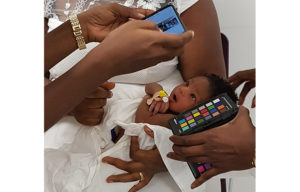
(Image by Dr Christabel Enweronu-Laryea, University of Ghana.)

Researchers in England have developed a smartphone app to better detect jaundice in darker-skinned babies.

Jaundice turns the skin and whites of the eyes yellow, and is harder to detect in darker-skinned newborns by relying on sight alone. The condition, caused by the buildup of a yellow substance called bilirubin, kills 114,000 newborns and causes 178,000 cases of disability a year worldwide, despite being a treatable condition. Many of these cases occur in south Asia and sub-Saharan Africa,

Now there’s a smartphone app whose developers believe can allow users to check for jaundice in newborn babies simply by taking a picture of the eye .

A pilot study led by University College London and its affiliated hospital found the app may be an effective, low-cost way to screen for the condition. Their study, published in PLOS ONE, found that the new screening method quantifies the yellowness of the eye and can be as effective at detecting more severe jaundice as costly screening devices recommended for use in the U.K.

“In many parts of the world, midwives and nurses rely on sight alone to assess jaundice. However, this is unreliable, especially for newborns with darker skin,” said senior author Dr. Terence Leung of UCL’s  Medical Physics & Biomedical Engineering department in a news release.  “Our smartphone-based method provides a more robust assessment, ensuring serious cases do not go unnoticed. While we await the evidence of a larger trial, we believe that this method, used as an app, could help to prevent the deaths of newborn babies due to severe jaundice worldwide.”

While most cases in newborns are harmless, in severe cases a neurotoxic form of bilirubin can enter the brain, leading to death or disabilities such as hearing loss, neurological conditions such as athetoid cerebral palsy, and developmental delays.

In hospitals, newborns suspected of being at risk can be given a blood test to determine the concentration of bilirubin in the blood. However, jaundice may only become problematic several days after birth, when mother and newborn are at home.

In the study, smartphone pictures were taken of the eyes of 37 newborn babies at UCLH who had been referred for blood tests. These images were processed to remove the distorting effects of background light and the yellowness of the eye quantified to predict the level of bilirubin in the blood.

These predictions were then compared to the results of the blood tests. The method successfully identified all cases where treatment would normally be required, while identifying cases that would not require treatment 60% of the time. This is a success rate comparable to transcutaneous bilirubinometers — expensive hand-held devices recommended for use by midwives in the UK.

“Our screening method would require no special equipment apart from a smartphone and is a tenth of the cost of commercial devices used in the UK,” said first author Felix Outlaw, also of UCL’s Medical Physics & Biomedical Engineering department. “Given that smartphones are common even in poor and remote parts of the world, being able to use them to screen for jaundice would have a significant impact.”

A larger trial of the screening method involving more than 500 babies is underway in Ghana. The trial, a collaboration between UCL and the University of Ghana as well as Greater Accra Regional Hospital, is funded by the “Saving Lives at Birth” award, with funders including the U.S. Agency for International Development, the government of Norway, the Bill & Melinda Gates Foundation, Grand Challenges Canada, the UK government, and the Korea International Cooperation Agency.
Related Articles Read More >

A photo of Edwards Lifesciences' Autus size-adjustable heart valve.
A heart valve that grows with children shows what pediatric devices can become
An image of the September 2026 Medical Design & Outsourcing magazine featuring the Medtech Big 100 ranking of the world's largest medical device companies.
September 2026 issue: The MDO Medtech Big 100 breaks $500 billion
A photo of nitinol, a nickel-titanium alloy used for medical devices such as stents, heart valves, catheters and orthopedics.
What is nitinol and where is it used?
A photo of Kolaleh Eskandanian.
Cleared for every child, covered for none, priced for the parents who can pay
“mdo
EXPAND YOUR KNOWLEDGE AND STAY CONNECTED
Get the latest medical device business news, application and technology trends.

DeviceTalks Weekly

See More >

MDO Digital Edition

Digital Edition

Subscribe to Medical Design & Outsourcing. Bookmark, share and interact with the leading medical design engineering magazine today.

MEDTECH 100 INDEX

Medtech 100 logo
Market Summary > Current Price
The MedTech 100 is a financial index calculated using the BIG100 companies covered in Medical Design and Outsourcing.

New MedTech Resource

Medical Tubing

MassDevice

Mass Device

The Medical Device Business Journal. MassDevice is the leading medical device news business journal telling the stories of the devices that save lives.

Visit Website
MDO ad
Medical Design and Outsourcing
  • MassDevice
  • DeviceTalks
  • MedTech100 Index
  • Medical Tubing + Extrusion
  • Medical Design Sourcing
  • Drug Delivery Business News
  • Drug Discovery & Development
  • Pharmaceutical Processing World
  • R&D World
  • About Us/Contact
  • Advertise With Us
  • Subscribe to Print Magazine
  • Subscribe to our E-Newsletter
  • Listen to our Weekly Podcasts
  • Join our DeviceTalks Tuesdays Discussion

Copyright © 2026 Arrowfly, LLC. All Rights Reserved. The material on this site may not be reproduced, distributed, transmitted, cached or otherwise used, except with the prior written permission of Arrowfly LLC. Site Map | Privacy Policy | RSS

Search Medical Design & Outsourcing

  • Home
  • Medical Device Business
    • Mergers & Acquisitions
    • Financial
    • Regulatory
  • Applications
    • Cardiovascular
    • Devices
    • Imaging
    • Implantables
    • Medical Equipment
    • Orthopedic
    • Surgical
  • Technologies
    • Supplies and Components Index
    • Contract Manufacturing
    • Components
    • Electronics
    • Extrusions
    • Materials
    • Motion Control
    • Prototyping
    • Pumps
    • Tubing
  • MedTech Resources
    • Medtech Events in 2026
    • The 2026 Medtech Big 100
    • Medical Device Handbook
    • MedTech 100 Index
    • Subscribe to Print Magazine
    • DeviceTalks
    • Digital Editions
    • eBooks
    • Educational Assets
    • Manufacturer Search
    • Podcasts
    • Webinars / Digital Events
    • Whitepapers
    • Voices
    • Views
    • Video
  • 2026 Leadership
    • 2025 Winners
    • 2024 Winners
    • 2023 Winners
    • 2022 Winners
    • 2021 Winners
  • Women in Medtech
  • Advertise
  • Subscribe