Medical Design and Outsourcing

  • Home
  • Medical Device Business
    • Mergers & Acquisitions
    • Financial
    • Regulatory
  • Applications
    • Cardiovascular
    • Devices
    • Imaging
    • Implantables
    • Medical Equipment
    • Orthopedic
    • Surgical
  • Technologies
    • Supplies and Components Index
    • Contract Manufacturing
    • Components
    • Electronics
    • Extrusions
    • Materials
    • Motion Control
    • Prototyping
    • Pumps
    • Tubing
  • MedTech Resources
    • Medtech Events in 2026
    • The 2026 Medtech Big 100
    • Medical Device Handbook
    • MedTech 100 Index
    • Subscribe to Print Magazine
    • DeviceTalks
    • Digital Editions
    • eBooks
    • Educational Assets
    • Manufacturer Search
    • Podcasts
    • Webinars / Digital Events
    • Whitepapers
    • Voices
    • Views
    • Video
  • 2026 Leadership
    • 2025 Winners
    • 2024 Winners
    • 2023 Winners
    • 2022 Winners
    • 2021 Winners
  • Women in Medtech
  • Advertise
  • Subscribe

Could Wireless Replace Wearables?

June 13, 2014 By Adam Conner-Simons, CSAIL

CSAIL wireless technology that measures heart rate and breathing through walls has applications for personal health, baby monitors, and law enforcement.

These days there’s perhaps no hotter tech topic than wearable sensors. Earlier this month, for instance, Apple announced a new “Health Kit” app for smartphones that tracks a person’s health. But events such as Fitbit’s recent recall of more than 1 million fitness bands over user skin irritations — and research published last week contending that health-trackers may be no more effective than a $25 pedometer — suggest that wearables have their drawbacks.

Imagine, then, if there was a technology that monitors your vital signs without touching your body — potentially even from another room.

Such science-fiction fantasies are becoming a reality, thanks to research conducted at MIT’s Wireless Center, hosted in the Computer Science and Artificial intelligence Laboratory (CSAIL).

Last year, a CSAIL team developed a wireless system that can track movement through a wall. Their latest report demonstrates that they can now detect gestures as subtle as the rise and fall of a person’s chest. From that, they can determine a person’s heart rate with 99 percent accuracy. The research could be used for health-tracking apps, baby monitors, and for the military and law enforcement.

“It has traditionally been very difficult to capture such minute motions that occur at the rate of mere millimeters per second,” says MIT professor of electrical engineering and computer science Dina Katabi, the paper’s co-author who also directs the Wireless Center. “Being able to do so with a low-cost, accessible technology opens up the possibilities for people to be able to track their vital signs on their own.”

The team — which includes Robert Miller, a professor of electrical engineering and computer science, and graduate students Fadel Adib and Zach Kabalec — has also developed the capability to track the movements of up to four distinct individuals, which could be helpful for search-and-rescue operations (such as when emergency responders are trying to find survivors inside a burning building).

As described in an earlier MIT News story, the system works by transmitting a low-power wireless signal and using its reflections to track moving humans. It can do so even if the humans are in closed rooms or hiding behind a wall. 

As the signal is transmitted at a wall, a portion of the signal penetrates through, reflecting off a person on the other side. However, due to all the signal interference from other objects, the team had to create technology to cancel out irrelevant reflections.

In order to monitor breathing, the technology needed to be precise: The researchers created a complex metric that approximates the subject’s volume, and then observed and amplified its changes to distinguish the breathing.

Katabi’s team is now working on higher resolution capabilities that would allow them to detect actual body silhouettes, gestures, and even emotions. (Heart rate and breathing are strong indicators of emotional extremes like fear or anger.)


Related Articles Read More >

The most innovative medical devices of 2026
Reconstructed 3D fluorescence image of the stained biohybrid mesh-tissue integration. The red, green, and blue colors correspond to the mesh, F-actin, and nuclei, respectively.
Researchers mesh electronics with human cells to develop living battery
A photo of the Paradromics Connexus brain-computer interface on a fingertip.
How Paradromics designed its Connexus brain-computer interface system
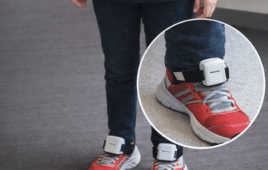
A photo of the wearable gait sensors used in the study.
Yale-led study finds wearable sensors match motion capture for gait tracking in knee osteoarthritis
“mdo
EXPAND YOUR KNOWLEDGE AND STAY CONNECTED
Get the latest medical device business news, application and technology trends.

DeviceTalks Weekly

See More >

MDO Digital Edition

Digital Edition

Subscribe to Medical Design & Outsourcing. Bookmark, share and interact with the leading medical design engineering magazine today.

MEDTECH 100 INDEX

Medtech 100 logo
Market Summary > Current Price
The MedTech 100 is a financial index calculated using the BIG100 companies covered in Medical Design and Outsourcing.

New MedTech Resource

Medical Tubing

MassDevice

Mass Device

The Medical Device Business Journal. MassDevice is the leading medical device news business journal telling the stories of the devices that save lives.

Visit Website
MDO ad
Medical Design and Outsourcing
  • MassDevice
  • DeviceTalks
  • MedTech100 Index
  • Medical Tubing + Extrusion
  • Medical Design Sourcing
  • Drug Delivery Business News
  • Drug Discovery & Development
  • Pharmaceutical Processing World
  • R&D World
  • About Us/Contact
  • Advertise With Us
  • Subscribe to Print Magazine
  • Subscribe to our E-Newsletter
  • Listen to our Weekly Podcasts
  • Join our DeviceTalks Tuesdays Discussion

Copyright © 2026 Arrowfly, LLC. All Rights Reserved. The material on this site may not be reproduced, distributed, transmitted, cached or otherwise used, except with the prior written permission of Arrowfly LLC. Site Map | Privacy Policy | RSS

Search Medical Design & Outsourcing

  • Home
  • Medical Device Business
    • Mergers & Acquisitions
    • Financial
    • Regulatory
  • Applications
    • Cardiovascular
    • Devices
    • Imaging
    • Implantables
    • Medical Equipment
    • Orthopedic
    • Surgical
  • Technologies
    • Supplies and Components Index
    • Contract Manufacturing
    • Components
    • Electronics
    • Extrusions
    • Materials
    • Motion Control
    • Prototyping
    • Pumps
    • Tubing
  • MedTech Resources
    • Medtech Events in 2026
    • The 2026 Medtech Big 100
    • Medical Device Handbook
    • MedTech 100 Index
    • Subscribe to Print Magazine
    • DeviceTalks
    • Digital Editions
    • eBooks
    • Educational Assets
    • Manufacturer Search
    • Podcasts
    • Webinars / Digital Events
    • Whitepapers
    • Voices
    • Views
    • Video
  • 2026 Leadership
    • 2025 Winners
    • 2024 Winners
    • 2023 Winners
    • 2022 Winners
    • 2021 Winners
  • Women in Medtech
  • Advertise
  • Subscribe