MiniMed EVP and Chief Product and Technology Officer Ali Dianaty holding the MiniMed Flex automated insulin delivery system. [Photo courtesy of MiniMed]
The smaller, screenless pump system is a major milestone for one of the world’s largest diabetes businesses.
“We have a long history with durable pumps,” MiniMed EVP and Chief Product and Technology Officer Ali Dianaty said in a Medical Design & Outsourcing interview. “We wanted to take the things that we knew were great about [the 700-series pumps] and keep them, then asked our customers the things that they would like to see and then incorporated that as our legacy going forward. That’s basically why Flex is what it is.”
Market intelligence: MassDevice’s Continuous Glucose Monitoring (CGM) Market Special Report
Analysts like what they’re seeing from MiniMed, with BTIG’s Marie Thibault, Alexandra Pang and Sam Eiber describing it as the diabetes technology industry’s only “full-stack” company in a large and underpenetrated market.
“MiniMed’s pipeline is full, with the MiniMed Go smart insulin pen system, the smaller MiniMed Flex tubed pump, and the MiniMed Fit patch pump all expected to be commercialized in the U.S. within the next two years,” they wrote in a note to clients. “Though the diabetes technology segment is highly competitive, we view MiniMed as having a strong product pipeline and the global scale and reach to commercialize effectively.”
Bank of America Research Analyst Travis Steed also has MiniMed as a buy, though he flagged potential downsides, including its continued relationship with Medtronic, which owns about 90% of MiniMed’s stock.
“Risks are heightened competition as other pump companies innovate, pipeline delays, entanglement with [Medtronic] and changes to pricing/reimbursement,” Steed wrote.

Led by CEO Que Dallara (center), MiniMed became an independent company when it went public in March 2026. [Photo courtesy of MiniMed]
Shrinking the MiniMed Flex

The MiniMed Flex system can be worn on a belt or tucked into a pocket. [Image courtesy of MiniMed]
Compared to the previous-generation MiniMed 780G, the 8-series MiniMed Flex pump is about half as large, allowing for more discrete placement while still using the same reservoirs and infusion sets. The pump comes in at roughly the size of two stacked insulin vials.
Flex is MiniMed’s first screenless design, created in partnership with people living with diabetes. Enabling smartphone control to skip the screen was a big part of the size reduction.
MiniMed’s SmartGuard algorithm with Meal Detection technology powers the pump. Dianaty said the team started out by aiming to make the pump smaller, as that was requested most by users, including MiniMed’s lead designer, who has type 1 diabetes and wanted a pump that would fit in his pocket or easily clip onto a belt.
MiniMed also wanted to maintain legacy features such as the 300-unit insulin reservoir and a seven-day infusion set, which is matched by seven days of battery life from a full charge, Dianaty said.
Making the pump smaller required some “minor tweaks,” Dianaty said. However, the system maintains the full pumping mechanism used by previous pumps, even within a smaller package.
“We wanted the accuracy of the pump — and everything about it in terms of its reliability and how it delivers insulin — to be maintained,” Dianaty said. “… It’s the pumping mechanism and the battery pack sandwiched in there with some electronics. That’s it.”
While “you can’t make it any smaller” for now because the company wanted to keep the reservoir and pumping the same to help 780G users transition to the new pump, Dianaty says there’s still room to make electronics and batteries slightly smaller one day down the line.
“If we in the future decided to make changes [on the reservoir] and pumping mechanism, we could shrink it down,” Dianaty said. “Then, hopefully at some point we’d have the means of testing the type of insulin inside the reservoir, because we could then make the reservoir even smaller by increasing the concentration of the insulin. But that’s way out there.”
Medtech pay analysis: Medtronic discloses pay for Diabetes leaders ahead of MiniMed IPO
Signals without a screen and switching with speed
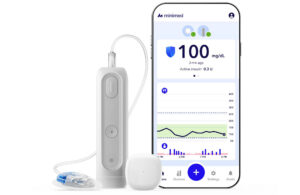
The MiniMed Flex pump system pairs with a smartphone and continuous glucose monitor — here, the Simplera Sync — to automate insulin delivery. [Image courtesy of MiniMed]
Even without a screen, the MiniMed Flex device has LED components to signal successful insulin delivery with green lights, yellow lights for alerts and red for alarms. The pump also vibrates and makes noise, with different tones pointing to different scenarios for the user.
“We tried to incorporate things that are important to patients and make it so that you can sneak [the pump] away and not have to ever worry about it,” Dianaty said.
The smartphone app design sought to enable patients to transition between modalities, including the company’s MiniMed Go smart insulin pen system for multiple daily injections (MDI). Users can go from pen to pump “very readily,” Dianaty said.
Similarly, clinicians use MiniMed’s CareLink data management system across systems in the same way, regardless of dosing method, mechanism or sensor.
“Making that all work, no one else has done it,” Dianaty said. “We’re going to be the first. At the same time, we are the first to send out both iOS and Android at the same time in a pump setup.”
“All of that was actually the bigger challenge in a lot of ways,” he continued, “to get the ecosystem working the way that we wanted to, to allow people to transition very smoothly, and then make it simple for people to be able to start up and go.”
MDO webinar with Sean Whooley: A look at the tech behind the world’s first year-long CGM, the Senseonics Eversense Evolution: