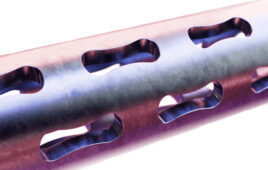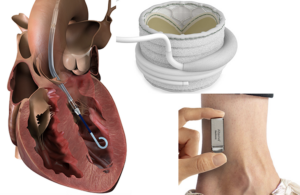
Clockwise from the left: Johnson & Johnson MedTech’s Impella CP pump, the Edwards Lifesciences Sapien M3 TMVR, and Medtronic’s Altaviva urinary incontinence implant [Images courtesy of the device developers]
The list spans specialties from heart implants to drug delivery, as well as tests from cancer to kidney function, and everything from the pocket-sized up to heavy linear accelerators.
To find out more about which medtech companies are investing the most in R&D and innovation, download our free Medtech Big 100 Special Report.
For the 20th anniversary of the Prix Galien USA ceremony, the foundation is planning the 2026 Galien Week of Innovation with virtual nominee showcases, the Galien Forum, the Galien Patient Summit and an Oct. 29 awards gala at the American Museum of Natural History in New York City. The evening will also host the International Prix Galien, held every two years to honor previous winners.
With categories of Best Digital Health Solution, Best Startup, and Incubators, Accelerators and Equity (plus awards for pharma and biotech drugs), the total program includes 215 nominated products from 108 companies across 25 therapeutic areas.
“For 20 years, Prix Galien USA has celebrated the scientific breakthroughs that have transformed patients’ lives. This anniversary is both a moment to honor that legacy and to look ahead to the next generation of discoveries that will redefine medicine,” Galien Foundation Chair Bruno Cohen said in a news release. “Under the theme ‘Legacy & Leap,’ the 2026 Galien Week of Innovation will bring together scientists, patients, industry leaders and policymakers from around the world, not simply to celebrate innovation, but to help imagine what comes next.”
For Best Medical Technology honors, a device must have received FDA approval within the past five years; as such, several were also nominated in 2025 and for the years prior. Sales data were not considered in their selection.
The nominated developers and their products include:
- Abbott, with its Aveir dual-chamber leadless pacemaker; the Esprit BTK everolimus-eluting resorbable scaffold; and TriClip G4 for tricuspid valve repair. Each was nominated in 2025.
- Alcon and its Unity vitreoretinal cataract surgery platform
- Beyond Air for LungFit PH, its tankless nitric oxide generator also nominated in 2025
- Cochlear’s Nucleus Nexa internal hearing implant
- Cresilon and its Traumagel instant bloodstopper, also nominated in 2025
- Edwards Lifesciences and its Sapien M3 transcatheter mitral valve replacement implant
- Establishment Labs’ Motiva Flora SmoothSilk MRI-conditional breast tissue expander, also nominated in 2025
- Guardant Health’s Guardant360 liquid biopsy test returns from 2025, following its win in 2023, while its Shield colorectal cancer screening blood test makes its nomination debut
- InsightTec and its Exablate Neuro incisionless, ultrasound-powered surgery system for Parkinson’s disease and tremor, which won in 2017
- Johnson & Johnson, with its Impella 5.5 and Impella CP heart pumps; the Shockwave C2 coronary catheter for intravascular lithotripsy; and the Inlexzo intravesical implant for delivering sustained-release gemcitabine against bladder cancer
- LumiCell’s LumiSystem, for highlighting residual breast tumor cells during surgery
- Lungpacer Medical’s AeroPace transvenous diaphragm neurostimulator
- MediBeacon’s TGFR monitor for real-time kidney function
- Medtronic, with its Altaviva tibial neuromodulation urinary incontinence implant and its Symplicity Spyral renal denervation system, the latter nominated in 2025
- MiniMed’s Go smart insulin pen system
- OUR United’s TaiChiPro combination radiosurgery and gamma ray platform, also nominated in 2025
- RefleXion Medical’s X1 linac with SCINTIX for PET-guided radiotherapy, also returning from 2025
The full list of 2025’s nominees is available here. The Edwards Evoque transcatheter tricuspid valve took home last year’s prize.
Evoque will also compete this year in the International Prix Galien’s medtech category, alongside previous honorees Biocon Biologics, and its Pichia Pastoris platform for producing recombinant human insulin and insulin glargine; Butterfly Network’s iQ3 handheld chip-based ultrasound probe; Insulet’s Omnipod 5 tubeless insulin pump; Medtronic’s GI Genius endoscopy module; MiniMed’s Flex insulin pump; and Novocure’s Optune Gio electric field therapy for glioblastoma multiforme.
Only at MDO: Leading medical device experts launch MDO Medtech Innovation Board
More on the newcomers to the 2026 Prix Galien USA class follows below:
Alcon’s Unity vitreoretinal cataract surgery system
Launched in May 2025, the Unity platform provides two configurations, with a combined vitreoretinal console for reaching the back of the eye as well as one for standalone cataract removal procedures. For vitreoretinal surgery, the company describes its HyperVit vitrectomy probe as the world’s fastest, capable of delivering 30,000 cuts per minute. It also includes real-time sensors for fluid pressure and flow control.
Cochlear’s Nucleus Nexa
Described as the hearing company’s first smart cochlear implant, the Nucleus Nexa carries upgradable firmware and internal memory to save personalized settings. Rolled out in June 2025, the device also adapts its power usage during the day to improve battery life, and can reduce background noise automatically when it detects a face-to-face conversation.
Edwards Lifesciences’ Sapien M3 TMVR system
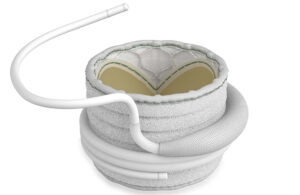
The Sapien M3 TMVR [Image courtesy of Edwards Lifesciences]
Related: Q&A with Darshin Patel, who led the Sapien M3 TMVR system’s development
Guardant Health’s Shield blood test
Shield aims to funnel people toward gold-standard colonoscopy screening for colorectal cancer, by starting with a first-line blood draw to search for floating fragments of tumor DNA and proteins. While at-home, stool-based tests have begun to make headway, millions of people in the U.S. are still going unscreened for the disease that ranks as the second-leading cause of cancer deaths. With a first-in-category approval from the FDA in 2024, Shield has demonstrated 91% sensitivity in detecting growing tumors in clinical studies.
Johnson & Johnson’s Inlexzo
The Inlexzo gemcitabine intravesical system includes a pretzel-shaped implant that’s placed in the bladder to slowly release its chemotherapy payload locally over a period of weeks. It was approved in September 2025 for adults with non-muscle invasive bladder cancer that has not responded to standard Bacillus Calmette-Guérin treatment.
Johnson & Johnson’s Impella 5.5 and Impella CP

The Impella CP pump [Illustration courtesy of J&J MedTech]
Johnson & Johnson Shockwave C2 coronary IVL catheter
The Shockwave C2 catheter is built to snake its way into calcified coronary arteries and deliver ultrasonic energy to crack apart the blockages and restore blood flow. A 384-patient study led to 99% success in subsequent stent placements and 92.2% of participants reporting zero major adverse cardiovascular events after 30 days. The faster and more flexible C2 Aero launched earlier this year.
Lumicell’s LumiSystem
The fluorescence-guided imaging system for breast cancer lumpectomies combines the LumiSight injectable agent and direct visualization with a handheld probe, highlighting suspicious patches of tissue within the resection cavity for surgeons in real time. The company said a clinical trial showed 15% of patients converting from positive residual margins to negative, with eight avoiding the need for a second procedure. LumiSystem was approved in 2024.
Lungpacer Medical’s AeroPace transvenous diaphragm neurostimulation system
To help strengthen the diaphragm of patients on long-term mechanical ventilation, AeroPace uses an electrode-laden venous catheter to periodically stimulate the phrenic nerve and cause muscle contractions. Approved in late 2024, it posted its first commercial procedures in 2025 and claimed reimbursements earlier this year.
MediBeacon’s TGFR system
The point-of-care test, approved in December 2025, non-invasively measures kidney function and glomerular filtration rate through the skin, following the injection of a non-iodine fluorescent compound. The wearable sensor then logs the clearance rate of the injection over time. MediBeacon is also studying the approach in gastroenterology, to track intestinal permeability for autoimmune and inflammatory diseases.
Medtronic’s Altaviva tibial neuromodulation implant

The Altaviva implant [Photo courtesy of Medtronic]
MiniMed Go system
Rolled out in May, the smart multiple daily insulin injection system combines the company’s InPen with the bespoke Instinct sensor made for the Medtronic spinout by Abbott. The approach was cleared for people with type 1 or type 2 diabetes ages seven and up; children between 2 and 6 can use it under supervision. The system includes missed dose alerts and guidance, plus an insulin calculator.
To find out more about which medtech companies are investing the most in R&D and innovation, download our free Medtech Big 100 Special Report.