
Johnson & Johnson MedTech Polyphonic President Shan Jegatheeswaran [Photo courtesy of J&J]
Medical Design & Outsourcing Editor-in-Chief Chris Newmarker spoke with Jegatheeswaran on a recent episode of DeviceTalks Weekly to discuss J&J’s latest “Future of Digital Surgery Report” and where the medical device manufacturer sees opportunity in surgical intelligence.
Here are five highlights from their conversation that engineers and medical device developers could learn from to integrate into their own projects.
The following has been lightly edited for clarity and space.
MDO: What is surgical intelligence?
Jegatheeswaran: “We define surgical intelligence as the clinical knowledge generated when multimodal data is connected across the perioperative surgical pathway and then analyzed to support clinical decision-making and operating performance. That’s sort of the definition in the report. If I were explaining it to someone outside of the industry, it’s essentially the culmination of digital, physical, and human coming together for the purposes of safer, better surgery.”
Related: J&J MedTech’s global head of digital wants to fund your AI project
What surprised you the most about the report?
Jegatheeswaran: “The key takeaway is number one that the input cost is improving and reducing at the same time, so that’s a sort of a check mark for technology, like compute performance doubles every nineish months these days, and the cost reduces quarter over quarter.
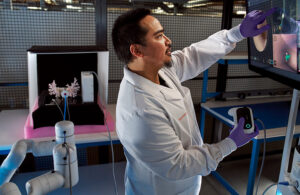
Johnson & Johnson MedTech’s Monarch robotics-assisted bronchoscopy system — seen here in the lab — is designed for Polyphonic connectivity. [Photo courtesy of J&J]
“The third thing for me, which wasn’t an aha, but it was nice to break it down into practical steps, was take away the tech challenge for a second. Not that it’s simple, but it’s simpler. It’s the mindset stuff. The mechanisms and incentives, how data standards now need to evolve so we can share data in a compliant way, norms and governance — that helps me internally speak the language within J&J with my counterparts and my functional leaders. Frankly, it also helps me speak with customers and some of our partners, as you mentioned with AWS and Nvidia, because they’ve done this, and so have I, done this exact play in other industries. We went through this journey. The automotive industry has gone through it itself. Capital markets as well. How do we leverage some of those lessons learned and jump ahead? Now, surgery is unique. It has its own nuances for sure. That’s where the talent and the capability of J&J come in, but there are definitely things that we can learn.”
Where do you see the opportunities for adoption beginning?
Jegatheeswaran: “If you’re a device manufacturer, you’re usually dropping some level of algorithmic value in your device because it’s a controlled environment, you have sort of the practices in place to deliver that safely. Teams that we work with within Johnson and Johnson do that today. Monarch just released an update to their AI algorithms for their devices, and you see that across the industry, and that’s where they tend to focus because that’s a competitive advantage. You own the device, you own the data within that device or have access to the data within that device. So that’s one theme that’s emerged, and is safely at scaleish across surgery.”
Who pays for this in the end?

J&J says its Polyphonic digital ecosystem “connects Ottava insights, video, telemetry, and procedural data with other sources across the surgical pathway” to offer “postoperative access to synchronized case video, metrics, and robotic data for independent analysis, download, and research.” [Image courtesy of J&J]
“I’m lucky, I can bring my previous experiences to this space, but I have access to some of the best world-class talent in government affairs, regulatory compliance, cyber, etc. That is functionally important. You need all of these things, all of these humans to weigh in, and that’s why I said that you started this conversation. It’s hard and you have to have conviction and sort of the appetite to take this on. Fundamentally, as a company, we believe that this is happening and will continue to happen, and not only do we want to participate, we want to lead in this space. Humbly, though, we don’t know everything. That’s why the report that we commissioned was one of the things that we’re doing to educate ourselves as we’re on this journey.”
For more, listen to the full DeviceTalks Weekly episode here.
Anything else to add?
Jegatheeswaran: “We overestimate what we can do in a year and underestimate what we can do in 10. There’s a lot of amazing work being done, but it is a journey, and I think we folks in the space need to have the appetite to join up and do this right. It’s not going to be done by J&J alone. It’s not going to be done by a competitor alone. It’s not going to be done by anyone alone. The mentality of how we work together as an industry is going to have to change.
“… In healthcare, we always say do no harm. Then in software, it’s move fast and break things, and both those things are different. In surgery, when they come together, we have to be very careful that we’re responsible. Yes, speed matters, but so do trust and quality and all those other things that, for the last century, we’ve been around with the company.
“This is an important space for us to solve for. A lot of smart people are in this space already, which is great. The sense of community and co-competition is something we need to really push on by working together, and that’s a new muscle. We’re very good working as individual organizations. What can we do together for the benefit of a patient or the industry at large? That’s going to be exciting to see over the next one to two years.”