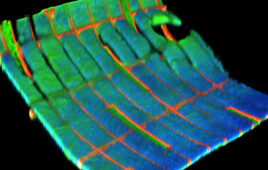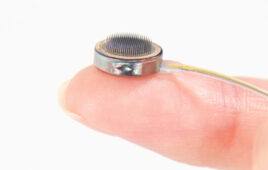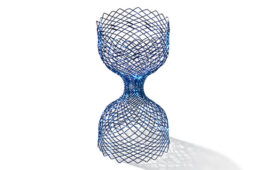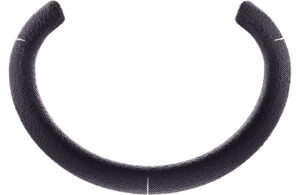
Corcym’s Memo 4D Curve has FDA clearance to treat congenital or acquired mitral or tricuspid insufficiencies or steno-insufficiencies with dilation and/or annulus deformation. [Image courtesy of Corcym]
The device developer’s semi-rigid annuloplasty rings for mitral repair include the Memo 3D, Memo 4D and the Memo 4D Curve. Corcym also developed the TriMemo annuloplasty ring for tricuspid valve repair.
The FDA cleared the Memo 3D and Memo 4D in April 2023, then cleared TriMemo in April 2026 and Memo 4D Curve in June 2026.
Corcym announced the first-in-human implantation of Memo 4D Curve ring in September 2026. That ring is the only one in the portfolio with an open configuration and gives “surgeons greater choice in mitral valve repair,” Corcym CEO Christian Mazzi said while announcing that first case.
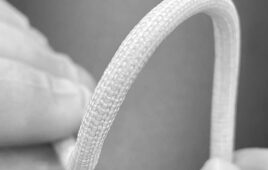
But all of the rings have a three-layer design with a laser-cut nitinol core, a silicone elastomer sheath, and an outer layer of knitted polyethylene terephthalate (PET) fabric coated with Carbofilm (turbostratic carbon).
“The choice of device materials and configuration have the aim to ensure its biocompatibility and hemocompatibility,” Corcym said in the 510(k) submission for its Memo 4D Curve.
Nitinol know-how: Advice from OEM experts, coverage of innovative devices and supply chain updates
Corcym Memo 4D Curve’s design features
Memo 4D Curve’s laser-cut nitinol core is designed to restore leaflet coaptation and valve function by reshaping the mitral annulus while preserving its natural motion.The ring uses superelastic nitinol to support the physiological movement of the annulus and adapt to three-dimensional annulus motion.
The ring’s semirigid stiffness fluctuates in different parts of the implant thanks to what Corcym describes as a “graduated distribution of laser-cut cells.” The core is stiffer in the posterior portion that sits near the native valve’s dilated wall and posterior leaflet, but increasingly flexible near the ring’s ends.
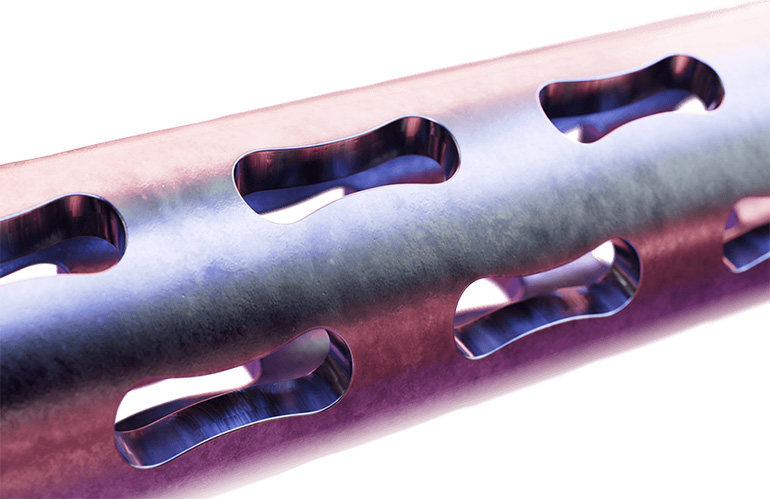
Corcym’s Memo 4D Curve’s laser-cut nitinol core enables its semi-rigid design. [Image courtesy of Corcym]
The ring’s saddle shape supports restoration of the valve while accommodating excess leaflet tissue, “reducing the risk of systolic anterior motion,” Corycm says in a Memo platform brochure. Memo 4D Curve’s low-profile design allows for use in minimally invasive cardiac surgery and robotic surgery.
2026 Min-Vasive Medtech: Watch on-demand webinar interviews with device development experts offering advice for minimally invasive medical devices and systems
The ring’s expected lifetime under continued function correlated to 400 million cycles, approximately equal to 10 years of implantation, Corcym said.
The annuloplasty ring is available in 10 sizes, increasing 2 mm in dimension, beginning at 24 mm and up to 42 mm.
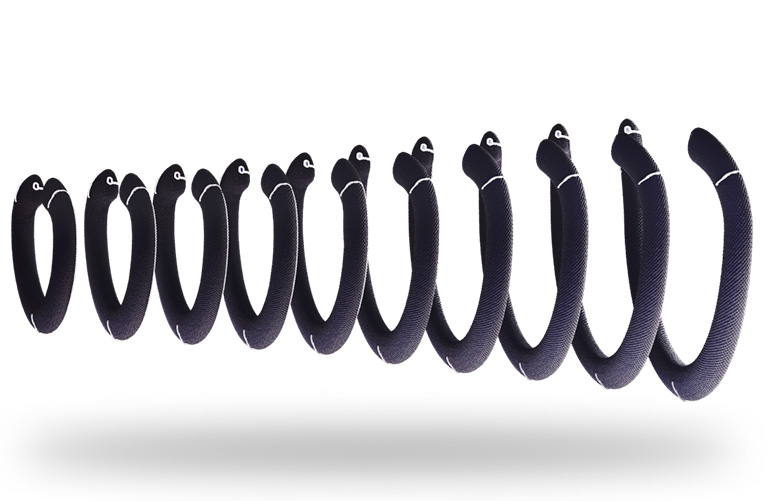
The Corcym Memo 4D Curve comes in a range of sizes. [Image courtesy of Corcym]