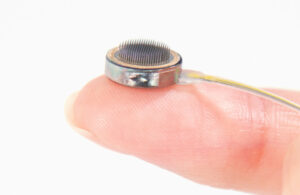
The Paradromics Connexus brain-computer interface records signals from individual neurons. [Photo courtesy of Paradomics]
A Michigan woman in her 60s was the first participant in the BCI developer’s 10-person feasibility study and had the opportunity to form her own responses and answer open-ended questions after having the system implanted in June.
“Okay, I have a lot to say,” she said, using the BCI to communicate with family members and speak with her grandchildren over the phone.
That moment followed years of development and a series of design decisions by Paradromics to make its BCI technology as accessible as possible once it’s been clinically proven and approved. In summer 2026, Paradromics received the FDA’s permission to expand the types of computing devices that Connexus can link to, including consumer laptops, tablets and phones toward a goal of evaluating the BCI system’s everyday utility.
“Our goal is to help millions of people, not just a handful of people,” Paradromics Chief Clinical Officer Dr. Bill Marks said in a Medical Design & Outsourcing interview. “We’ve deliberately built and engineered our system for scaling.”
One part of Paradromics’ ethos is ranking implant durability as high as safety and performance, and the company is targeting a device lifetime of at least 10 years.
Connexus was designed to be completely wireless and fully housed within the body to eliminate the risks of infection that come with connectors passing through the skin. The implant’s components and materials are modeled after medical devices with a proven track record, such as pacemakers and deep brain stimulators that are placed in tens of thousands of patients per year.
The Connexus implantation procedure is pretty familiar and straightforward as far as brain surgery goes, said Marks, who is also a neurologist.
“The idea is simple incisions, a small craniotomy, and a module that you insert with visual inspection of the area, all navigated by your imaging findings,” he said. “Then it’s tunneling the wire down into the chest region, where our internal transceiver resides.”
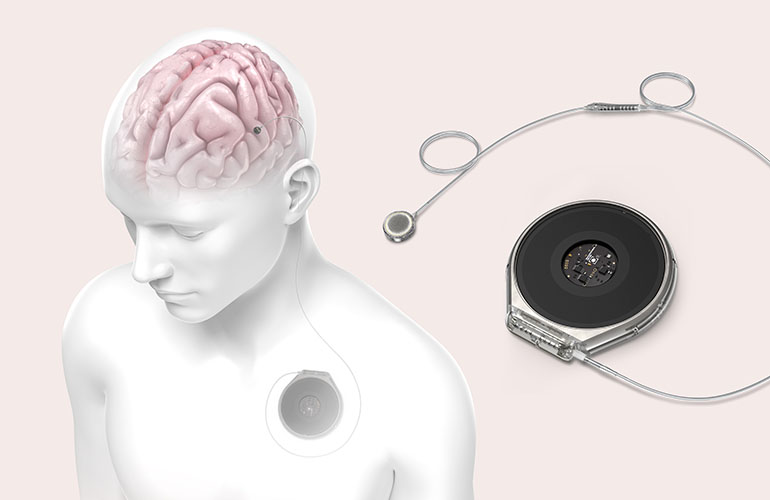
The internal transceiver in the pectoral region provides wireless power and high-bandwidth data relay. [Illustration courtesy of Paradromics]

CCO Dr. William Marks [Photo courtesy of Paradromics]
The high-density array has 421 microelectrodes, each thinner than a human hair and 1.5 mm deep. That minimizes their impact on the brain while capturing single-neuron resolution. The array placed on the surface of the cortex, allowing it to float with the natural movement of the brain without the mechanical stresses of being fixed to the unmoving skull.
The entire metal and ceramic device is hermetically sealed to help safeguard against the need for early replacements, similar to cardiac pacemakers.
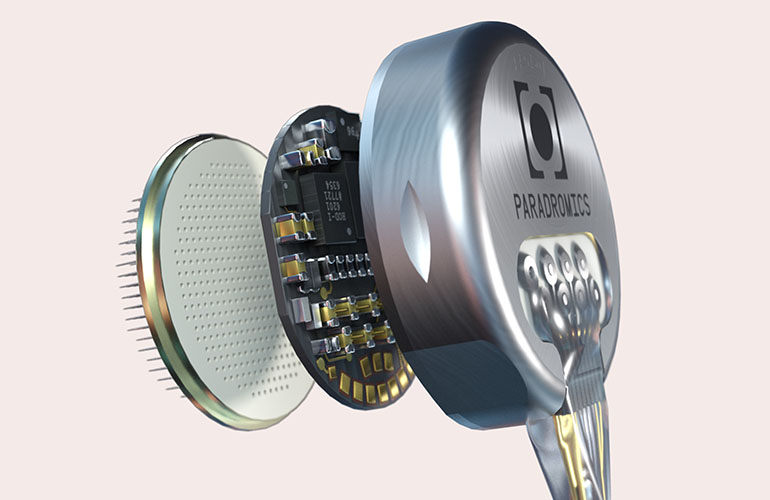
The cortical module’s microelectrodes are less than 40 microns in diameter, with feedthroughs hermetically sealed for long-term implantation. The module’s diameter is 10.4 mm. [Illustration courtesy of Paradromics]
The company plans to continue enrolling patients for its early feasibility study before moving into pivotal testing, including at clinical sites at the University of Michigan, Massachusetts General Hospital and University of California, Davis.



Tell Us What You Think!
You must be logged in to post a comment.