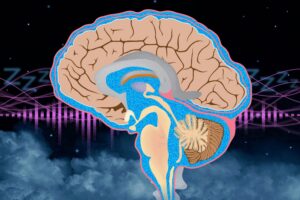
This illustration from MIT researchers shows how pink noise can strengthen the flow of cerebrospinal fluid (CSF) to clear debris from the brain and keep it healthy. [Illustration courtesy of Christine Daniloff/MIT and iStock]
That includes waste products like lactic acid and potentially harmful proteins such as amyloid beta and tau, which are linked to Alzheimer’s disease and other forms of dementia.
They plan to use the technology for a wearable device.
The researchers used short, millisecond bursts of the waterfall-like static known as pink noise, and timed them to overlap with stages of deeper, non-REM sleep by tracking participants’ EEG readings as they slept in an MRI scanner. Compared to the broad-frequency hiss of white noise, pink noise can sound softer and deeper.
According to a paper published in Science Translational Medicine, pink noise can help increase certain EEG readings known as neural slow waves. Those have been linked to the flow of CSF during deep sleep, with functional MRI scans tracking the pumping action of constricting and dilating blood vessels.
“We found that we were able to increase the size of the CSF flow wave during sleep, which as far as we know, there hasn’t been a method to do before,” said the paper’s senior author, Laura Lewis, the Athinoula A. Martinos associate professor of electrical engineering and computer science at MIT.

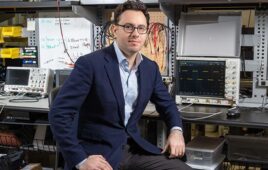
Laura Lewis [Photo courtesy of MIT]
The experiment needed to overcome the technical issues that come with trying to log EEG readings while dealing with the brain scanner’s magnetic interference. According to MIT, the researchers developed a method to clean up the EEG signals in less than 100 milliseconds, and employed an algorithm to help predict the next peaks of slow waves.
“You can make more of these electrical slow waves through an auditory stimulus, if it comes at just the right time,” Lewis said. “Similar to a child on a swing, if you push them when they’re at the right moment in their movement, you can make that swing go farther.”
After testing the approach in 14 healthy volunteers, the researchers next aim to develop a closed-loop sensor device, such as a headband, that people could use at home to increase CSF flow while they sleep, and potentially test it in patients with mild cognitive impairment or other neurodegenerative disorders.

Tell Us What You Think!
You must be logged in to post a comment.