Medical Design and Outsourcing

  • Home
  • Medical Device Business
    • Mergers & Acquisitions
    • Financial
    • Regulatory
  • Applications
    • Cardiovascular
    • Devices
    • Imaging
    • Implantables
    • Medical Equipment
    • Orthopedic
    • Surgical
  • Technologies
    • Supplies and Components Index
    • Contract Manufacturing
    • Components
    • Electronics
    • Extrusions
    • Materials
    • Motion Control
    • Prototyping
    • Pumps
    • Tubing
  • MedTech Resources
    • Medtech Events in 2026
    • The 2025 Medtech Big 100
    • Medical Device Handbook
    • MedTech 100 Index
    • Subscribe to Print Magazine
    • DeviceTalks
    • Digital Editions
    • eBooks
    • Educational Assets
    • Manufacturer Search
    • Podcasts
    • Webinars / Digital Events
    • Whitepapers
    • Voices
    • Views
    • Video
  • 2026 Leadership
    • 2025 Winners
    • 2024 Winners
    • 2023 Winners
    • 2022 Winners
    • 2021 Winners
  • Women in Medtech
  • Advertise
  • Subscribe

MIT researchers develop bioresorbable batteries for ingestible medical devices

September 28, 2026 By Skyler Rivera Leave a Comment

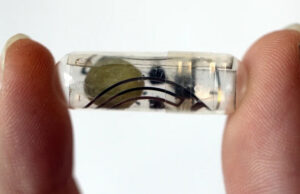
The 1.84 volt paper battery (brown circle structure) was tested in pigs with a bioabsorbable radio-frequency identification (RFID) device.

The 1.84-volt paper battery (the brown circle structure in the bioabsorbable radio-frequency identification device capsule shown here) was tested in pigs. [Photo courtesy of Mehmet Girayhan Say/MIT]

MIT researchers have created tiny, bioresorbable 1.84-volt batteries that could power ingestible electronic medical devices.

The researchers said bioresorbable batteries could make ingestible medical devices safer for patients and minimize the environmental impact of batteries after excretion.

“For many of the systems we’re developing, we need power, and we power the system through different ways,” Giovanni Traverso, senior author of the research paper published in Nature Chemical Engineering, said in an MIT news release. “Often, we use batteries, so the question here was: Could we develop a battery that was bioresorbable, and then apply that across a range of application areas?”

Ingestible medical devices typically rely on transmitted external power sources or coin batteries. These batteries often contain lithium, silver oxide and other metals that pose a safety risk or release toxic materials if the ingested device and outer casing break or the battery leaks.

Traverso and his team determined their battery needed to include metals that could act as electrodes but were also safe for human consumption.

“We were highly restricted in what materials to use,” he told Nature.

They chose magnesium for the battery’s anode and molybdenum trioxide for its cathode, since the two are metallic micronutrients the body needs and could consume in small amounts. Together, magnesium and molybdenum trioxide can produce a voltage high enough to power small devices. Traverso and his team chose an ionic liquid gel for its electrolyte.

“Those materials are known to be relatively safe,” Traverso said. “That was the biggest driver, thinking about materials that can be tolerated by humans.”

Inspired by edible candy wrappers made of rice paper, the battery’s outer packaging consists of a cellulose-based coating dipped in beeswax that supports the battery without affecting electrical performance. The beeswax slows down the effects of stomach acid by preventing thermal damage to the gel electrolyte and provides short-term protection for the battery. Over time, the entire battery dissolves.

A graphic showing a 7.5 mm disc version of the battery (top) and a 24 mm rectangular bar version (bottom) for various future applications.

The researchers designed a 7.5 mm disc version of the battery (top) and a 24 mm rectangular bar version (bottom) for various future applications. [Image courtesy of MIT]

Testing the batteries

The researchers tested how the batteries would behave in the GI tract by exposing the devices to a highly acidic solution to mimic gastric juice.The batteries functioned normally for about three days before performance declined. The batteries came apart within a few weeks and completely dissolved after several months.

The team then tested the battery in a degradable electrical stimulation device they developed in 2023. The device delivers an electrical current to the stomach lining, stimulating endocrine cells to increase levels of the hunger hormone ghrelin. Ghrelin secretion stimulation could help treat symptoms such as nausea, loss of appetite and body mass loss that occur in patients with cancer, cachexia and other chronic illnesses.

In the study, the battery powered continuous electrical stimulation for up to three days.

Related: MIT researchers develop injectable nanodevices that remotely kill brain tumor cells

The then researchers tested the batteries in pigs with ingestible, bioresorbable radio-frequency identification (RFID) devices that transmit data from inside the body to an external source.

Battery-assisted RFID systems often use coin cell batteries to power the ingestible device in tracking and patient monitoring for medication adherence. RFID tags with the investigational battery could transmit continuously from the GI tract for up to 1.5 meters, a longer range than traditionally powered tags, the study showed.

Travers and his team are planning how to test the biodegradable RFID devices powered by their bioresorbable battery in humans. He said they hope to start human testing in less than two years.

“What makes this work exciting is that we were able to show that a bioresorbable battery is not just a concept,” said Mehmet Girayhan Say, the paper’s lead author. “It can actually power clinically relevant functions inside the gastrointestinal tract and then simply dissolve.”


About The Author

Skyler Rivera

Skyler Rivera is an associate editor at Arrowfly, covering medical device industry news and technology at MassDevice and Medical Design & Outsourcing. She began her career covering sports at The Athletic and MLB before transitioning to medical writing at Edwards Lifesciences. Based in Southern California, she holds a master's degree in science writing from Johns Hopkins University and a bachelor’s in broadcast journalism from Syracuse University. Connect with her on LinkedIn or email at [email protected].

Tell Us What You Think! Cancel reply

You must be logged in to post a comment.

Related Articles Read More >

An illustration of HITMAN operating in glioblastoma cells.
MIT researchers develop injectable nanodevices that remotely kill brain tumor cells
An image of VahatiCor's A-Flux implant.
Nitinol outsourcing made VahatiCor’s new cardiac implant possible
A photo of Conexeu Sciences co-founder and Chief Scientific Officer Dr. Claudia Chavez-Munoz.
This tissue engineering scientist is bioprinting next-gen absorbable implants
An image of the September 2026 Medical Design & Outsourcing magazine featuring the Medtech Big 100 ranking of the world's largest medical device companies.
September 2026 issue: The MDO Medtech Big 100 breaks $500 billion
“mdo
EXPAND YOUR KNOWLEDGE AND STAY CONNECTED
Get the latest medical device business news, application and technology trends.

DeviceTalks Weekly

See More >

MDO Digital Edition

Digital Edition

Subscribe to Medical Design & Outsourcing. Bookmark, share and interact with the leading medical design engineering magazine today.

MEDTECH 100 INDEX

Medtech 100 logo
Market Summary > Current Price
The MedTech 100 is a financial index calculated using the BIG100 companies covered in Medical Design and Outsourcing.

New MedTech Resource

Medical Tubing

MassDevice

Mass Device

The Medical Device Business Journal. MassDevice is the leading medical device news business journal telling the stories of the devices that save lives.

Visit Website
MDO ad
Medical Design and Outsourcing
  • MassDevice
  • DeviceTalks
  • MedTech100 Index
  • Medical Tubing + Extrusion
  • Medical Design Sourcing
  • Drug Delivery Business News
  • Drug Discovery & Development
  • Pharmaceutical Processing World
  • R&D World
  • About Us/Contact
  • Advertise With Us
  • Subscribe to Print Magazine
  • Subscribe to our E-Newsletter
  • Listen to our Weekly Podcasts
  • Join our DeviceTalks Tuesdays Discussion

Copyright © 2026 Arrowfly, LLC. All Rights Reserved. The material on this site may not be reproduced, distributed, transmitted, cached or otherwise used, except with the prior written permission of Arrowfly LLC. Site Map | Privacy Policy | RSS

Search Medical Design & Outsourcing

  • Home
  • Medical Device Business
    • Mergers & Acquisitions
    • Financial
    • Regulatory
  • Applications
    • Cardiovascular
    • Devices
    • Imaging
    • Implantables
    • Medical Equipment
    • Orthopedic
    • Surgical
  • Technologies
    • Supplies and Components Index
    • Contract Manufacturing
    • Components
    • Electronics
    • Extrusions
    • Materials
    • Motion Control
    • Prototyping
    • Pumps
    • Tubing
  • MedTech Resources
    • Medtech Events in 2026
    • The 2025 Medtech Big 100
    • Medical Device Handbook
    • MedTech 100 Index
    • Subscribe to Print Magazine
    • DeviceTalks
    • Digital Editions
    • eBooks
    • Educational Assets
    • Manufacturer Search
    • Podcasts
    • Webinars / Digital Events
    • Whitepapers
    • Voices
    • Views
    • Video
  • 2026 Leadership
    • 2025 Winners
    • 2024 Winners
    • 2023 Winners
    • 2022 Winners
    • 2021 Winners
  • Women in Medtech
  • Advertise
  • Subscribe