Medical Design and Outsourcing

  • Home
  • Medical Device Business
    • Mergers & Acquisitions
    • Financial
    • Regulatory
  • Applications
    • Cardiovascular
    • Devices
    • Imaging
    • Implantables
    • Medical Equipment
    • Orthopedic
    • Surgical
  • Technologies
    • Supplies and Components Index
    • Contract Manufacturing
    • Components
    • Electronics
    • Extrusions
    • Materials
    • Motion Control
    • Prototyping
    • Pumps
    • Tubing
  • MedTech Resources
    • Medtech Events in 2026
    • The 2026 Medtech Big 100
    • Medical Device Handbook
    • MedTech 100 Index
    • Subscribe to Print Magazine
    • DeviceTalks
    • Digital Editions
    • eBooks
    • Educational Assets
    • Manufacturer Search
    • Podcasts
    • Webinars / Digital Events
    • Whitepapers
    • Voices
    • Views
    • Video
  • 2026 Leadership
    • 2025 Winners
    • 2024 Winners
    • 2023 Winners
    • 2022 Winners
    • 2021 Winners
  • Women in Medtech
  • Advertise
  • Subscribe

MIT researchers design implantable ultrasound-powered drug delivery device to minimize tumor recurrence

The implant combines wireless ultrasound and targeted drug delivery technology to help drugs bypass the blood-brain barrier.

October 27, 2026 By Skyler Rivera

MIT researcher's implant is called LUCID.

The implant is called LUCID, which is short for Long-term Ultrasound-enhanced Convective Injection Device. [Image courtesy of the MIT researchers]

MIT researchers have designed an implantable drug delivery device that could prevent the recurrence of glioblastoma.

Named LUCID, for Long-term Ultrasound-enhanced Convective Injection Device, the implant combines wireless ultrasound and targeted delivery technology to help drugs bypass the blood-brain barrier and spread farther through the brain.

LUCID is designed to be placed during tumor removal surgery and gradually release medication directly to neural circuits that would assist in killing remaining cancer cells. A wireless controller can be used post-implantation to program specific ultrasound doses and further disperse the drug molecules.

While patients undergo procedures to remove glioblastoma, it’s often difficult to remove all cancer cells, leading to tumor recurrence. In situ therapeutic injections require repeated invasive surgeries that risk damaging healthy tissue, the researchers said, and other treatment methods can’t provide chronic, controlled and well-distributed drug delivery.

“Getting a drug into the brain is only part of the challenge. It also needs to spread through the surrounding tissue. We brought a delivery channel and a tiny ultrasound array together in one implant to help molecules reach a larger area, even during slow infusion,” said Jason Hou, a lead author of the study that appeared in Device.
The MIT researcher's implant, LUCID.

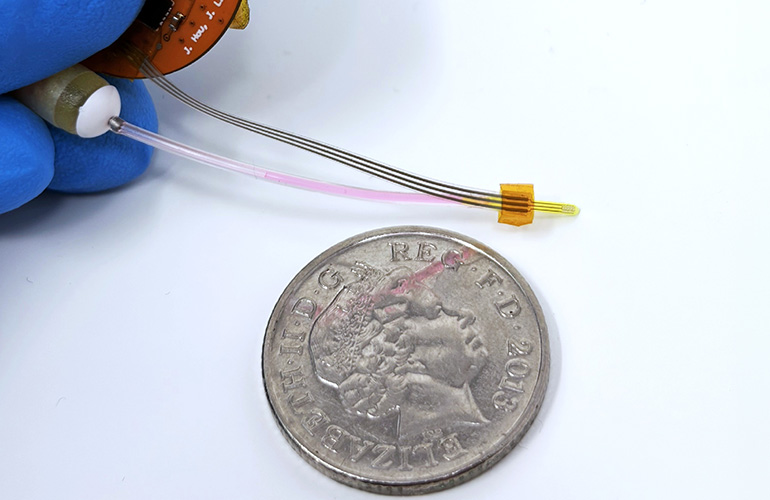
The MIT researcher’s implant, LUCID, features a miniature drug delivery catheter (seen here) for in situ drug therapy. [Image courtesy of the MIT researchers]

How it was developed and how it works

MIT researchers led by Canan Dagdeviren set out to design a device with better control of drug-release timing while incorporating ultrasound arrays to enhance the molecule’s distribution, the university said in an announcement.

The team integrated previous research that demonstrated how ultrasound could create convective flows to help drug molecules disperse across longer distances. They also showed how mechanical oscillations generated by ultrasound waves could temporarily increase blood-brain barrier permeability, MIT said.

The team’s prototype combines research expertise with Dagdeviren’s previous work in minimally invasive neural technology.

In 2018, Dagdeviren designed a miniature cannula about the size of a human hair that could deliver one or more drugs to the brain with precision control over dosage and infusion location. In 2024 she developed a miniature implant, called ImPULS, that uses ultrasound to perform deep brain stimulation.

The LUCID flexible implant prototype has “24 transducers in one ultrasound array, which can help a given drug bypass the blood-brain barrier and enhance the drug infusion,” Dagdeviren said, which “gives doctors options in terms of the size, the length, and the number of infusions.”

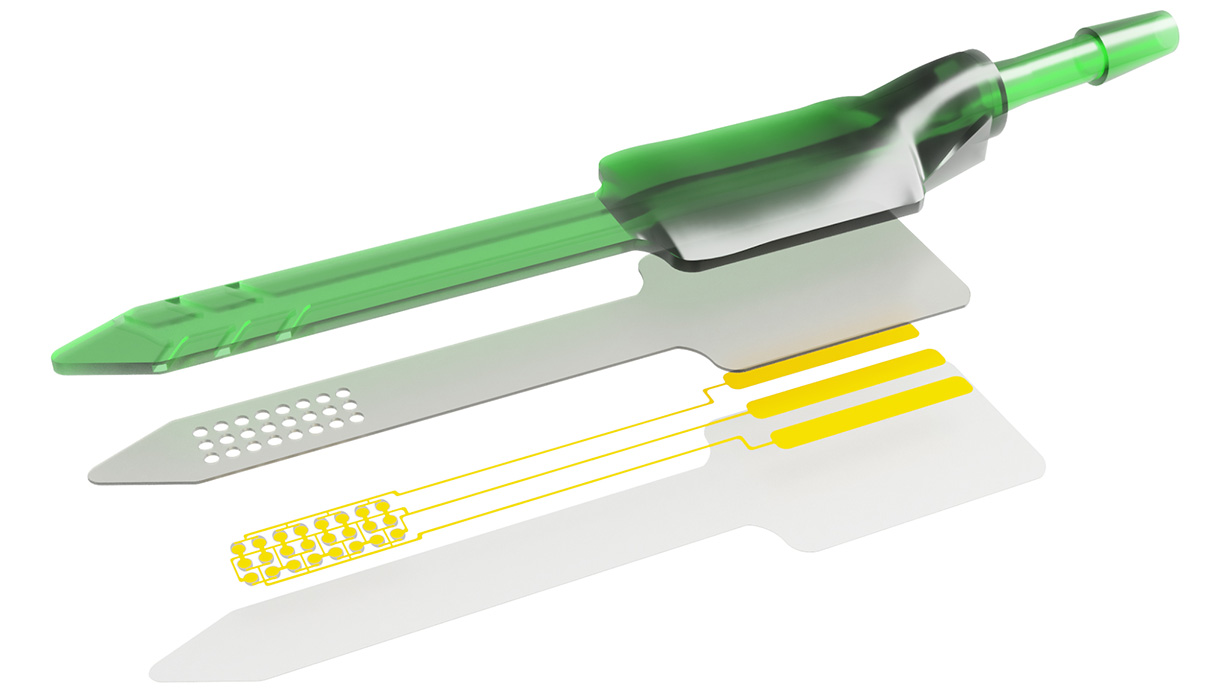
LUCID’s delivery cannula is 3D printed on the ultrasound array. The 24 transducers generate ultrasound waves at the tip of the cannula needle that help drug molecules travel further into the neural tissue.
An illustration of LUCID's design with a layered drug delivery cannula and ultrasound array.

This illustration shows how LUCID combines its 3D printed fluid-delivery channel with a layered miniature ultrasound array. [Image courtesy of the MIT researchers]

The implant’s reservoir could hold about 100 microliters of fluid, and infusion is supplied by a passive osmotic pump. Ultrasound can be controlled wirelessly through a Bluetooth connection, and the system contains a small battery that can be recharged wirelessly.

The drug cannula and ultrasound array would be implanted inside the skull if the technology is developed for clinical use, the researchers said, with its electronics and battery located outside the skull.

Early “tissue phantom” testing demonstrated that the ultrasound technology helped disperse drug molecules farther than drug delivery without ultrasound, the researchers said.

“By enhancing that distribution locally and programmably with ultrasound, you can reduce systemic toxicity in nontarget organs, while the therapy that you’re using has a better chance of reaching whatever tumor cells are within the affected area,” MIT graduate student and lead study author Sarah Ornellas said.
[Image courtesy of the MIT researchers]

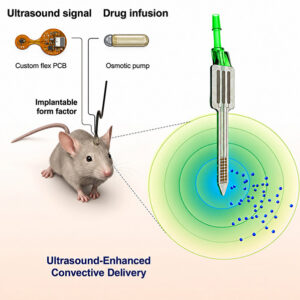
The team then tested LUCID in mice, delivering an MRI contrast agent to demonstrate distribution capabilities. They saw similar results as the agent spread further throughout the brain when ultrasound was activated than when ultrasound wasn’t used.

While the team focused on small-molecule drug delivery, the technology could also be used to deliver biologics such as immunotherapies and nucleic acids, including gene therapies, and potentially be used in other organs.

“We started with the brain as a follow-up to our ImPULS technology, but eventually this can be used for other soft tissue treatments for different types of drugs, different types of interventions in deep body tissue,” Dagdeviren said. “We are showing that we can make any kind of payload be distributed in a better way.”


About The Author

Skyler Rivera

Skyler Rivera is an associate editor at Arrowfly, covering medical device industry news and technology at MassDevice and Medical Design & Outsourcing. She began her career covering sports at The Athletic and MLB before transitioning to medical writing at Edwards Lifesciences. Based in Southern California, she holds a master's degree in science writing from Johns Hopkins University and a bachelor’s in broadcast journalism from Syracuse University. Connect with her on LinkedIn or email at [email protected].

Related Articles Read More >

An illustration showing Corcym's Memo 4D Curve's laser-cut nitinol core.
Laser-cut nitinol and a layered design let these cardiac implants flex
Reconstructed 3D fluorescence image of the stained biohybrid mesh-tissue integration. The red, green, and blue colors correspond to the mesh, F-actin, and nuclei, respectively.
Researchers mesh electronics with human cells to develop living battery
A close of of Medical 21's Maverics graft.
A surgeon’s prayer helped St. Jude Medical founder Manny Villafaña size his latest device
A photo of the Paradromics Connexus brain-computer interface on a fingertip.
How Paradromics designed its Connexus brain-computer interface system
“mdo
EXPAND YOUR KNOWLEDGE AND STAY CONNECTED
Get the latest medical device business news, application and technology trends.

DeviceTalks Weekly

See More >

MDO Digital Edition

Digital Edition

Subscribe to Medical Design & Outsourcing. Bookmark, share and interact with the leading medical design engineering magazine today.

MEDTECH 100 INDEX

Medtech 100 logo
Market Summary > Current Price
The MedTech 100 is a financial index calculated using the BIG100 companies covered in Medical Design and Outsourcing.

New MedTech Resource

Medical Tubing

MassDevice

Mass Device

The Medical Device Business Journal. MassDevice is the leading medical device news business journal telling the stories of the devices that save lives.

Visit Website
MDO ad
Medical Design and Outsourcing
  • MassDevice
  • DeviceTalks
  • MedTech100 Index
  • Medical Tubing + Extrusion
  • Medical Design Sourcing
  • Drug Delivery Business News
  • Drug Discovery & Development
  • Pharmaceutical Processing World
  • R&D World
  • About Us/Contact
  • Advertise With Us
  • Subscribe to Print Magazine
  • Subscribe to our E-Newsletter
  • Listen to our Weekly Podcasts
  • Join our DeviceTalks Tuesdays Discussion

Copyright © 2026 Arrowfly, LLC. All Rights Reserved. The material on this site may not be reproduced, distributed, transmitted, cached or otherwise used, except with the prior written permission of Arrowfly LLC. Site Map | Privacy Policy | RSS

Search Medical Design & Outsourcing

  • Home
  • Medical Device Business
    • Mergers & Acquisitions
    • Financial
    • Regulatory
  • Applications
    • Cardiovascular
    • Devices
    • Imaging
    • Implantables
    • Medical Equipment
    • Orthopedic
    • Surgical
  • Technologies
    • Supplies and Components Index
    • Contract Manufacturing
    • Components
    • Electronics
    • Extrusions
    • Materials
    • Motion Control
    • Prototyping
    • Pumps
    • Tubing
  • MedTech Resources
    • Medtech Events in 2026
    • The 2026 Medtech Big 100
    • Medical Device Handbook
    • MedTech 100 Index
    • Subscribe to Print Magazine
    • DeviceTalks
    • Digital Editions
    • eBooks
    • Educational Assets
    • Manufacturer Search
    • Podcasts
    • Webinars / Digital Events
    • Whitepapers
    • Voices
    • Views
    • Video
  • 2026 Leadership
    • 2025 Winners
    • 2024 Winners
    • 2023 Winners
    • 2022 Winners
    • 2021 Winners
  • Women in Medtech
  • Advertise
  • Subscribe


