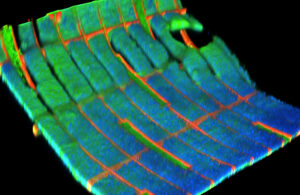
A reconstructed 3D fluorescence image showing the bending piezoelectric mesh in red. [Image courtesy of UMass Amherst]
Using cardiac cells grown around a thin, flexible, ceramic-and-polymer mesh, the developers described the approach as the start of a reliable source of power that could do away with batteries.
“Our bodies are 24/7 power plants. Every single cell produces its own power,” said Siqi Wang, the Ph.D. student at UMass Amherst’s Riccio College of Engineering who was lead author of the paper published in Science Advances.
The researchers said their piezoelectric framework could help support new designs for medical implants that aren’t structured around a single battery that requires recharging.
“We wanted to shift this traditional, centralized paradigm to something more distributed and modeled on biology,” said Associate Professor Jun Yao, who has worked on employing bioelectric meshes for monitoring heart tissue and organoids.
This time, researchers built an array using thin ribbons of lead zirconate titanate, which can convert mechanical movement into electrical energy. A polymer scaffold helps in vitro cardiac cells grow into the mesh, mimicking an extracellular matrix and generating power with the tissue’s contractions.
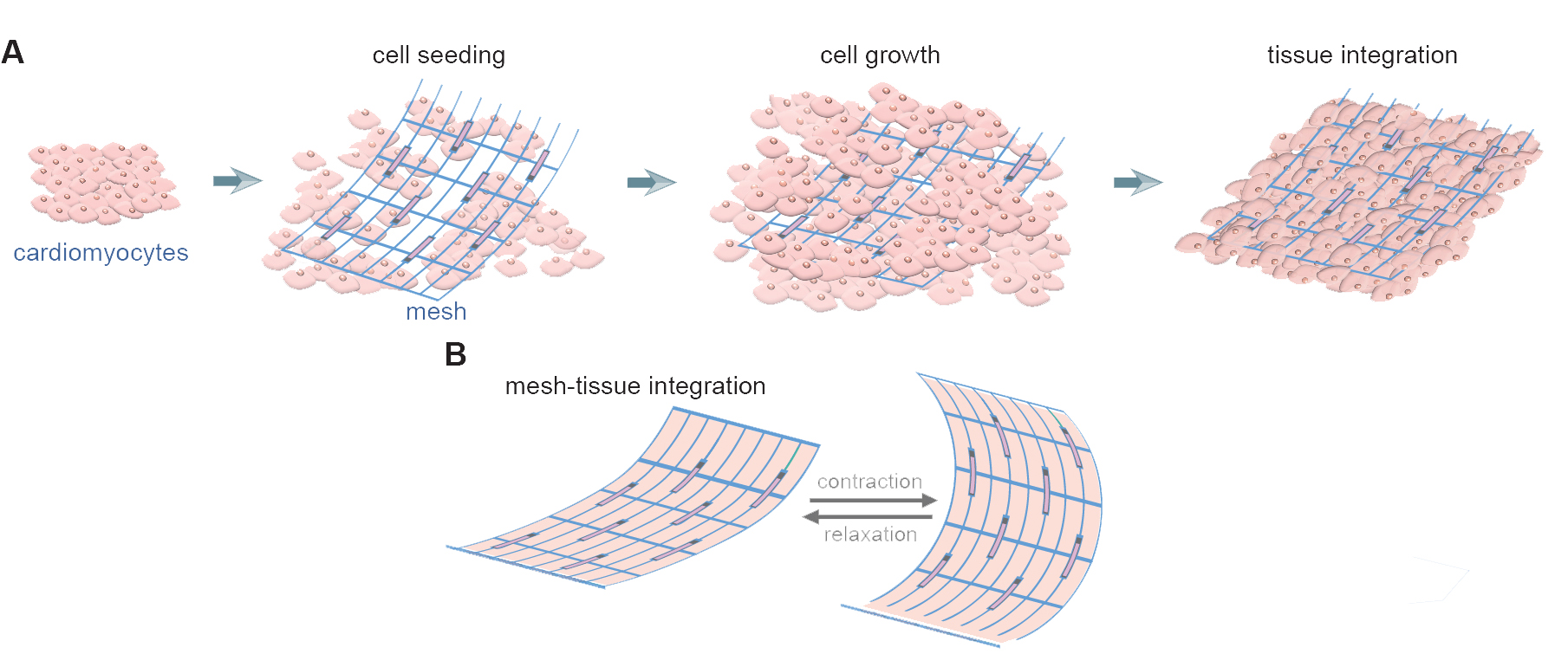
UMass Amhert researchers say their biohybrid mesh harvester moves and looks like human tissue, but works like a battery that never needs to be replaced. [Image courtesy of Siqi Wang]
“The beauty of this system is how noninvasive and powerful it is,” Yao said in a statement. “Our bodies want to reject systems that come with bulk batteries, but when the device exists at the cellular level, you get vastly improved biocompatibility.”
Previously from UMass Amherst: Materials Chemists Tap Body Heat to Power ‘Smart Garments’