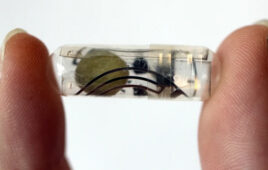
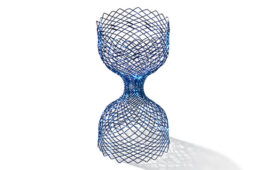
Manny Villafaña and his team at Medical 21 have developed an artificial artery that could eliminate the need for blood vessel harvesting in coronary artery bypass grafting (CABG) procedures. [Photo courtesy of Medical 21]
As the two men scrubbed in, Villafaña followed the surgeon’s lead to better understand the workflow, even starting in the washroom.
“He hits the pump three times, I hit the pump three times,” Villafaña said in a Medical Design & Outsourcing interview. “He scrubs like this, I’m scrubbing like this. He takes the towel from there, I take the towel from there. We’re finally drying our hands, he puts the towel on the end of the sink and puts his hand on the towel, kneels on one knee, bows his head and prays.”
What Villafaña learned next would inform the innovative device’s eventual design, and demonstrates how valuable it is for medical device developers to work with physicians at the site of care and make the most of the opportunity to closely observe, ask questions and listen.
It’s a lesson Villafaña learned long ago, having founded three medical device developers acquired by OEMs for a combined $57.4 billion: Cardiac Pacemakers Inc. (CPI, purchased by Boston Scientific for $27 billion), St. Jude Medical (purchased by Abbott for $30 billion) and ATS Medical (purchased by Medtronic for $400 million).
Villafaña’s newest venture, Medical 21, developed the Maverics graft to eliminate blood vessel harvesting in coronary artery bypass grafting (CABG) procedures. The graft is made with a resorbable synthetic polymer scaffold and nitinol wiring, and its 4 mm diameter came directly from that day with the surgeon.

Medical 21 founder and CEO Manny Villafaña [Photo courtesy of Manny Villafaña]
The surgeon replied, “Not only do I pray to God to help me with this patient, but I also pray that he gives me a decent vessel out of the patient’s legs,” as Villafaña tells it.
“When you open the legs,” Villafaña explains, “you don’t know what the hell you’re going to get.”
Next, he asked the surgeon what he was praying for, and the surgeon told him: “Between 3.5 mm and 4 mm.”
Villafaña said he “put that way in the back of my mind, and when we started this company, somebody asked what size we were going to make. I said 4 mm, and they asked where I pulled that from.
“I said, ‘If I saw a guy asking God for 4 [mm], that’s the least I can do.'”
MDO Min-Vasive Medtech: Hear Villafaña discuss the technology and what he’s learned in his long medtech career