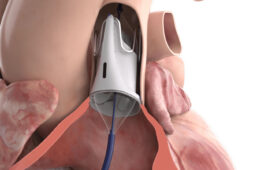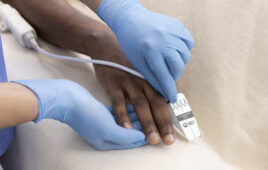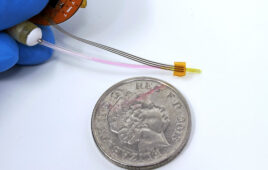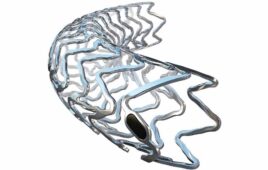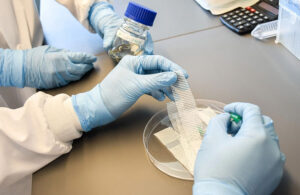
SanaHeal’s bioadhesive is designed to stick to wet, uneven tissue and form air- and fluid-tight seals. [Image courtesy of SanaHeal]
The team’s design was first inspired by natural sticky materials such as barnacles and spider webs, MIT said. Similar to nature’s sticky substances, SanaHeal’s bioadhesive grips wet, uneven tissue and forms an air- and fluid-tight seal within seconds, according to the team’s published research.
Staples and sutures surgeons usually use to seal or connect tissues can cause further damage to tissues, trigger immune responses, and lead to infection or scar tissue. SanaHeal’s hydrogels are biocompatible, which limits immune responses and scar tissue buildup, according to MIT.
“Our solution is more like a Post-it note. It’s much less invasive and easier to use with surgical robots,” SanaHeal founder and CTO Hyunwoo Yuk told MIT. “Also, faster and more efficient surgical procedures have potential to help lower ever-increasing costs of surgeries that are significantly straining the health care system.”
In 2019, Yuk and colleagues in Xuanhe Zhao’s MIT lab published a paper describing how an early version of the tape combined a biopolymer with a crosslinked polyacrylic acid grafted with N-hydroxysuccinimide (NHS) ester. The polyacrylic acid, which is the same absorbent polymer used in diapers, absorbs water from the tissue so it can bond to a dry area. The NHS esters create covalent bonds that improve adhesion stability and strength, and the biopolymer enables the tape to maintain its shape.
The first-generation tape bonded silicone rubber, titanium and hydrogels to wet tissue and held a polyurethane patch on the hearts of living rats.
Related: MIT researchers develop bioresorbable batteries for ingestible medical devices
Two years later, In 2021, the team published a follow-up describing a moldable paste inspired by the way barnacles adhere to surfaces, made by grinding the adhesive into microparticles and suspending them in medical-grade silicone oil, which repels blood so the particles can seal bleeding tissue.
The paste is also dissolvable, allowing surgeons to reopen sites as necessary. The researchers suggested it for uses including stopping bleeding around catheters and extracorporeal membrane oxygenation lines. In 2024, a National Institutes of Health (NIH) grant, with Mayo Clinic and Brigham and Women’s Hospital, advanced development of the paste for surgical bleeding.
Read about SanaHeal’s start in the 2024 MedTech Innovator cohort and other innovators here
“It’s a major unmet need,” Yuk said. “We are giving surgeons more options for a host of complex procedures. They are really excited about this.”
SanaHeal now provides the technology to medical device companies who are developing products across applications including open, laparoscopic and endoscopic surgery and sutureless device implantation for hernia and nerve repair.
“We have envisioned ourselves as a platform company from the beginning,” Yuk told MIT, adding that SanaHeal lacks the resources to develop many products at once, so it partners with larger companies to commercialize them. SanaHeal plans to begin human trials for another indication, surgical bleeding control and tissue repair, in 2027.