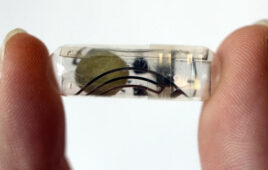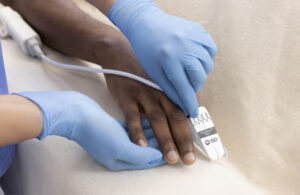
HemoSphere Stream Module noninvasively tracks hemodynamic changes through the VitaWave Plus finger cuff. [Photo courtesy of BD]
“If you’re building products for the in-hospital setting, it has to be to that [arterial] standard,” BD Worldwide President of Advanced Patient Monitoring (APM) Tim Patz said in a Medical Design & Outsourcing interview. “My hope is that our products can eventually be used outside the hospital, but maintain the same standards that we set for in-hospital use.”
The technology was part of the Edwards Lifesciences Critical Care business that BD purchased and rebranded as APM.
As medical devices advance toward a less invasive future, we asked Patz how his team developed its technology to help other device developers understand what it takes to design less invasive medtech. The following has been lightly edited for length and clarity.
MDO: What was the big advance that made this system possible?
Patz: “[Edwards] purchased a company called BMEYE more than 15 years ago. BMEYE was based in the Netherlands. They had built this technology on the finger cuff originally for the Space Station. It was a technology meant to be very robust in multiple environments, and zero gravity was one of the environments. The advance happened years ago and the team that’s been working with us, we’ve kept and have an office in Amsterdam. The team is still advancing the cuff every year to make improvements in software and in the disposable cuff’s design. I’d say this is an evolution that’s taken 20 to 25 years,in terms of when this organization was created and then us acquiring it and integrating it into our technologies.
“The key piece is that it’s not as widely adopted as it should be because the majority of our cuff products, which are known by a different brand name — Clearside Cuff or Acumen IQ Cuff — still require an advanced patient monitoring specialty monitor, our Hemisphere monitors. For a product like Stream, the fact that it connects to any bedside monitor is going to allow more ubiquity of the product because not all hospitals can afford expensive equipment. We want to make sure we have different products that meet different profiles for hospitals.”
Was there a specific design change that accelerated innovation?
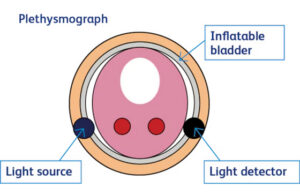
This illustration depicts how BD’s finger cuff uses a plethysmograph sensor to noninvasively monitor blood pressure. [Illustration courtesy of BD]
What were the biggest technical challenges during HemoSphere Stream’s development?
Patz: “Two things. No. 1 is to make something on a mass market scale, we had to make some changes. One of the changes we made was that we had to simplify the finger cuff design to make them as easy to use as pulse ox. Pulse ox, if you go to any hospital or any primary care, they just put it on your finger. It’s a very simple clip, or they wrap it around your finger and put some tape on it. That’s one of the biggest advancements. The cuff is a two-step process. You wrap it around the finger. It wraps around the top of your finger and you’re done. That’s it. Then you press start on the screen.

HemoSphere Stream Module enables continuous blood pressure monitoring with innovative noninvasive monitoring technology. [Image courtesy of BD]
More minimally invasive advice: Watch MDO’s 2026 Min-Vasive webinar series on-demand to learn more from experts in minimally invasive robotic and cardiac technology.
Have you accounted for different patient skin tones with this device?
Patz: “The situation that Medtronic and Masimo were under brought to attention that light plays a role in different skin tones and can have biases. How the FDA responds is that anytime we submit a new product, we have to have diversity of patients. There’s a certain percentage of your patients who have to have darker skin tones, and they give you a spectrum of skin colors. You have to have a certain amount of patients on each of these spectrums to justify any change in light products. Now that is for pulse oximetry. We also sell products that do a different type of oximetry in the brain, which looks at the tissue and the oxygen level in your brain tissue. It’s a product called Foresight that we make. Whether it’s Foresight or whether it’s products that go onto the finger where we use light, we do have to have a heightened scale and [diverse] groups of patients to make sure there’s no bias in the system. The big companies that were under this initial ask from the FDA, like Masimo and Medtronic, had to then give their data back to the FDA, but it’s forced all companies to go to that level now, which we’re fully supportive of.”
Read more from this interview: How BD wants to advance noninvasive continuous patient monitoring