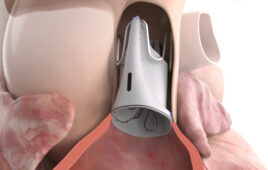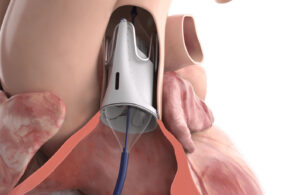
The Autus size-adjustable heart valve can be expanded years after implantation with a minimally invasive balloon catheter. [Illustration courtesy of Edwards Lifesciences]
The valve reduces the need for repeat open-heart surgeries in children with congenital pulmonary valve disease. After the valve is implanted via open-heart surgery, it can later be expanded with a minimally invasive transcatheter procedure that widens the valve using a balloon catheter.
It is the first artificial heart valve approved in the U.S. with polymeric material leaflets rather than animal-derived tissue leaflets. It’s also the first pediatric device to win approval after participating in the FDA’s Total Product Life Cycle Advisory Program (TAP), the agency’s accelerator for innovative devices.
Related: How device innovators can make the most of FDA’s TAP accelerator
The Autus valve endured 600 million cycles of frame fatigue testing for FDA review. That’s equivalent to 15 years of heartbeats, but the device developer can’t yet say how durable the implant is beyond that.

Autus Valve Technologies co-founder and former CEO Dr. Sophie-Charlotte Hofferberth [Photo courtesy of Autus Valve Technologies]
Hofferberth is the former CEO of Autus Valve Technologies, which she founded in 2019 with Drs. Elazer Edelman and Pedro del Nido. Autus sold to Edwards Lifesciences in February 2026 for $128.9 million plus up to $132.5 million in milestone payments, according to a securities filing.
How the Autus valve expands for years of growth
Before Autus, children with congenital heart disease were often treated with off-label prosthetic valves in the pulmonary position or homograft donor valves. Those options had “very limited durability” and were frequently oversized, Hofferberth said.
“The objective is to be able to implant the valve at a size that is optimal for their body’s size, rather than standard of care options today, which is essentially taking an adult-size valve and trying to fit that into a small child,” she said. “There’s data that shows that when you do that, it further limits the durability of those valves.”
The Autus valve is manufactured with a diameter of 12.7 mm and sized according to each patient’s body surface area. Prior to implantation, the surgical team expands the valve with a balloon to match the patient’s size and then implants the valve at the optimal diameter specific to the patient.
Autus can be implanted with a diameter as small as 13 mm, the appropriate size for a toddler or preschool-age patient. It can be expanded in 2 mm increments up to a maximum diameter of 22 mm, comparable to an adult-sized pulmonary valve.
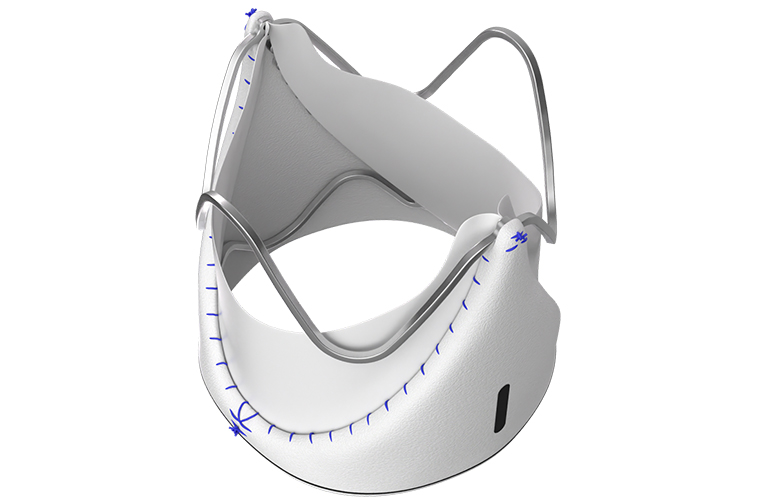
The Edwards Lifesciences Autus size-adjustable heart valve won FDA approval in October 2026. [Illustration courtesy of Edwards Lifesciences]
How the Autus valve was developed
In the early stages of developing the Autus valve, Hofferberth started with the patient’s hearts. First, she reviewed echocardiogram imaging from patients diagnosed with Tetralogy of Fallot, a combination of four congenital heart defects that occur together and impact the heart’s ability to circulate blood throughout the body.
She gathered measurements from the imaging to determine the anatomical dimensions in babies, and then mapped out changes as a child grows.
“What size do you need to start with?” she recalled asking herself. “What extent of growth is relevant if you’re trying to bridge a child through childhood to being a young adult?”
Hofferberth and her team then set out to develop leaflet geometry that would enable the valve’s diameter changes while maintaining unidirectional blood flow, or coaptation. They took inspiration from venous valves for their valve’s bileaflet design. Venous valves have a natural washout process, catalyzed by vortices that usher blood in a unilateral direction toward the heart to prevent backflow.
“What we’ve been able to show is that that same flow profile exists with the Autus valve when we implant it in the pulmonary valve position, which makes sense, given that we have mimicked that same geometric profile of the leaflets,” Hofferberth said.
Autus chose 316L stainless steel for the frame and ePTFE for the leaflets specifically to support growth and stability over time in the pediatric population, enabling expansion while maintaining structural durability.
“The choice of stainless steel is very relevant,” Hofferberth said. “It’s a material that has a long track record of use in permanent implants. It’s safe, and what was very relevant about using that for the frame is that it has very limited elastic recoil.”
The stainless frame is encased by a sleeve of ePTFE that extends below the stent frame to support suture placement and fixation to the surrounding tissue. The frame supports the leaflets and the symmetrical expansion of the valve, allowing it to remain at the set diameter after balloon expansion and for the leaflets to maintain optimal configuration for coaptation across a range of diameters
The accelerated metabolism of children is one the reasons commercially available tissue valves have limited durability in pediatric use, Hofferberth said. While tissue valves perform well in adults, pediatric immune systems and metabolisms are more active than adults, and animal tissue often hardens and breaks down faster in children.
“If you take the same [tissue] valve and implant that in a child, unfortunately, it has very limited durability,” she said. “… An assessment was done about what material would be most suitable in this specific population, and that took me down the road of ePTFE.”
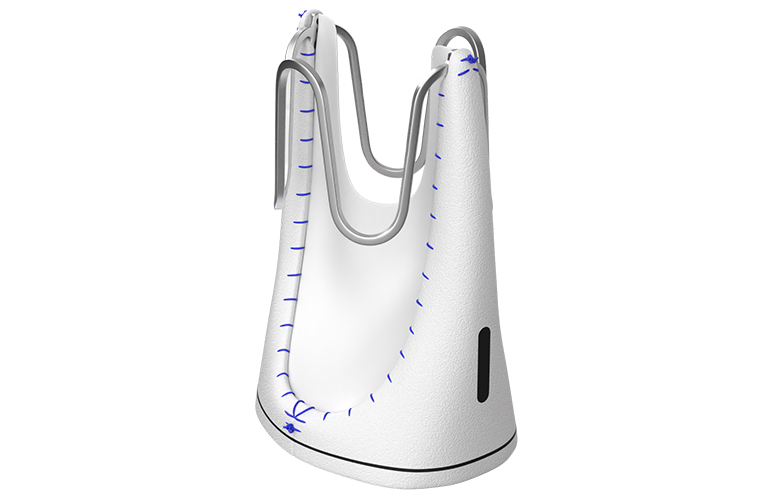
The Autus size-adjustable heart valve is shown here before expansion and implantation. [Illustration courtesy of Edwards Lifesciences]
“With a much smaller patient, their cardiac output — the blood flow going through the valve — is much lower and the pressures on the right side of the heart are much lower as well,” she said. “What that means is that it’s critical to have a material that will effectively perform in that environment. That, along with the biological response, was the reason we chose ePTFE.”
Related: ePTFE might be the next nitinol-like medtech material
In a clinical study used for its FDA submission, 62 pediatric patients were implanted with the Autus valve. At the six-month follow-up, 60 patients had acceptable hemodynamic performance and no more than mild valve regurgitation, according to the agency. Three patients experienced a fracture in the valve’s frame and two experienced reduced leaflet movement, but none of these events resulted in symptoms, FDA said.
The Autus valve is the latest step in the transition of care for children with congenital heart disease over the past 60 years.
“It used to be about just trying to help these children survive, and now survival rates are very high and they have improved greatly,” Hofferberth said. “The next phase for the field is quality of life and helping these children thrive in childhood and also thrive as adults.”