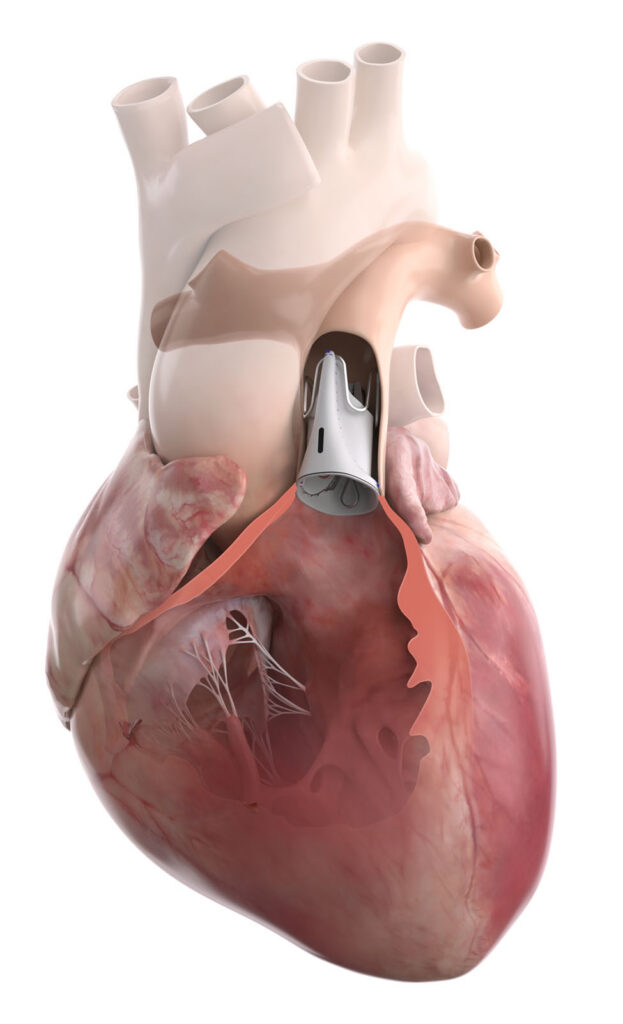
Edwards Lifesciences’ Autus size-adjustable heart valve [Illustration courtesy of Edwards Lifesciences]
Edwards Lifesciences announced FDA approval of the Autus Size-Adjustable Valve on Oct. 1, 2026. It is the first surgical pulmonary valve for pediatric patients and the first heart valve approved for expansion after implant.
It goes in at about 13 mm, small enough for a toddler. As the child grows, a balloon catheter can enlarge it to 22 mm, comparable to an adult valve. The goal is fewer open-heart operations across childhood.
It is also the first pediatric approval to come through FDA’s Total Product Life Cycle Advisory Program (TAP). The approval rested on data from 62 children at 12 U.S. sites. The work began roughly a decade ago in a Boston Children’s Hospital lab and included testing in growing lambs.
Six days before that announcement, I spoke at FDA’s public meeting on regulatory science, co-sponsored by the Medical Device Innovation Consortium (MDIC). I made two separate arguments.
The first was technical. We need methodologies for growth-accommodating devices so children do not need repeated surgeries throughout their lives.
The second was about policy. FDA lets manufacturers plan certain device changes in advance, so why not plan for age bands?
Autus speaks directly to the first argument. The second deserves its own case.
Growth needs shared tools
Growth is the defining design challenge in pediatrics, and Autus shows it can be engineered. A pediatric implant must keep working as the anatomy around it changes size, geometry, and loading from toddlerhood into adolescence. Today, developers largely build their own preclinical models and computational cases for that changing anatomy. Shared models and test methods would let the next team start where this one finished.
The foundation exists. FDA’s Office of Science and Engineering Laboratories (OSEL) maintains the Regulatory Science Tools Catalog, a peer-reviewed resource for use where standards and qualified Medical Device Development Tools (MDDT) do not yet exist.
Only a handful of its tools sit in the pediatric and perinatal devices area, including a method for testing emissions from neonatal incubators and a reference dataset for pediatric bone plates and screws. Growth is the natural next addition. Federal policy points the same way. The Administration for Strategic Preparedness and Response (ASPR) strategic plan for fiscal years 2026 to 2029 calls for “research models that reduce reliance on animal testing” in biodefense and pandemic research. The same logic fits pediatric devices. A validated growth model could stand in for some growing-animal studies.
Tools scale. Sponsors can use a qualified MDDT without reconfirming its suitability within the same context of use. One investment serves every product that follows, and that multiplier matters in a small market.
Growth also needs early engagement. Autus shows what TAP can do for a pediatric device. Since July, TAP has accepted breakthrough and Safer Technologies Program (STeP) devices across all Center for Devices and Radiological Health (CDRH) Offices of Health Technologies. That is good news for children’s devices, and it is a reason to give them a reserved lane.
Age bands need a policy decision. The age-band question is different. It is not a tool gap. FDA already defines pediatric subpopulations, from neonates through adolescents up through age 21. Since 2016, it has had guidance on extrapolating existing clinical data to pediatric uses. What is missing is a way to agree in advance how a device’s labeling could extend from one age band to the next as evidence accrues. Predetermined change control plans (authorized by Congress in 2022) don’t fully close that gap. FDA’s draft guidance says planned modifications should generally keep a device within its existing indications for use, and that most changes to indications would be difficult to assess prospectively. Adding an age band is a change to the indications.
Four steps to help the next growth-accommodating device follow faster.
- Build growth models: FDA, NIH, and Biomedical Advanced Research and Development Authority (BARDA) should invest in open, virtual pediatric patient cohorts with growth trajectories for key anatomies, credibility evidence under ASME V&V 40, and a path to MDDT qualification.
- Standardize growth testing: OSEL and standards bodies should develop test methods for growth-accommodating devices, including in-service expansion and durability after expansion. The FDA-funded Pediatric Device Consortia can serve as test beds.
- Reserve pediatric capacity in TAP: TAP is still formally a pilot under the current device user fee agreement, which runs through fiscal year 2027. The next agreement should reserve capacity for pediatric devices.
- Create an age-band plan: FDA should define a prospective plan — agreed at authorization — for extending labeling across pediatric age bands, built on its extrapolation guidance. If that requires new authority, the next user fee cycle is the moment to ask Congress for it.
FDA approved a valve that grows with the child. With the right tools and the right policy, the next growth-accommodating device will arrive faster, and it will not be the last.

Kolaleh Eskandanian [Photo courtesy of Eskandanian]
Read more MDO Contributions and learn how to submit your own.
The opinions expressed in this blog post are the author’s only and do not necessarily reflect those of Medical Design & Outsourcing or its employees.



Tell Us What You Think!
You must be logged in to post a comment.