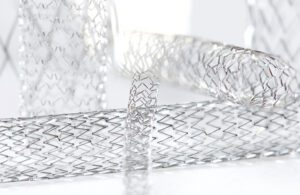
Nitinol — a nickel-titanium alloy — is used for medical devices such as stents, heart valves, catheters and orthopedics. [Photo via Adobe Stock]
Nitinol is a nearly equiatomic metal alloy of nickel and titanium with unique properties, including superelasticity (also called pseudoelasticity) and shape memory.
Superelasticity/pseudoelasticity means medical-grade nitinol shows great flexibility and elasticity under stress and can snap back to its original shape when pressure is released.
Nitinol’s superelastic properties allow minimally invasive medical devices made with this alloy to compress to a lower profile for delivery via a catheter.
Register now: The MDO Min-Vasive Medtech webinar series returns Aug. 18-20
Implants made from nitinol tubing or wire such as stents and replacement heart valves expand to their intended size and shape at the site of implantation and remain inside the patient, while nitinol therapy devices such as pulsed field ablation (PFA) catheters and renal denervation (RDN) systems expand inside the body, treat targeted tissue, and then compress again for retrieval.
Shape memory means medical-grade nitinol can remember its original shape and return to it when heated.
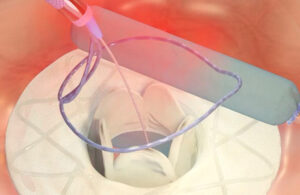
Adona Medical’s interatrial shunt is adjusted after implantation using an induction catheter to heat the shape memory nitinol. [Illustration courtesy of Adona Medical]
“With an increasing trend to treat patients using minimally invasive procedures, nitinol has become a popular choice of material due to its ability to return to its original shape after being mechanically deformed or after heat is applied,” the FDA said in a nitinol guidance document. “These properties are due to reversible transformations between the austenite and martensite phases, which may be temperature-induced (shape-memory) or stress-induced (pseudoelasticity). As a result, nitinol can withstand greater amounts of reversible deformations without plastic deformation than conventional metallic alloys, such as stainless steel, titanium, or cobalt-chrome alloys.”
Nitinol medical devices include cardiovascular implants, catheters for ablation and denervation, brain implants, devices for removing blood clots like those that cause strokes, and orthopedic implants. Nitinol is also used for dental products.
MDO Nitinol Innovation Special Reports: Download our free special reports featuring nitinol expertise and tips from medical device OEMs and interviews with device experts developing nitinol-enabled pulsed-field ablation devices
Nitinol’s use in cardiovascular implants

The shape memory properties of the nitinol wire struts in Medtronic’s Harmony transcatheter pulmonary valve (TPV) allow it to collapse down into a catheter for delivery and then expand inside a patient’s heart. [Photo courtesy of Medtronic]
Nitinol Knowledge: Join us for a free webinar featuring Medtronic Distinguished Engineer Ramesh Marrey
Structural heart surgical robotics startup Capstan Medical uses nitinol to expand and anchor the catheter-delivered mitral and tricuspid heart valves it’s developing. Nitinol can also be used for actuator wire in robotics.
Nitinol is also used in Abbott’s implantable clips to repair leaky heart valves, left atrial appendage occlusion (LAAO) devices, and CroíValve’s tricuspid valve repair implant.
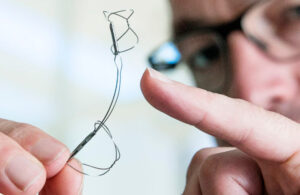
The Cardiac Dimensions Carillon Mitral Contour System is made of nitinol for its superelasticity and shape memory properties. [Photo courtesy of Cardiac Dimensions]
J&J MedTech’s V-Wave has developed an investigational interatrial shunt with nitinol for heart failure, while Heartpoint Global is developing a self-expanding pediatric stent.
Nitinol is commonly coated or wrapped with expanded polytetrafluoroethylene (ePTFE) for cardiovascular implants.
MDO Min-Vasive Medtech: Download our free 72-page special report featuring interviews with minimally invasive device development experts and engineers at major OEMs and groundbreaking startups, including some using nitinol
Nitinol in therapeutic catheters
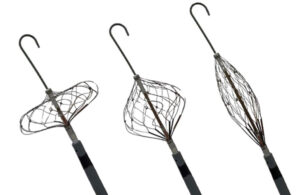
The Affera Sphere-360 PFA catheter is adjustable, allowing the nitinol electrode to take different shapes inside a patient. [Image courtesy of Medtronic]
Pulse field ablation is the latest wave of these catheters, including PFA systems developed by Medtronic, Affera (purchased by Medtronic, these catheters use nitinol both to expand inside a patient’s heart and as electrodes for generating the energy fields), Boston Scientific, J&J MedTech, Abbott and Pulse Biosciences.
J&J MedTech radiofrequency (RF) and dual-energy (PFA and RF) ablation catheters use nitinol springs for contact-force sensing.
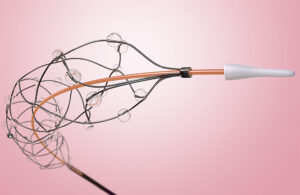
Flow Medical’s novel delivery scaffold uses hollow nitinol tubing to deliver clot-busting drugs. [Image courtesy of Flow Medical]
Startup Flow Medical is developing a minimally invasive system to treat pulmonary embolism with a novel nitinol scaffold that perforates blood clots and infuses them with tissue plasminogen activator (TPA), a thrombolytic drug commonly referred to as a clot-buster.
Nitinol medical devices in the brain

A blood clot captured by the Embotrap stent retriever [Photo courtesy of Johnson & Johnson MedTech]
Startup Retriever Medical is developing thrombectomy technology that combines nitinol baskets with aspiration, clot-busting drugs and blood filtration for reinfusion.
Brain-computer interface (BCI) developer Synchron is testing catheter-placed nitinol implants in the brain to restore function to patients with paralysis.
Another potential neuro application of nitinol is a surgical robot prototype built at Boston Children’s Hospital for pediatric brain tumor procedures.
Other uses of nitinol in medical devices and systems
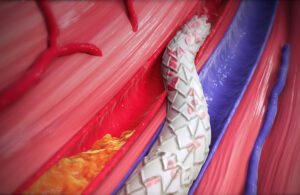
The LimFlow system’s self-expanding nitinol crossing stent diverts blood from a diseased tibial artery to a tibial vein to deliver oxygen to a patient’s ischemic foot. [Illustration courtesy of LimFlow]
Nitinol enables peripheral intervention devices such as Inari Medical’s first-of-its-kind LimFlow system for avoiding amputations due to chronic limb-threatening ischemia. Inari Medical has also developed a nitinol-enabled thrombectomy system for acute limb ischemia.
Nitinol is also used in various colorectal surgery devices for reconnecting the intestine after a pathology is removed, and in oncology for wires that mark and locate breast tumors.
Alcon sells a nitinol implant to treat glaucoma in conjunction with cataract surgery.
Nitinol is being researched at MIT for dissolvable devices and at Harvard for mechanical actuation to fight muscle atrophy.
Nitinol for dental products and devices
Nitinol is used in dentistry, especially in orthodontics for wires and brackets that connect the teeth. SureSmile dental braces are an example of nitinol’s use in orthodontics. Nitinol’s also used in endodontics, mainly for cleaning and shaping root canals.
How did nitinol get its name?
The word “nitinol” comes from the atomic symbols for the metals nickel (Ni) and titanium (Ti) plus “NOL” for Naval Ordnance Laboratory. That’s the U.S. military explosives testing facility — now known as the Naval Surface Warfare Center — in White Oak, Maryland, where nitinol was developed. Fun fact: The former NOL facility in White Oak is now the FDA’s headquarters.
More nitinol know-how from Medical Design & Outsourcing:
- 2026 MDO Nitinol Innovation Special Report: Pulsed-field ablation

Medical nitinol processing turns a solid tube into stents like these — one compressed and the other expanded. [Photo by Zarathustra via Adobe Stock]
- 2025 MDO Nitinol Innovation Special Report: What is nitinol, how to work with it, and how it’s enabling medical device innovation
- Medical nitinol manufacturing: How this nickel-titanium alloy is made for medical devices
- Medical nitinol processing: How NiTi is turned into wire, tubes and sheets for devices
- Nitinol machining and finishing for medical devices
- Nitinol knowledge from Ming Wu, former SVP of engineering at Edwards Lifesciences
- How Medtronic uses nitinol to improve the structure and effectiveness of heart devices
- What’s next for nitinol tubing?
- Understanding nitinol implant design and manufacturing
- Avoid these four common blunders when using nitinol for medical devices
- Salt baths increase stability in the nitinol device tempering process
Notable nitinol supply chain updates
- July 2026: Quasar Medical buys Medres Nitinol Design and Development Center

Titanium sponge (pictured) is a key ingredient for medical nitinol manufacturing. [Photo by Alexey Rezvykh via Adobe Stock]
- July 2026: Fort Wayne Metals sold
- May 2026: Confluent hires new COO and opens nitinol wire manufacturing facility in India
- January 2026: Resonetics is buying Resolution Medical to expand in neuromod and cardiology
- January 2026: Medtronic recognizes nitinol supplier Fort Wayne Metals with innovation award
- October 2025: Medical Device Components rebrands as Lighteum Medical
- October 2025: Switchback combines with LightningCath and Proto Lase after private equity deal
- June 2025: Fort Wayne Metals, Vascotube, Euroflex, Admedes and MeKo MedTech launch PRIME Project for nitinol supply chain strength
- May 2025: Resonetics buys nitinol gun drilling assets from Medical Component Specialists
- May 2025: MeKo MedTech expands to Costa Rica
- April 2025: MeKo Manufacturing launches US medtech operations in Minnesota
- March 2025: Resonetics expands nitinol tubing capability and capacity
- January 2025: MedRes expands its Nitinol Technology Center in California
- December 2024: Fort Wayne Metals expands nitinol melt capacity as device demand surges
- November 2024: Resonetics VP Eric Veit on medical nitinol lead times, prices and ‘major changes’ in the works
- November 2024: MDC acquires nitinol-based medical components maker Lighteum
- November 2024: Nitinol prices climb for medical devices after melting deals
- September 2024: Resonetics opens second manufacturing facility in Costa Rica
- July 2024: Johnson Matthey completes $700M Medical Device Components sale
- March 2024: Montagu to buy Johnson Matthey Medical Device Components for $700M
- January 2024: Confluent Medical Technologies invests in expanding ATI nitinol melting infrastructure
- October 2023: Resonetics closes $900M nitinol deal and rebrands Memry and Smart Materials
- December 2022: Johnson Matthey opens medical nitinol facility in Mexico
- August 2022: Confluent expands Costa Rica manufacturing footprint for nitinol, complex catheter production
- June 2022: Resonetics acquires Agile MV
- February 2022: Confluent closes majority investment from TPG Capital
- December 2021: Carlyle makes a significant investment in Resonetics
- November 2021: Resonetics buys Hudson Medical Innovations
- November 2021: Confluent opens new tubing center in Tennessee
- April 2021: Resonetics to expand manufacturing in Costa Rica
- January 2021: Confluent inks nitinol supply deal with melter Allegheny Technologies (ATI)
- November 2020: Resonetics acquires medical business of Hutchinson Technology
- August 2020: Confluent opens catheter development center in Austin, Texas
- September 2019: Resonetics acquires Tru Tech Systems
- February 2019: Confluent acquires Tube Hollows International for nitinol gun-drilling
- February 2019: Resonetics acquires Caribou Technologies
Find more information about nitinol and other materials used for medical devices in our Medical Device Handbook.
This post was originally published in 2016 and most recently updated in July 2026.


Hi, I was curious to understand what the author’s take is on the current value of the Nitinol market within the medical device industry. Additionally, how would they estimate the growth rate of nitinol based devices?
Many thanks and best regards,
Mithila