Medical Design and Outsourcing

  • Home
  • Medical Device Business
    • Mergers & Acquisitions
    • Financial
    • Regulatory
  • Applications
    • Cardiovascular
    • Devices
    • Imaging
    • Implantables
    • Medical Equipment
    • Orthopedic
    • Surgical
  • Technologies
    • Supplies and Components Index
    • Contract Manufacturing
    • Components
    • Electronics
    • Extrusions
    • Materials
    • Motion Control
    • Prototyping
    • Pumps
    • Tubing
  • MedTech Resources
    • Medtech Events in 2026
    • The 2026 Medtech Big 100
    • Medical Device Handbook
    • MedTech 100 Index
    • Subscribe to Print Magazine
    • DeviceTalks
    • Digital Editions
    • eBooks
    • Educational Assets
    • Manufacturer Search
    • Podcasts
    • Webinars / Digital Events
    • Whitepapers
    • Voices
    • Views
    • Video
  • 2026 Leadership
    • 2025 Winners
    • 2024 Winners
    • 2023 Winners
    • 2022 Winners
    • 2021 Winners
  • Women in Medtech
  • Advertise
  • Subscribe

Catheter design was key for the Boston Scientific Farapulse pulsed field ablation system

February 5, 2024 By Sean Whooley

Boston Scientific Chief Medical Officer Dr. Ken Stein explains how catheter design drives the Farapulse pulsed field ablation system.
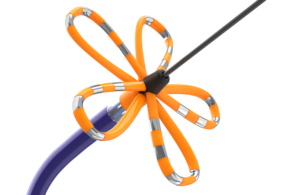
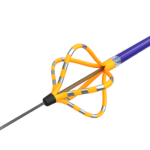
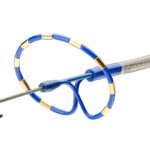
A photo of the Boston Scientific Farapulse pulsed field ablation system's Farawave catheter.

This image depicts the Boston Scientific Farapulse PFA system’s Farawave ablation catheter in its flower shape. [Image courtesy of Boston Scientific]

Following FDA approval on Jan. 31, Farapulse from Boston Scientific is now the second pulsed field ablation (PFA) system approved to treat atrial fibrillation (AFib) in the U.S.

Medtronic’s PulseSelect PFA System picked up the first FDA approval in December for the treatment of paroxysmal and persistent AFib.

Boston Scientific’s Farapulse, on the other hand, is indicated for the isolation of pulmonary veins to treat drug-refractory, recurrent, symptomatic, paroxysmal AFib.

Farapulse delivers pulsed field energy using the Farawave ablation catheter, Farastar ablation generator and Faradrive steerable sheath. Boston Scientific’s VersaCross Connect access solution complements the sheath to provide safe and effective left heart access.

The Farawave catheter treats a range of pulmonary vein anatomies using an over-the-wire catheter with a variable basket and flower shapes. This allows for the device to adapt to individual patient anatomies.

Dr. Ken Stein, Boston Scientific’s chief medical officer, offered more detail on the Farapulse system and how it was built in an interview with Medical Design & Outsourcing.

“We see this as a transformative technology,” Stein said. “I think it’s transformative for Boston Scientific EP (Electrophysiology). And, I think — just as importantly — this is transformative for patients.”

What comprises the Farapulse system?
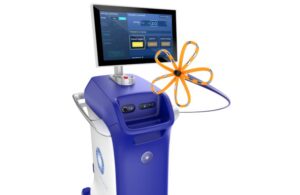
A photo of the Boston Scientific Farapulse PFA system generator, ablation catheter and sheath.

The Farapulse system includes the Farawave ablation catheter, Farastar ablation generator and Faradrive steerable sheath. [Image courtesy of Boston Scientific]

The three critical components of the Boston Scientific Farapulse PFA system are the Farastar energy generator, Faradrive sheath and Farawave ablation catheter.

Farastar generates the voltages for the ablation current delivered to the Farawave catheter, which creates lesions on the heart’s tissue, scarring it to isolate irregular heart signals that cause AFib.

The Faradrive sheath brings the ablation catheter into the patient’s body and positions it within the correct space inside the heart’s left atrium.

Then the Farawave catheter emerges from the Faradrive sheath for manipulation and positioning within the heart. The Farawave catheter takes two different shapes — a flower and a basket — both used in the procedure to ablate the pulmonary veins.
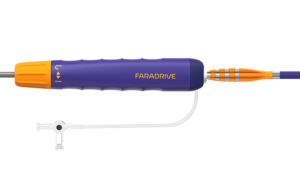
An image of the Boston Scientific Farapulse PFA system's Faradrive steerable sheath,

The Farapulse PFA system’s Faradrive steerable sheath with the Farawave catheter to the right. [Image courtesy of Boston Scientific]

Conventional ablation technologies use radiofrequency energy to heat tissue or cryoablation to freeze tissue. Both can lead to complications, which is why Boston Scientific went a different route with Farapulse, he said.

“What’s unique about Farapulse is that it uses this very high-voltage, oscillating electrical field that doesn’t heat the tissue,” he said. “What it does is it actually causes the cell membranes of the tissue you’re trying to ablate to start to break down.”

That process — called electroporation — works so well because heart tissue is uniquely susceptible to this type of energy, Stein said. With the right waveform and the right catheter, it means Farapulse can avoid a lot of the potential complications associated with ablating non-cardiac tissue, Stein said.

“That’s why this is proving out to be a safer procedure than conventional thermal ablation,” he said. “Because of the safety, that also enables you to get to good efficacy and to get a really fast, efficient procedure.”

Catheter design was key for Boston Scientific
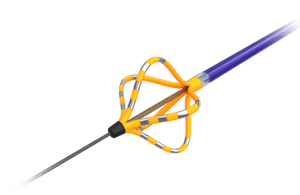
Boston Scientific image of the Farapulse pulsed-field ablation system Farawave single-shot catheter

This image depicts the Boston Scientific Farapulse PFA system’s Farawave ablation catheter in its basket shape. [Image courtesy of Boston Scientific]

With radiofrequency ablation, any 5 mm-tip ablation catheter with the same degree of contact delivers the same result, no matter which company’s ablation catheter you use, Stein said. In that sense, it’s generic, he said — but PFA is different.

“Pulsed field ablation results are really critically dependent on a number of different aspects of the technology,” Stein said.

Catheter design sits atop the list of the crucial elements that go into PFA technology. A vital part of development comes with addressing the variability of patient anatomy, so having a versatile catheter design makes it more straightforward to deal with the various challenges of unique anatomies.

The Farawave catheter treats a range of pulmonary vein anatomies using an over-the-wire catheter with variable basket and flower shapes. This allows the device to adapt to the different shapes and sizes of individual patient anatomies.

Boston Scientific already has a next-generation catheter for Farapulse that it hopes to roll out “in the near future,” Stein noted. The devicemaker also has alternative catheter designs under development that could offer utility in different arrhythmias beyond AFib.

A photo of Boston Scientific SVP and Global Chief Medical Officer Dr. Ken Stein.

Boston Scientific SVP and Global Chief Medical Officer Dr. Ken Stein [Photo courtesy of Boston Scientific]

“Unlike a lot of the competitors out there, Farapulse is unique in that it was designed from the ground up as a pulsed field ablation system,” Stein said. “It’s not a repurposed catheter that was designed for something completely different.”

Stein also highlighted the importance of the shape of the electrical field created by Farapulse and the waveform used to create it, and  the system’s critical dependence on the dosing strategy applied to ablation procedures. Cardiac tissue targeted by ablation can be particularly susceptible to this energy source due to the geometry of cardiac muscle cells, he said.

“If you can create the right shape of an electrical field — that gets back to catheter design — and if you provide just the right amount of energy, and that gets to things like the waveform, then you can tune it in a way that is relatively selective for heart tissue, as opposed to other tissue,” Stein said.

You may also like:

  • An image showing the Abbott Volt pulsed field ablation (PFA) catheter's balloon-in-basket design and eight electrode splines.
    Abbott bets on balloons in pulsed field ablation battle
  • An image of the Medtronic PulseSelect Pulsed Field Ablation (PFA) System's catheter.
    What’s so special about pulsed field ablation? Medtronic EVP Sean…
  • Boston Scientific image of the Farapulse pulsed-field ablation system Farawave single-shot catheter
    Boston Scientific ramps up Farapulse manufacturing with new site
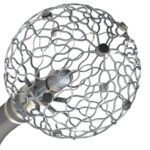
  • A sphere-shaped, expandable lattice device with electrodes for cardiac ablation
    Why Affera’s cardiac ablation technology is worth $1B to Medtronic

About The Author

Avatar photo
Sean Whooley

Sean Whooley is an associate editor who mainly produces work for MassDevice, Medical Design & Outsourcing and Drug Delivery Business News. He received a bachelor's degree in multiplatform journalism from the University of Maryland, College Park. You can connect with him on LinkedIn or email him at [email protected].

Related Articles Read More >

A clinician guides a needle and wire into the side of a patient's neck during a central venous catheter insertion.
New campaign targets fibrin sheath CVC complication
An illustration of Fractyl Health's Revita system in using ablation in the dueodenum.
This minimally invasive ablation device shows promise to keep pounds off after GLP-1s
A photo of the Zeus CathX Medical facility in Cartago, Costa Rica.
Zeus plans new catheter manufacturing facility in Costa Rica
The MDO Min-Vasive Medtech webinar series features medical device R&D experts from major OEMs and groundbreaking startups.
We’ve got a medtech legend, teleprocedures and autonomous robots for the 2026 MDO Min-Vasive Medtech webinar series
“mdo
EXPAND YOUR KNOWLEDGE AND STAY CONNECTED
Get the latest medical device business news, application and technology trends.

DeviceTalks Weekly

See More >

MDO Digital Edition

Digital Edition

Subscribe to Medical Design & Outsourcing. Bookmark, share and interact with the leading medical design engineering magazine today.

MEDTECH 100 INDEX

Medtech 100 logo
Market Summary > Current Price
The MedTech 100 is a financial index calculated using the BIG100 companies covered in Medical Design and Outsourcing.

New MedTech Resource

Medical Tubing

MassDevice

Mass Device

The Medical Device Business Journal. MassDevice is the leading medical device news business journal telling the stories of the devices that save lives.

Visit Website
MDO ad
Medical Design and Outsourcing
  • MassDevice
  • DeviceTalks
  • MedTech100 Index
  • Medical Tubing + Extrusion
  • Medical Design Sourcing
  • Drug Delivery Business News
  • Drug Discovery & Development
  • Pharmaceutical Processing World
  • R&D World
  • About Us/Contact
  • Advertise With Us
  • Subscribe to Print Magazine
  • Subscribe to our E-Newsletter
  • Listen to our Weekly Podcasts
  • Join our DeviceTalks Tuesdays Discussion

Copyright © 2026 Arrowfly, LLC. All Rights Reserved. The material on this site may not be reproduced, distributed, transmitted, cached or otherwise used, except with the prior written permission of Arrowfly LLC. Site Map | Privacy Policy | RSS

Search Medical Design & Outsourcing

  • Home
  • Medical Device Business
    • Mergers & Acquisitions
    • Financial
    • Regulatory
  • Applications
    • Cardiovascular
    • Devices
    • Imaging
    • Implantables
    • Medical Equipment
    • Orthopedic
    • Surgical
  • Technologies
    • Supplies and Components Index
    • Contract Manufacturing
    • Components
    • Electronics
    • Extrusions
    • Materials
    • Motion Control
    • Prototyping
    • Pumps
    • Tubing
  • MedTech Resources
    • Medtech Events in 2026
    • The 2026 Medtech Big 100
    • Medical Device Handbook
    • MedTech 100 Index
    • Subscribe to Print Magazine
    • DeviceTalks
    • Digital Editions
    • eBooks
    • Educational Assets
    • Manufacturer Search
    • Podcasts
    • Webinars / Digital Events
    • Whitepapers
    • Voices
    • Views
    • Video
  • 2026 Leadership
    • 2025 Winners
    • 2024 Winners
    • 2023 Winners
    • 2022 Winners
    • 2021 Winners
  • Women in Medtech
  • Advertise
  • Subscribe