Medical Design and Outsourcing

  • Home
  • Medical Device Business
    • Mergers & Acquisitions
    • Financial
    • Regulatory
  • Applications
    • Cardiovascular
    • Devices
    • Imaging
    • Implantables
    • Medical Equipment
    • Orthopedic
    • Surgical
  • Technologies
    • Supplies and Components Index
    • Contract Manufacturing
    • Components
    • Electronics
    • Extrusions
    • Materials
    • Motion Control
    • Prototyping
    • Pumps
    • Tubing
  • MedTech Resources
    • Medtech Events in 2026
    • The 2025 Medtech Big 100
    • Medical Device Handbook
    • MedTech 100 Index
    • Subscribe to Print Magazine
    • DeviceTalks
    • Digital Editions
    • eBooks
    • Educational Assets
    • Manufacturer Search
    • Podcasts
    • Webinars / Digital Events
    • Whitepapers
    • Voices
    • Views
    • Video
  • 2026 Leadership
    • 2025 Winners
    • 2024 Winners
    • 2023 Winners
    • 2022 Winners
    • 2021 Winners
  • Women in Medtech
  • Advertise
  • Subscribe

Abbott bets on balloons in pulsed field ablation battle

January 31, 2024 By Jim Hammerand

The Abbott Volt aims to beat first-generation pulsed field ablation (PFA) systems with its balloon-in-basket design and other features.

An image showing the Abbott Volt pulse field ablation (PFA) catheter's balloon-in-basket design and eight electrode splines.

The Abbott Volt pulsed field ablation (PFA) catheter features a balloon-in-basket design and eight electrode splines. [Image courtesy of Abbott]

One component stands out as unique when you compare the Abbott Volt against competing pulsed field ablation (PFA) systems from Medtronic and Boston Scientific.

The Volt cardiac ablation catheter has a balloon, something you won’t see on Medtronic’s PulseSelect PFA catheter — the first of its kind approved by the FDA — or the Farawave catheter in Boston Scientific’s Farapulse PFA system.

The Abbott Volt’s balloon-in-basket is designed to support the efficient deployment of energy into the tissue during cardiac ablation to treat atrial fibrillation (AFib). That energy creates lesions, scarring the heart tissue to block the irregular electrical signals that disrupt the heart’s normal rhythm.

Abbott said the catheter’s design improves the accuracy, quality and efficiency of ablation to minimize the number of applications needed to treat a patient, as well as potential side effects.

“We have data showing if you use a balloon versus a basket without the balloon it makes a difference [in] lesion depths by 20% to 30%,” said Dr. Christopher Piorkowski, the chief medical officer of Abbott’s electrophysiology division, in an interview with Medical Design & Outsourcing.

To further maximize efficient energy transfer into the heart tissue, Abbott designed the device with electrodes that only face outward and insulated nitinol splines that are flat, not round.

Based on Abbott’s bench and animal testing data, the Volt design can drive chronic lesion depths of 6 to 8 mm, Piorkowski said, calling those depths “very sufficient for the left atrium and pulmonary vein isolation.”

At the same time, the balloon acts as an insulator for the blood inside the patient’s beating heart, reducing the incidence of hemolysis and thermal effects such as bubble formation. Piorkowski said the Volt also uses less voltage for ablation than competing PFA devices, reducing the risk of thermal effects. (He declined to say how much voltage Abbott’s system uses or to quantify the difference.)

The balloon helps stabilize the basket inside the pulmonary vein, where the device’s round shape allows a physician to place the catheter at the ablation target site, apply energy, and rotate the device slightly to achieve a spline offset for a second energy application. In tests, physicians are using three to four applications per treatment.

“That is way below everything that is currently being done with PFA in the clinical field,” he said.

The Abbott Volt is a hybrid catheter that can be used for both single-shot and focal ablation. Piorkowski said this design allows for spline selectivity and manual handling.

“Operators can select individual pair of splines to deliberately deploy individual PFA lesions,” he said.

Regarding manual handling, “The catheter can be positioned ‘over-the-wire’ like a single shot. It can also be manipulated by a bidirectional catheter handle plus the support of the bidirectional sheath, like a large focal catheter,” he said. “In the trials we have seen physicians are making use of these design functionalities depending on anatomical needs, such as a common ostium.”

Measuring tissue contact during PFA

An image of the Abbott Volt PFA System catheter and cart, which helps physicians visualize the location and effectiveness of cardiac ablation.

The Abbott Volt PFA System can tell a physician whether the catheter’s electrodes are in good contact with heart tissue to maximize ablation effectiveness. [Image courtesy of Abbott]

Another unique element of the Abbott Volt PFA system is a tissue contact assessment feature, Piorkowski said. Because PFA energy delivery depends on tissue contact, it’s important for the physician to know that the electrodes are directly touching the tissue to make the best possible lesions.

Abbott engineers took an impedance-based measurement that the company invented for previous ablation catheters and applied it to each of the Volt’s electrodes.

“We immediately saw the benefit in bench testing [and] also in the clinical field,” Piorkowski said. “In PFA, we have enabled the system to perform such contact assessment not on a single electrode, but on all eight splines of the device.”

What’s next for the Abbott Volt PFA system

A photo of Abbott Electrophysiology Chief Medical Officer Dr. Christopher Piorkowski.

Abbott Electrophysiology Chief Medical Officer Dr. Christopher Piorkowski [Photo courtesy of Abbott]

Abbott recently announced that physicians had performed the first procedures in a global clinical trial of the Volt PFA system. The company said it hopes to win investigational device exemption (IDE) from the FDA for a U.S. clinical trial in the first half of 2024.

Because PFA is relatively new, the FDA and other regulators are learning about it along with the medtech industry, taking what they learn from publications, conferences and presentations and bringing their questions to device developers like Abbott during clinical trial design.

“Bubble formation was something in the beginning of the PFA era that was little talked about,” Piorkowski said. “When we designed our clinical trial — and we have a lot of pre-sub meetings, for instance, with FDA where we talk about the trial design and what they feel is important and how we should address it — this topic of bubble formation came up and we had to address it in preclinical testing and also in the trial design.”

The IDE trial will include patients with paroxysmal (intermittent) AFib and patients with persistent AFib. If successful, that study could lead to the Abbott Volt PFA system’s FDA approval and product launch as early as 2026, though Abbott has not yet shared a timeline for approval or commercialization.

“There are obviously risks down the road, [but] we try to be as fast as possible. … We see excitement on the enrollment side. These trials enroll really fast,” Piorkowski said. “Where we stand right now, we’ve treated 30 patients successfully in in Australia. These patients go through an intermediate assessment of safety and efficacy, and this data will be critical for the discussion of when we can start our IDE study.”

This post was originally published on Jan. 22, 2024, and updated on Aug. 13, 2024, with information about the single-shot/focal hybrid design.
You may also like:

  • An image of the Medtronic PulseSelect Pulsed Field Ablation (PFA) System's catheter.
    What’s so special about pulsed field ablation? Medtronic EVP Sean…
  • Boston Scientific image of the Farapulse pulsed-field ablation system Farawave single-shot catheter
    Boston Scientific ramps up Farapulse manufacturing with new site
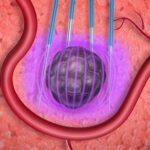
  • An illustration showing how pulsed field ablation uses electronic fields to kill cells using irreversible electroporation.
    Applications of electrical energy in medicine: RF ablation and electroporation
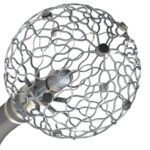
  • A sphere-shaped, expandable lattice device with electrodes for cardiac ablation
    Why Affera’s cardiac ablation technology is worth $1B to Medtronic

About The Author

Jim Hammerand

Jim Hammerand is the managing editor of Arrowfly's Medical Design & Outsourcing, where he leads coverage of medtech innovation, design, engineering and manufacturing. He also reports breaking news at Arrowfly's MassDevice and contributes to our DeviceTalks podcasts and live events. Hammerand has more than two decades of journalism experience spanning newspapers, magazines, websites, live events, radio and TV news. For nearly a decade, Hammerand reported and edited business news for American City Business Journals as a reporter and digital editor at the Minneapolis/St. Paul Business Journal and then as managing editor of the Puget Sound Business Journal in Seattle. He holds degrees in journalism and management from the University of Minnesota and has won journalism awards from the Society of Professional Journalists, American Society of Business Publication Editors, and Trade, Association, Business Publications International. Connect with him on LinkedIn or by email at [email protected].

Related Articles Read More >

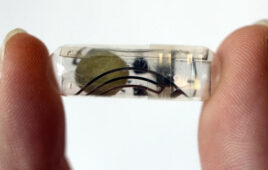
The 1.84 volt paper battery (brown circle structure) was tested in pigs with a bioabsorbable radio-frequency identification (RFID) device.
MIT researchers develop bioresorbable batteries for ingestible medical devices
An illustration of HITMAN operating in glioblastoma cells.
MIT researchers develop injectable nanodevices that remotely kill brain tumor cells
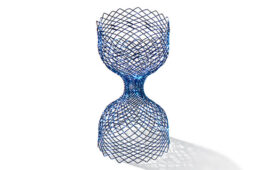
An image of VahatiCor's A-Flux implant.
Nitinol outsourcing made VahatiCor’s new cardiac implant possible
A photo of Conexeu Sciences co-founder and Chief Scientific Officer Dr. Claudia Chavez-Munoz.
This tissue engineering scientist is bioprinting next-gen absorbable implants
“mdo
EXPAND YOUR KNOWLEDGE AND STAY CONNECTED
Get the latest medical device business news, application and technology trends.

DeviceTalks Weekly

See More >

MDO Digital Edition

Digital Edition

Subscribe to Medical Design & Outsourcing. Bookmark, share and interact with the leading medical design engineering magazine today.

MEDTECH 100 INDEX

Medtech 100 logo
Market Summary > Current Price
The MedTech 100 is a financial index calculated using the BIG100 companies covered in Medical Design and Outsourcing.

New MedTech Resource

Medical Tubing

MassDevice

Mass Device

The Medical Device Business Journal. MassDevice is the leading medical device news business journal telling the stories of the devices that save lives.

Visit Website
MDO ad
Medical Design and Outsourcing
  • MassDevice
  • DeviceTalks
  • MedTech100 Index
  • Medical Tubing + Extrusion
  • Medical Design Sourcing
  • Drug Delivery Business News
  • Drug Discovery & Development
  • Pharmaceutical Processing World
  • R&D World
  • About Us/Contact
  • Advertise With Us
  • Subscribe to Print Magazine
  • Subscribe to our E-Newsletter
  • Listen to our Weekly Podcasts
  • Join our DeviceTalks Tuesdays Discussion

Copyright © 2026 Arrowfly, LLC. All Rights Reserved. The material on this site may not be reproduced, distributed, transmitted, cached or otherwise used, except with the prior written permission of Arrowfly LLC. Site Map | Privacy Policy | RSS

Search Medical Design & Outsourcing

  • Home
  • Medical Device Business
    • Mergers & Acquisitions
    • Financial
    • Regulatory
  • Applications
    • Cardiovascular
    • Devices
    • Imaging
    • Implantables
    • Medical Equipment
    • Orthopedic
    • Surgical
  • Technologies
    • Supplies and Components Index
    • Contract Manufacturing
    • Components
    • Electronics
    • Extrusions
    • Materials
    • Motion Control
    • Prototyping
    • Pumps
    • Tubing
  • MedTech Resources
    • Medtech Events in 2026
    • The 2025 Medtech Big 100
    • Medical Device Handbook
    • MedTech 100 Index
    • Subscribe to Print Magazine
    • DeviceTalks
    • Digital Editions
    • eBooks
    • Educational Assets
    • Manufacturer Search
    • Podcasts
    • Webinars / Digital Events
    • Whitepapers
    • Voices
    • Views
    • Video
  • 2026 Leadership
    • 2025 Winners
    • 2024 Winners
    • 2023 Winners
    • 2022 Winners
    • 2021 Winners
  • Women in Medtech
  • Advertise
  • Subscribe