Conexeu Sciences co-founder and Chief Scientific Officer Dr. Claudia Chavez-Munoz developed an innovative regenerative, bioabsorbable extracellular matrix (ECM) platform. [Photo courtesy of Conexeu Sciences]
As a surgeon working with burn cases, she created the technology after seeing inadequacies in available acellular dermal matrices for wound healing.
She set out to design a platform that was “ready to use, easy to use [and] would conform to any topography, any irregularity” before disappearing, she said in a Medical Design & Outsourcing interview.
The result was the proprietary CXU platform, a thermosensitive extracellular matrix (ECM) that transitions into a stable gel at body temperature.
“That’s how CXU came to life,” Chavez-Munoz said. “The first thing is wound healing and from there we have looked at many different verticals that can use this.”
The company intends to first pursue FDA 510(k) clearance for wound care as the foundation for its eventual move into the $11 billion injectable medical aesthetics market that’s growing fast due to the GLP-1 drug boom.
“GLP-1 is one of the defining medical stories of a generation,” Conexeu Sciences President and CEO Miles Harrison said in a July 2026 announcement that the company had completed its 12-month preclinical study testing CXU’s tissue restoration performance as an aesthetic injectable.
The success of GLP-1s “has created an entirely new patient profile: people whose bodies have changed faster than the aesthetics industry was built to address,” he continued. “We believe no existing injectable was designed specifically for that gap.”
As Conexeu explored additional indications for its technology, Chavez-Munoz thought about a different patient population: cancer patients, specifically post-mastectomy breast cancer patients.
“There are so many things that they go through that these patients are hurting, and then going into the radical mastectomy, which removes everything and then leaves them with nothing,” she said. “When they look at their mirror, they’re like, ‘I feel empty.’ This was my purpose of creating BREAST.”
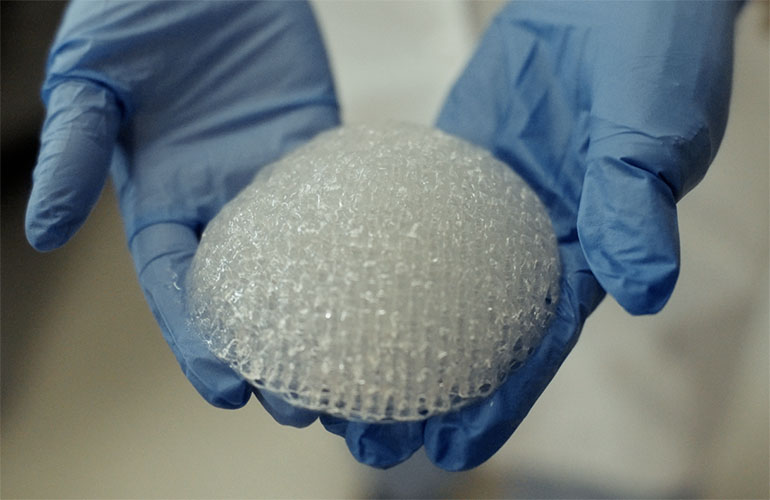
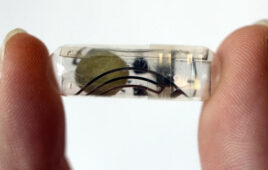
The absorbable BREAST implant incorporates Dr. Chavez-Munoz’s CXU technology. [Photo courtesy of Conexeu Sciences]
What is BREAST
BREAST stands for bio-regenerative, ergonomically architected, smart tissue. Chavez-Munoz designed it as a breast implant replacement to “support biological restoration rather than simply replacing volume.”
Bioabsorbable polymers for implantable medical devices: What to know
Instead of using the same breast implants that are used in aesthetics, “why not have something better,” Chavez-Munoz said, “something that actually will produce tissue, and not necessarily have something that is a foreign body there?”
Unlike Conexeu’s liquid-based CXU offerings, BREAST is a 3D-printed implant customized to match the anatomical geometry of each patient.
“Our intent is not to sell different sizes of breast implants,” Chavez-Munoz said. “Our intent is to do personalized medicine.”
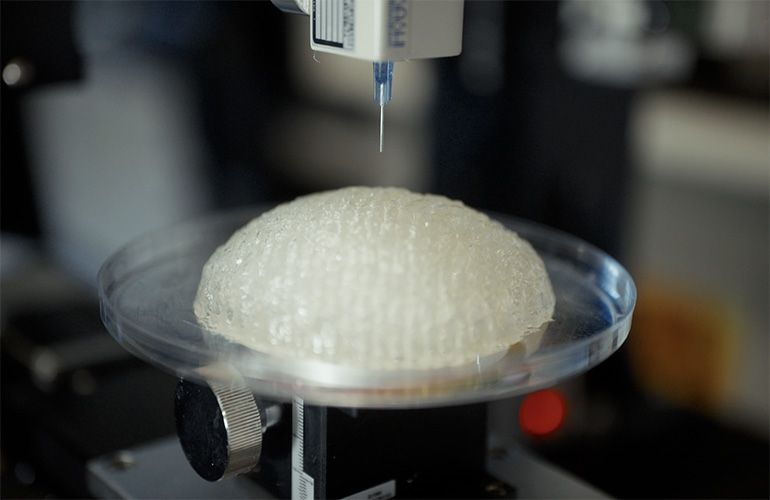
Each BREAST implant is custom 3D-printed for the patient. [Photo courtesy of Conexeu Sciences]
Signals are emitted by cells after an injury, and the ECM captures these signals to help regulate the behavior of the cells. The ECM “tells the cell if there’s a stem cell that goes there because there is a lack of cells and then stem cells chime in,” she explained.
When these cells arrive at the injury site, ECM directs the stem cells on what kind of cell to become to promote healing and regeneration.
Previously, scientists thought polylactic acid (PLAs) and poly(lactic-co-glycolic acid) (PLGAs) scaffolds, and any biosynthetic, bioresorbable, biomechanically functional, synthetic material could replace the body’s natural ECM, Chavez-Munoz said. But she said that’s no longer thought to be true.
“There are specific proteins that have specific binding pockets where [ECM] signals are able to bind in place, and this is dictating the behavior of the cell,” she said. “Because we know this complexity, the design of BREAST was about how our body behaves and the composition of our body, and using those same proteins, we built the scaffold of BREAST. … People have tried doing collagen scaffolds, but collagen is only one protein out of many other proteins, sugars and [other components] in that extracellular matrix. We know now that one component is not enough. We know that the activity is not the same.”
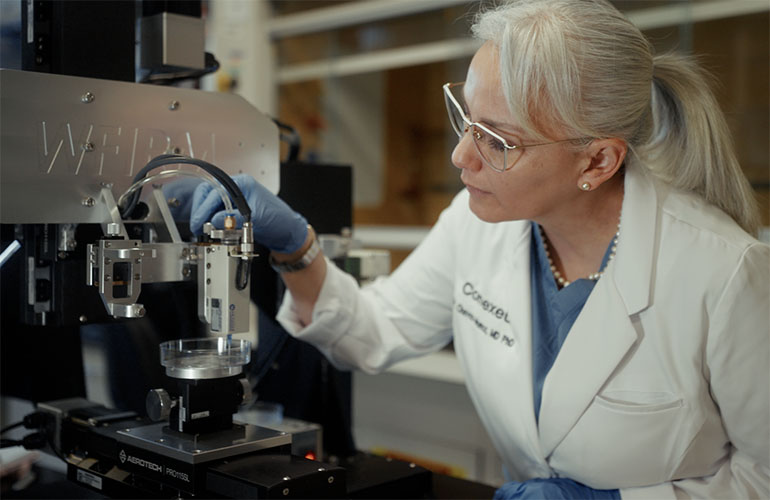
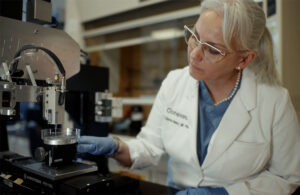
Dr. Claudia Chavez-Munoz thought of the idea of the CXU scaffold after seeing inadequacies in available products for burn patients. She’s pictured here with the 3D-printer used to manufacture absorbable BREAST implants. [Photo courtesy of Conexeu Sciences]
“Cells are able to migrate in, vascularity happens, cells are able to form their signals and communicate with other cells, and at the end that gets reabsorbed,” Chavez-Munoz said.
She says the implant lowers the body’s immune response and that preclinical studies show the implant matrix allows host tissue to progressively replace the scaffold on its own timeline.
“It’s almost like the body feels there was an injury, and it responds to that injury, but once we place [the implant], we quiet everything,” she said. “The body knows that [the injury] already closed; it’s completed, so it doesn’t have to go through all those phases of wound healing.
“It goes just to the phase of migration, then [the cells] proliferate, and we see a very minimal proliferation. There’s not an active response, and eventually over time it gets remodeled.”
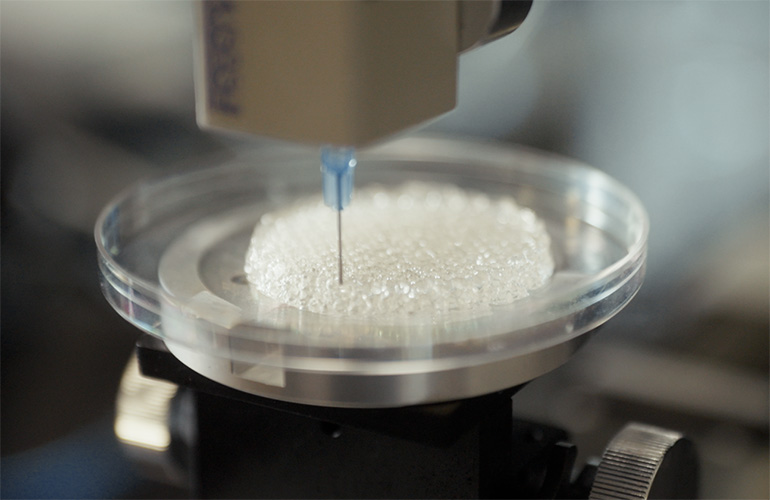
The 3D-printed BREAST implant (seen here) is designed to promote tissue regeneration and then disappear. [Photo courtesy of Conexeu Sciences]
Areas of opportunity for bioregenerative technology
Chavez-Munoz said preclinical work for BREAST starts in fall 2026, but emphasized that the product still has a long path ahead before reaching breast cancer patients.
“We don’t know exactly how many years is going to take us, but it’s going to be some years,” she said. “The most important thing is to make sure it works, that it’s safe for the patients, that it does what we have seen that it does.”
In early 2026, Conexeu transitioned its wound care program from research and development into manufacturing, testing, and regulatory planning. Conexeu plans to submit CXU for wound care to the FDA for 510(k) review in the first quarter of 2027.
Aside from wound care, Conexeu aims to enter oral health with a periodontal ECM (in preclinical development), veterinary wound care (also in preclinical development) and facial and body contouring to address skin laxity in GLP-1 patients.
“The future is regenerative medicine,” Chavez-Munoz said, but she cautioned the challenge is “not simply building devices [and] ensuring that the devices survive in the body, but also that they enable the potential of our body.”
She continued, “That’s where they should disappear. In the end, it should just be our body’s tissue.”