Medical Design and Outsourcing

  • Home
  • Medical Device Business
    • Mergers & Acquisitions
    • Financial
    • Regulatory
  • Applications
    • Cardiovascular
    • Devices
    • Imaging
    • Implantables
    • Medical Equipment
    • Orthopedic
    • Surgical
  • Technologies
    • Supplies and Components Index
    • Contract Manufacturing
    • Components
    • Electronics
    • Extrusions
    • Materials
    • Motion Control
    • Prototyping
    • Pumps
    • Tubing
  • MedTech Resources
    • Medtech Events in 2026
    • The 2025 Medtech Big 100
    • Medical Device Handbook
    • MedTech 100 Index
    • Subscribe to Print Magazine
    • DeviceTalks
    • Digital Editions
    • eBooks
    • Educational Assets
    • Manufacturer Search
    • Podcasts
    • Webinars / Digital Events
    • Whitepapers
    • Voices
    • Views
    • Video
  • 2026 Leadership
    • 2025 Winners
    • 2024 Winners
    • 2023 Winners
    • 2022 Winners
    • 2021 Winners
  • Women in Medtech
  • Advertise
  • Subscribe

MIT researchers develop injectable nanodevices that remotely kill brain tumor cells

September 23, 2026 By Conor Hale Leave a Comment

An illustration of HITMAN operating in glioblastoma cells.

An illustration depicts HITMAN nanoantennas being wirelessly activated in glioblastoma tissue. [Image courtesy of Baju Joy and Gopikrishna Pillai]

MIT researchers have developed injectable nanodevices that can be magnetically activated to target and kill brain cancer cells without damaging adjacent healthy tissue.

The MIT Media Lab’s HITMAN (short for highly localized electric field-induced tumor therapy using magnetically actuated nanoantennas) technology employs small nanoantennas to create localized electric fields strong enough to initiate cellular dysfunction, such as damaging cellular membranes or interfering with protein folding, triggering cell death.

“The persistent failure of these therapies underscores the urgent need for novel approaches to target treatment-resistant glioblastoma cells,” the researchers said. “HITMAN offers a minimally invasive, spatially precise, and clinically translatable therapy for glioblastoma.”

The nanoantennas, each about 150 nanometers across, are constructed in two layers. First, a cobalt ferrite core designed to physically react and strain to change shape when hit with a low-frequency magnetic field. The outer layer covers the nanoantennas in a piezoelectric barium titanate shell, which, when squeezed, produces the damaging electric field.

Early laboratory and animal studies showed the technology “significantly reduced tumor growth and extended survival without detectable side effects” against drug-resistant glioblastoma, an aggressive brain cancer with a median survival rate of about 12 to 15 months, MIT Media Lab Chair Deblina Sarkar said.

Using tissue from patients at the Mayo Clinic with aggressive, treatment-resistant glioblastoma, HITMAN eliminated more than half (52%) of drug-resistant cancer cells and left neurons and other healthy cells unharmed.
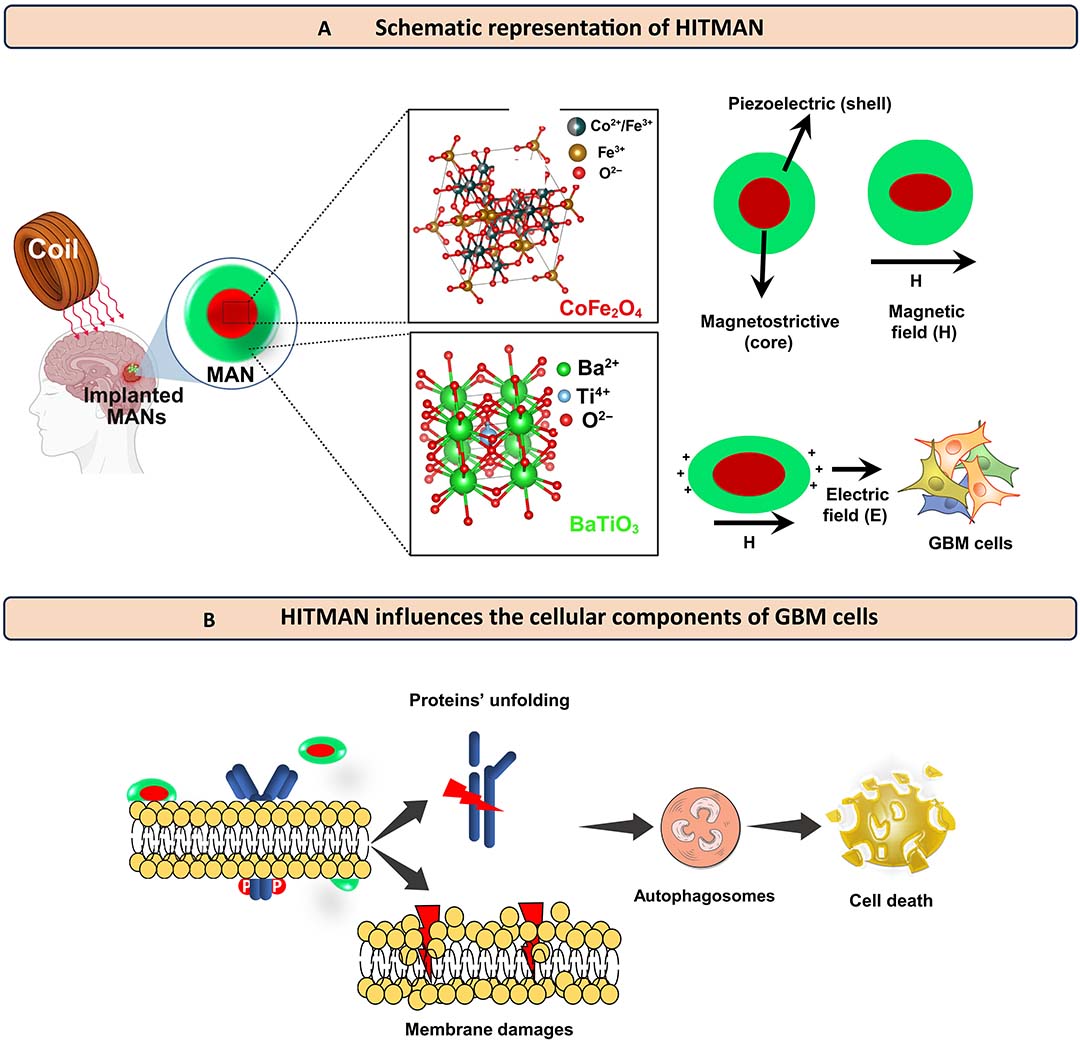
A figure depicts the magnetically actuated nanoantennas (MANs) and how the technology triggers cell death.

This figure depicts the magnetically actuated nanoantennas (MANs) and how the technology triggers cell death. [Figure courtesy of Monochura Saha, Science Advances]

Then, researchers implanted patient-derived tumor cells in mice to test the technology in vivo. HITMAN inhibited tumor growth and extended median survival in the mice by over 50%. The preclinical experiments showed no systemic toxicity or signs of inflammation, according to the university.

The researchers’ approach delivered therapeutic effects without generating heat or causing other mechanical or chemical effects, suggesting that HITMAN may affect gliomas as they undergo cell division.

The number of distinct cancer cell colonies also declined, from 112 and 150 in the control groups to 26, which the researchers said could translate into reduced tumor recurrence and metastasis.

Related: Mayo Clinic is using this device startup’s new system ‘like an induction cooktop’ to kill cancer

“Overall, the therapeutic potential of HITMAN, supported by its consistent efficacy in vitro, pronounced antitumor activity in preclinical models and mechanistic clarity, highlights its promise as a compelling candidate for further investigation in translational and clinical settings,” they wrote in a paper published in Science Advances.

While one therapeutic route would involve injecting the nanoantennas directly into the brain, members of the team developed a technology dubbed “circulatronics” that would allow them to be inserted into the bloodstream through the arm, while cloaking them from the body’s immune response and allowing them to pass through the blood-brain barrier.

MIT’s Media Lab and the Nano-Cybernetic Biotrek research group have also been developing comparatively larger injectable antennas, toward the goal of wirelessly powering implants located deep within tissue. Early research showed that designs using low-frequency magnetic fields could generate more power than metallic coils operating in the gigahertz range.
Tell Us What You Think! Cancel reply

You must be logged in to post a comment.

Related Articles Read More >

An image of VahatiCor's A-Flux implant.
Nitinol outsourcing made VahatiCor’s new cardiac implant possible
A photo of Conexeu Sciences co-founder and Chief Scientific Officer Dr. Claudia Chavez-Munoz.
This tissue engineering scientist is bioprinting next-gen absorbable implants
An image of the September 2026 Medical Design & Outsourcing magazine featuring the Medtech Big 100 ranking of the world's largest medical device companies.
September 2026 issue: The MDO Medtech Big 100 breaks $500 billion
A photo of Petal Surgical co-founder and CEO Prash Chopra.
Petal Surgical CEO Prash Chopra offers advice for device developers
“mdo
EXPAND YOUR KNOWLEDGE AND STAY CONNECTED
Get the latest medical device business news, application and technology trends.

DeviceTalks Weekly

See More >

MDO Digital Edition

Digital Edition

Subscribe to Medical Design & Outsourcing. Bookmark, share and interact with the leading medical design engineering magazine today.

MEDTECH 100 INDEX

Medtech 100 logo
Market Summary > Current Price
The MedTech 100 is a financial index calculated using the BIG100 companies covered in Medical Design and Outsourcing.

New MedTech Resource

Medical Tubing

MassDevice

Mass Device

The Medical Device Business Journal. MassDevice is the leading medical device news business journal telling the stories of the devices that save lives.

Visit Website
MDO ad
Medical Design and Outsourcing
  • MassDevice
  • DeviceTalks
  • MedTech100 Index
  • Medical Tubing + Extrusion
  • Medical Design Sourcing
  • Drug Delivery Business News
  • Drug Discovery & Development
  • Pharmaceutical Processing World
  • R&D World
  • About Us/Contact
  • Advertise With Us
  • Subscribe to Print Magazine
  • Subscribe to our E-Newsletter
  • Listen to our Weekly Podcasts
  • Join our DeviceTalks Tuesdays Discussion

Copyright © 2026 Arrowfly, LLC. All Rights Reserved. The material on this site may not be reproduced, distributed, transmitted, cached or otherwise used, except with the prior written permission of Arrowfly LLC. Site Map | Privacy Policy | RSS

Search Medical Design & Outsourcing

  • Home
  • Medical Device Business
    • Mergers & Acquisitions
    • Financial
    • Regulatory
  • Applications
    • Cardiovascular
    • Devices
    • Imaging
    • Implantables
    • Medical Equipment
    • Orthopedic
    • Surgical
  • Technologies
    • Supplies and Components Index
    • Contract Manufacturing
    • Components
    • Electronics
    • Extrusions
    • Materials
    • Motion Control
    • Prototyping
    • Pumps
    • Tubing
  • MedTech Resources
    • Medtech Events in 2026
    • The 2025 Medtech Big 100
    • Medical Device Handbook
    • MedTech 100 Index
    • Subscribe to Print Magazine
    • DeviceTalks
    • Digital Editions
    • eBooks
    • Educational Assets
    • Manufacturer Search
    • Podcasts
    • Webinars / Digital Events
    • Whitepapers
    • Voices
    • Views
    • Video
  • 2026 Leadership
    • 2025 Winners
    • 2024 Winners
    • 2023 Winners
    • 2022 Winners
    • 2021 Winners
  • Women in Medtech
  • Advertise
  • Subscribe