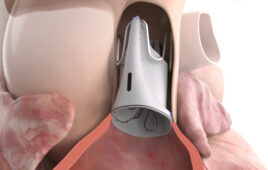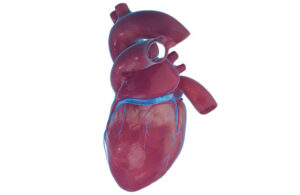
VahatiCor’s A-Flux is a small, hourglass-shaped, self-expanding nitinol implant placed in the coronary sinus. [Illustration courtesy of VahatiCor]
The investigational implant has an hourglass design with a tight nitinol mesh weave, developed with the company’s proprietary SwiftCell technology to treat patients with chest pain caused by coronary microvascular dysfunction (CMD).
“It’s a very elegant mechanical design to create a fluid dynamic state that solves a very complex disease problem,” Rowland said in a Medical Design & Outsourcing interview. “What really stands out is the self-expanded tighter mesh, which ultimately gives the physicians the potential for a smoother, easier, faster, more controlled procedure, and for patients the potential for a faster treatment effect for reducing chest pain.”
Previously from Rowland: After selling Endotronix to Edwards, this CEO sees an ‘eye-popping’ cardiac opportunity at VahatiCor
We asked Rowland to explain how VahatiCor developed A-Flux and how the company has leveraged partnerships within the nitinol supply chain and overcome technical challenges to turn the design into reality. The following has been lightly edited for length and clarity.
MDO: Where did the idea for A-Flux come from?
Rowland: “All credit to the VahatiCor founding team and the physician inventors. A lot of medtech is this intersection of curious, passionate physicians who are trying to solve a problem for patients, teaming up with engineers on how to build a device, working together and coming up with a brand new innovation. That’s the pathway that happened here with T45 Labs. Physicians around the Cleveland Clinic, who were trained at the Cleveland Clinic, met with [T45 Labs Founder and Managing Partner] Marwan Berrada-Sounni and [T45 Labs Chief Medical Officer] Dr. Rishi Puri. That mind mix of physician engineering expertise came up at the innovation several years ago, launched the company and created the product that has progressed to a really great spot today.”
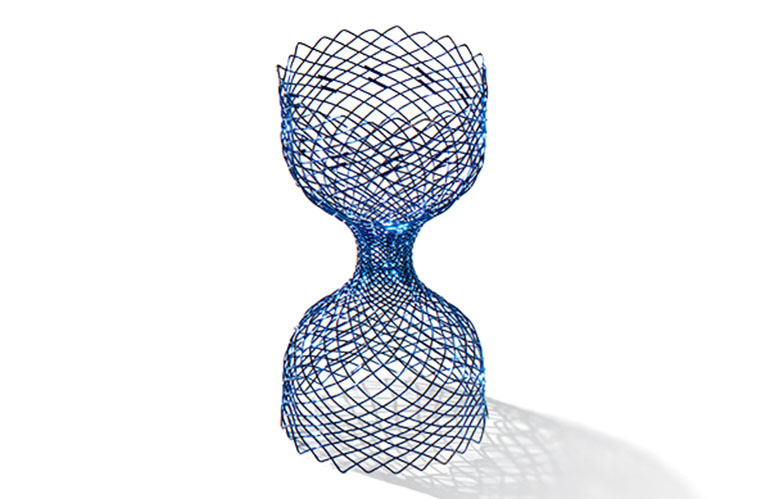
A-Flux’s hourglass design features a tight mesh weave at its narrow point made from VahatiCor’s proprietary SwiftCell technology. [Image courtesy of VahatiCor]
How did VahatiCor arrive at this design? Who’s involved in its manufacturing process?
Rowland: “MDO is great for being connected to the supply chain and the materials chain around medtech innovation. One thing I really like about A-Flux, coming from heart failure, is that it is an active, implantable medical device. [Medtech includes] software, cloud software, patient software, so many different things, but here it’s true, classic medtech. We have catheter-based technologies, body-contacting less than 24 hours. We follow guidewires in and steer catheters in, and go over that guidewire and deliver a nitinol implant that is biocompatible and durable, and it’s going to be tried and true and provide a long-term positive treatment effect for these patients.
“The supply chain around nitinol processing, manufacturing, passivation, as well as the catheter-based technologies, is really well established. The VahatiCor team has done an amazing job of working with vendors in that supply chain. Then people supporting that as well, whether it’s on the regulatory side or getting your simulation testing done for FDA packages to start clinical trials and work towards premarket (PMA) approval, the teams have done a great job leveraging that. We’re based in Silicon Valley, where a lot of these legendary technologies come out of. You go back to the FoxHollow days, like so much catheter-based innovation and nitinol-based innovation is in that hotbed, so VahatiCor has taken full advantage of that.”

VahatiCor CEO Harry Rowland joined the early-stage device developer in May 2026. [Photo courtesy of VahatiCor]
What was the biggest technical challenge in developing A-Flux and what was the solution?
Rowland: “Really speaking to it around the innovation of the SwiftCell technology. How do you do this in a self-expanding manner that’s going to be reliable across different anatomy that you’re going to face? How do you make it self-expanding, but when you’re collapsing the outer ends of the device to secure it in place, you’re not also collapsing the neck region? You need to keep that neck region small and reliably small, but still not so small that it collapses completely. The innovation around the mechanical design to make that happen and provide the potential for faster patient relief — that’s the core innovation behind the company.”