Medical Design and Outsourcing

  • Home
  • Medical Device Business
    • Mergers & Acquisitions
    • Financial
    • Regulatory
  • Applications
    • Cardiovascular
    • Devices
    • Imaging
    • Implantables
    • Medical Equipment
    • Orthopedic
    • Surgical
  • Technologies
    • Supplies and Components Index
    • Contract Manufacturing
    • Components
    • Electronics
    • Extrusions
    • Materials
    • Motion Control
    • Prototyping
    • Pumps
    • Tubing
  • MedTech Resources
    • Medtech Events in 2026
    • The 2025 Medtech Big 100
    • Medical Device Handbook
    • MedTech 100 Index
    • Subscribe to Print Magazine
    • DeviceTalks
    • Digital Editions
    • eBooks
    • Educational Assets
    • Manufacturer Search
    • Podcasts
    • Webinars / Digital Events
    • Whitepapers
    • Voices
    • Views
    • Video
  • 2026 Leadership
    • 2025 Winners
    • 2024 Winners
    • 2023 Winners
    • 2022 Winners
    • 2021 Winners
  • Women in Medtech
  • Advertise
  • Subscribe

Novel Approach To Cardiac Surgery

July 30, 2018 By Stanford University

Second-year medical student Kevin Cyr is part of a team of Stanford researchers investigating new ways to survey electricity in the heart. The research has led to the development of cardiac surgical devices that could one day help patients who suffer from a common heart ailment.

“I’m using 3D-printed tools to design cardiac-mapping catheters, devices used by surgeons to map the electrical activity of the heart and find disturbances,” says Cyr.
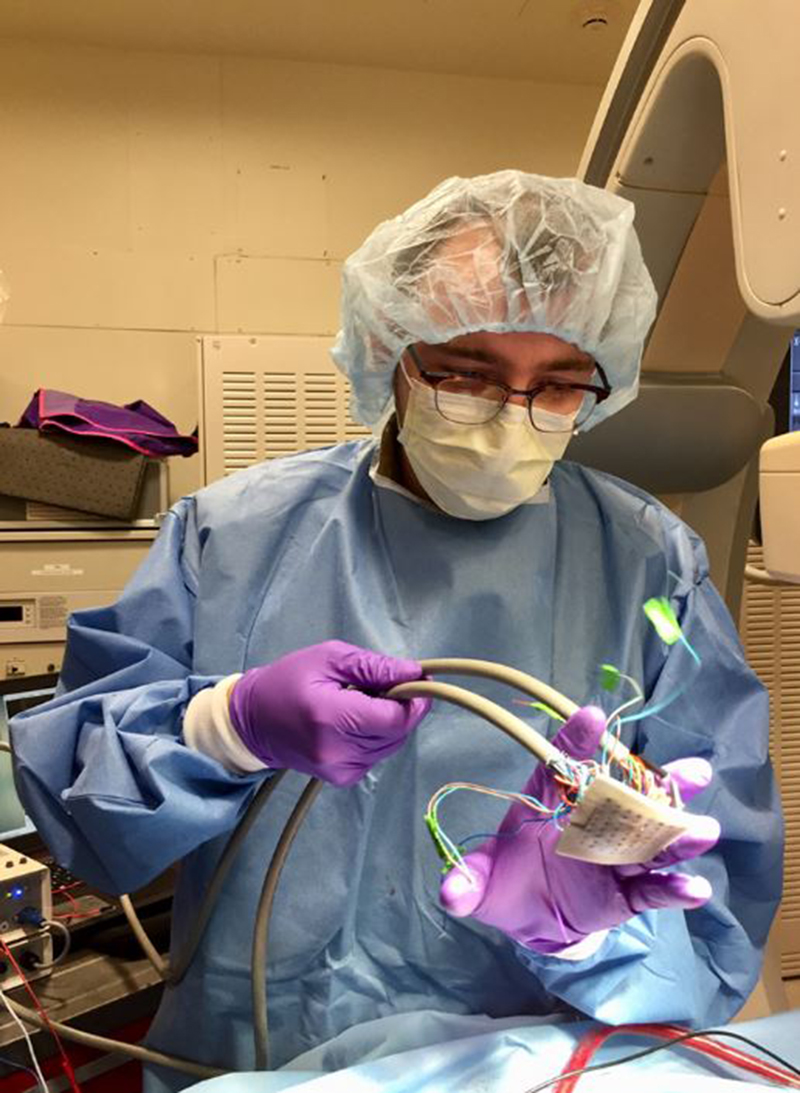
Cyr demonstrates how a surgeon uses the customized cardiac-mapping device in the operating room. Credit: Kevin Cyr

The research began a few years ago under the direction of Anson Lee, assistant professor of cardiothoracic surgery. Cyr, whose background is in bioengineering, joined the team last year as a student interested in developing new medical technologies that can transition from research to clinical practice.

Their investigation is focused on atrial fibrillation, or AFib, a heart disorder characterized by irregular and often rapid heartbeats that disrupt the flow of blood from the heart to the rest of the body. It is the most common rhythm disorder, which affects more than 6 million Americans and is responsible for over 750,000 hospitalizations every year. While some AFib patients have few, if any, problems, others suffer serious complications requiring surgery or medications.

Cyr says that finding and understanding rhythm disturbances in patients has been challenging because of the one-size-fits-all nature of existing medical devices, which use electrodes that contact the surface of the heart to measure electrical activity. So the researchers created devices that are customized to each patient, conforming to the unique contours and divots of the individual’s heart.
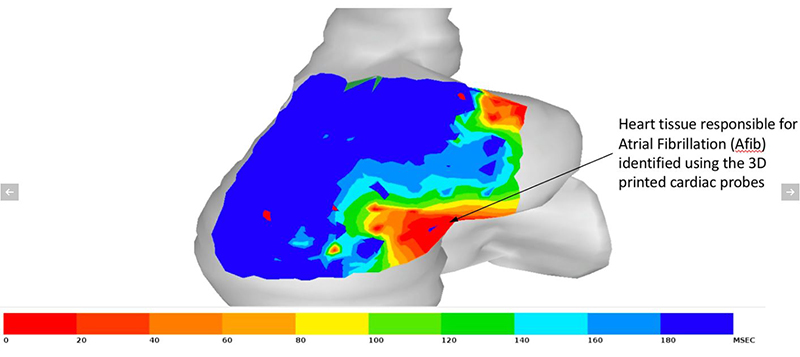
A heat map of the electrical activity of a heart projected onto a computer-simulated model of the right atrium. Credit: Kevin Cyr

To do this, patients undergo an MRI or CT scan that records an image file of their heart, which is then fed into a 3D printer. Cyr says that using the scan, “we can replicate that natural geometry and anatomy specific to that patient” and apply it to the device.

The device is a small, thin, flexible silicone membrane with tiny holes in a grid-like formation, each holding a tiny electrode. When placed on the surface of the heart’s atrium, the device can measure the electrical activity over that specific region of the heart. The data is transmitted to a computer, where it produces a recording that shows the electrical activity at that site. The recordings produce a heatmap of the electrical activity that physicians use to identify the regions of the heart that need treatment.

The customized device can track electrical activity with great precision, Cyr says. “We can map in perfect detail this rectangular grid of information and not have to worry about missing signals, poor contact or things like that, which otherwise might throw out errors.”

The devices are currently used on the epicardium, or exterior, layer of the heart.

The researchers are investigating whether their 3D-printed device could also be used to map the interior surface of the heart. If so, they believe it could provide much greater accuracy in measuring the rhythmic disturbance there as well.

The underlying goal of the research is to identify the problem spots where irregular electrical activity occurs and remove them to restore normal electrical flows.

Cyr says the researchers will likely take another year or two to refine their technology, which has not yet been tested on humans.
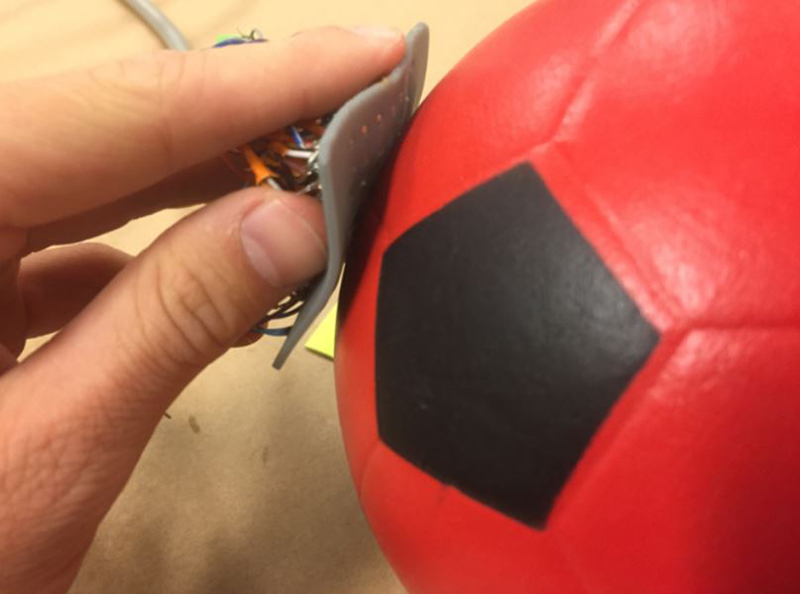
Using a soccer ball, Cyr demonstrates how the device conforms to the surface of a heart. Credit: Kevin Cyr

Related Articles Read More >

A photo of Medtronic VP of Global Contract Manufacturing Derek Minnock.
Medtronic has a new global contract manufacturing VP
An image of the September 2026 Medical Design & Outsourcing magazine featuring the Medtech Big 100 ranking of the world's largest medical device companies.
September 2026 issue: The MDO Medtech Big 100 breaks $500 billion
A photo of Capstan Medical CEO Maggie Nixon posing with the structural heart startup's robotic catheter delivery system.
Capstan Medical CEO Maggie Nixon’s career advice, travel tips and how she starts her day
The MDO Min-Vasive Medtech webinar series features medical device R&D experts from major OEMs and groundbreaking startups.
We’ve got a medtech legend, teleprocedures and autonomous robots for the 2026 MDO Min-Vasive Medtech webinar series
“mdo
EXPAND YOUR KNOWLEDGE AND STAY CONNECTED
Get the latest medical device business news, application and technology trends.

DeviceTalks Weekly

See More >

MDO Digital Edition

Digital Edition

Subscribe to Medical Design & Outsourcing. Bookmark, share and interact with the leading medical design engineering magazine today.

MEDTECH 100 INDEX

Medtech 100 logo
Market Summary > Current Price
The MedTech 100 is a financial index calculated using the BIG100 companies covered in Medical Design and Outsourcing.

New MedTech Resource

Medical Tubing

MassDevice

Mass Device

The Medical Device Business Journal. MassDevice is the leading medical device news business journal telling the stories of the devices that save lives.

Visit Website
MDO ad
Medical Design and Outsourcing
  • MassDevice
  • DeviceTalks
  • MedTech100 Index
  • Medical Tubing + Extrusion
  • Medical Design Sourcing
  • Drug Delivery Business News
  • Drug Discovery & Development
  • Pharmaceutical Processing World
  • R&D World
  • About Us/Contact
  • Advertise With Us
  • Subscribe to Print Magazine
  • Subscribe to our E-Newsletter
  • Listen to our Weekly Podcasts
  • Join our DeviceTalks Tuesdays Discussion

Copyright © 2026 Arrowfly, LLC. All Rights Reserved. The material on this site may not be reproduced, distributed, transmitted, cached or otherwise used, except with the prior written permission of Arrowfly LLC. Site Map | Privacy Policy | RSS

Search Medical Design & Outsourcing

  • Home
  • Medical Device Business
    • Mergers & Acquisitions
    • Financial
    • Regulatory
  • Applications
    • Cardiovascular
    • Devices
    • Imaging
    • Implantables
    • Medical Equipment
    • Orthopedic
    • Surgical
  • Technologies
    • Supplies and Components Index
    • Contract Manufacturing
    • Components
    • Electronics
    • Extrusions
    • Materials
    • Motion Control
    • Prototyping
    • Pumps
    • Tubing
  • MedTech Resources
    • Medtech Events in 2026
    • The 2025 Medtech Big 100
    • Medical Device Handbook
    • MedTech 100 Index
    • Subscribe to Print Magazine
    • DeviceTalks
    • Digital Editions
    • eBooks
    • Educational Assets
    • Manufacturer Search
    • Podcasts
    • Webinars / Digital Events
    • Whitepapers
    • Voices
    • Views
    • Video
  • 2026 Leadership
    • 2025 Winners
    • 2024 Winners
    • 2023 Winners
    • 2022 Winners
    • 2021 Winners
  • Women in Medtech
  • Advertise
  • Subscribe