Medical Design and Outsourcing

  • Home
  • Medical Device Business
    • Mergers & Acquisitions
    • Financial
    • Regulatory
  • Applications
    • Cardiovascular
    • Devices
    • Imaging
    • Implantables
    • Medical Equipment
    • Orthopedic
    • Surgical
  • Technologies
    • Supplies and Components Index
    • Contract Manufacturing
    • Components
    • Electronics
    • Extrusions
    • Materials
    • Motion Control
    • Prototyping
    • Pumps
    • Tubing
  • MedTech Resources
    • Medtech Events in 2026
    • The 2026 Medtech Big 100
    • Medical Device Handbook
    • MedTech 100 Index
    • Subscribe to Print Magazine
    • DeviceTalks
    • Digital Editions
    • eBooks
    • Educational Assets
    • Manufacturer Search
    • Podcasts
    • Webinars / Digital Events
    • Whitepapers
    • Voices
    • Views
    • Video
  • 2026 Leadership
    • 2025 Winners
    • 2024 Winners
    • 2023 Winners
    • 2022 Winners
    • 2021 Winners
  • Women in Medtech
  • Advertise
  • Subscribe

Surgical robots don’t improve knee surgery revision rates, study says

February 16, 2024 By Chris Newmarker

This is a Pixabay illustration of knee inflamation to go with stories about knee surgery.

[Image from Pixabay]

Robotically assisted total knee arthroplasty has skyrocketed in popularity, but a new registry data analysis raises some questions about the benefits for knee surgery patients.

The analysis of American Joint Replacement Registry (AJRR) data, presented at AAOS 2024 in San Francisco, found that revision rates were similar in conventional and robotic-assisted cementless TKA at two years post-operatively. The study also found that the odds of revision due to infection or mechanical loosening were not significantly different between the two methods.

“A lot of single surgeon studies show there is improved precision with robotic-assisted TKA,” Dr. Lucas Nikkel, assistant professor of orthopedic surgery at Johns Hopkins Medicine, said in a news release about the study. “Some studies suggest there may be improved early recovery or less damage to soft tissue. One of the challenges with evaluating this is that many previous studies had significant financial conflicts of interest with the authors. We wanted to evaluate these questions using a registry study to eliminate the potential confounding factors to understand if there is a difference when this technology is applied to a surgery.”

Studying the results of robotic knee surgery matters as the field becomes a big business. Ortho device giant Stryker has been grabbing market share amid the rising popularity of its Mako robots. Stryker ended 2023 with 60% of its knee replacement procedures and 34% of its hip replacements in the U.S. performed using the robotic system. The percentages were 40% of knees and nearly 20% of hips worldwide. In recent years, competitors including Johnson & Johnson’s DePuy Synthes business, Zimmer Biomet, and Smith+Nephew have entered the market with their own robotic systems.

The researchers acknowledged some limitations to the new knee surgery study. National registries such as AJRR rely on the accuracy of data submitted. About 60% of the TKAs on the AJRR register did not report whether or not robotic assistance was used. In addition, the study did not include younger patients.

An AAOS spokesperson said the research has not been to a peer-reviewed journal yet, but will be at some point in the future.

The new study identified 9,220 cementless TKAs, nearly half of which were performed with robotic assistance. The results — which used a multivariable, mixed-effects logistic regression model with controlling for cofounders — included:

  • The odds of all-cause revision at two years following surgery were similar between the conventional and robotic-assisted cohorts (odds ratio 0.8, 95% CI .05 to 1.3; p=0.4).
  • The odds of revision due to infection were similar between the two groups (OR 1.47 95% CI 0.8 to 2.6; p=0.19).
  • Mechanical loosing was not significantly different between the cohorts (OR 3.2, 95% CI 0.8-12; p=0.09).

“Utilizing patients over age 65, we expected them to have higher failure rates as the potential for biologic fixation may be slightly lower,” Nikkel said. “We found there was no significant differences in the risk of needing another operation within the first two years after surgery with a robotic-assisted or manual technique. This is significant in this population as the likelihood of an early failure is pretty much the same whether robotic assistance is used or not. Some patients desire a robotic-assisted TKA because they’ve heard it is better, but we’ve shown that there isn’t a true benefit in terms of the likelihood of needing another surgery in the early period.”


About The Author

Avatar photo
Chris Newmarker

Chris Newmarker is the executive editor of WTWH Media life science's news websites and publications including MassDevice, Medical Design & Outsourcing and more. A professional journalist of 18 years, he is a veteran of UBM (now Informa) and The Associated Press whose career has taken him from Ohio to Virginia, New Jersey and, most recently, Minnesota. He’s covered a wide variety of subjects, but his focus over the past decade has been business and technology. He holds bachelor’s degrees in journalism and political science from Ohio State University. Connect with him on LinkedIn or email at [email protected].

Related Articles Read More >

Reconstructed 3D fluorescence image of the stained biohybrid mesh-tissue integration. The red, green, and blue colors correspond to the mesh, F-actin, and nuclei, respectively.
Researchers mesh electronics with human cells to develop living battery
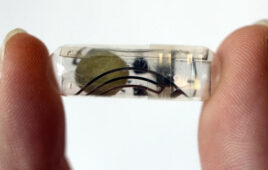
The 1.84 volt paper battery (brown circle structure) was tested in pigs with a bioabsorbable radio-frequency identification (RFID) device.
MIT researchers develop bioresorbable batteries for ingestible medical devices
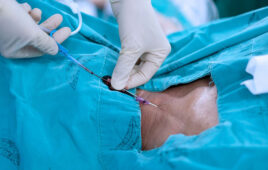
A clinician guides a needle and wire into the side of a patient's neck during a central venous catheter insertion.
New campaign targets fibrin sheath CVC complication
An illustration of HITMAN operating in glioblastoma cells.
MIT researchers develop injectable nanodevices that remotely kill brain tumor cells
“mdo
EXPAND YOUR KNOWLEDGE AND STAY CONNECTED
Get the latest medical device business news, application and technology trends.

DeviceTalks Weekly

See More >

MDO Digital Edition

Digital Edition

Subscribe to Medical Design & Outsourcing. Bookmark, share and interact with the leading medical design engineering magazine today.

MEDTECH 100 INDEX

Medtech 100 logo
Market Summary > Current Price
The MedTech 100 is a financial index calculated using the BIG100 companies covered in Medical Design and Outsourcing.

New MedTech Resource

Medical Tubing

MassDevice

Mass Device

The Medical Device Business Journal. MassDevice is the leading medical device news business journal telling the stories of the devices that save lives.

Visit Website
MDO ad
Medical Design and Outsourcing
  • MassDevice
  • DeviceTalks
  • MedTech100 Index
  • Medical Tubing + Extrusion
  • Medical Design Sourcing
  • Drug Delivery Business News
  • Drug Discovery & Development
  • Pharmaceutical Processing World
  • R&D World
  • About Us/Contact
  • Advertise With Us
  • Subscribe to Print Magazine
  • Subscribe to our E-Newsletter
  • Listen to our Weekly Podcasts
  • Join our DeviceTalks Tuesdays Discussion

Copyright © 2026 Arrowfly, LLC. All Rights Reserved. The material on this site may not be reproduced, distributed, transmitted, cached or otherwise used, except with the prior written permission of Arrowfly LLC. Site Map | Privacy Policy | RSS

Search Medical Design & Outsourcing

  • Home
  • Medical Device Business
    • Mergers & Acquisitions
    • Financial
    • Regulatory
  • Applications
    • Cardiovascular
    • Devices
    • Imaging
    • Implantables
    • Medical Equipment
    • Orthopedic
    • Surgical
  • Technologies
    • Supplies and Components Index
    • Contract Manufacturing
    • Components
    • Electronics
    • Extrusions
    • Materials
    • Motion Control
    • Prototyping
    • Pumps
    • Tubing
  • MedTech Resources
    • Medtech Events in 2026
    • The 2026 Medtech Big 100
    • Medical Device Handbook
    • MedTech 100 Index
    • Subscribe to Print Magazine
    • DeviceTalks
    • Digital Editions
    • eBooks
    • Educational Assets
    • Manufacturer Search
    • Podcasts
    • Webinars / Digital Events
    • Whitepapers
    • Voices
    • Views
    • Video
  • 2026 Leadership
    • 2025 Winners
    • 2024 Winners
    • 2023 Winners
    • 2022 Winners
    • 2021 Winners
  • Women in Medtech
  • Advertise
  • Subscribe