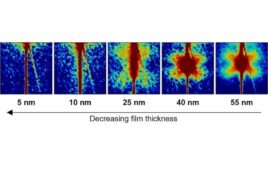
MIT engineers have designed diagnostic particles that can be aerosolized and inhaled. At bottom is a scanning electron micrograph of the particles, which are coated with nanosensors that interact with cancer-associated proteins in the lungs. [Image courtesy of MIT]
If the sensors encounter cancer-linked proteins in the lungs, they produce a signal that accumulates in urine. Patients can then take a urine test with a simple paper test strip and it reveals the potential presence of a tumor.
The researchers say the approach could potentially replace or supplement the low-dose computed tomography (CT) imaging currently used as the gold standard for diagnosing lung cancer. Particularly, according to MIT, it could help low- and middle-income countries that lack widespread CT scanner availability.
Sangeeta Bhatia served as senior author of a paper appearing this month in Science Advances outlining the approach. Bhatia serves as the John and Dorothy Wilson Professor of Health Sciences and Technology and of Electrical Engineering and Computer Science at MIT. Qian Zhong, an MIT research scientist, and Edward Tan, a former MIT postdoc, serve as the lead authors of the study.
“Around the world, cancer is going to become more and more prevalent in low- and middle-income countries. The epidemiology of lung cancer globally is that it’s driven by pollution and smoking, so we know that those are settings where accessibility to this kind of technology could have a big impact,” Bhatia said in a post on MIT’s website.
About the inhalable particles
According to MIT, Bhatia spent the last decade developing nanosensors for use in diagnosing cancer and other diseases. She and her colleagues used this study to explore the potential of these nanosensors as an alternative to CT scanning for lung cancer.
The researchers designed the sensors from polymer nanoparticles coated with a reporter, such as a DNA barcode. This reporter is cleaved from the particle when the sensor encounters enzymes called proteases, which are often overactive in tumors, MIT says. The reporters eventually accumulate in urine excreted from the body.
MIT says previous versions of the sensors targeted cancer sites such as the liver and overies with an intravenous delivery. Inhalable versions could help with lung cancer in lower resource settings, though. So, the researchers created two formulations of the particles — an aerosolized solution for nebulizer delivery and a dry powder option for inhalers.
Once the particles reach the lungs, they are absorbed into the tissue and encounter any potentially present proteases. Cancerous proteases cleave DNA barcodes from the sensors, allowing the barcodes to circulate in the bloodstream until excreted in urine.
Earlier versions used mas spectrometry to analyze the urine sample. However, equipment for that method may not be available in low-resource areas. Because of this, the team created a lateral flow assay, allowing for detection on a paper test strip. They designed the strip to detect up to four different DNA barcodes. The urine sample requires no pre-treatment or processing and results can come in about 20 minutes.
“We were really pushing this assay to be point-of-care available in a low-resource setting, so the idea was to not do any sample processing, not do any amplification, just to be able to put the sample right on the paper and read it out in 20 minutes,” Bhatia says.
Accuracy remains key
The team tested the system in mice genetically engineered to develop lung tumors similar to those seen in humans. They administered sensors 7.5 weeks after tumors began to form. This would likely correlate with stage 1 or 2 cancer in humans.
In the first set of experiments in mice, the researchers measured the levels of 20 different sensors for detecting different proteases. Using machine learning to analyze results, they identified a combination of four sensors predicted to give accurate results. They then tested that combination in the mouse model and found that it could accurately detect early-stage lung tumors.
According to MIT, human use may require more sensors for an accurate diagnosis. However, they see potential in using multiple paper strips, with each detecting four different DNA barcodes.
Now, the team plans to analyze human biopsy samples to see if the sensor panels would also detect human cancers. Further down the road, they hope for in-human clinical trials. The team said a company called Sunbird Bio already ran Phase I trials on a similar sensor developed by Bhatia’s lab for use in diagnosing liver cancer and a form of hepatitis known as nonalcoholic steatohepatitis (NASH).
Bhatia’s team believes this could offer a dramatic improvement in lung cancer screening in parts of the world with limited CT access, given that results are obtained in a single visit.
“The idea would be you come in and then you get an answer about whether you need a follow-up test or not, and we could get patients who have early lesions into the system so that they could get curative surgery or lifesaving medicines,” Bhatia says.