Medical Design and Outsourcing

  • Home
  • Medical Device Business
    • Mergers & Acquisitions
    • Financial
    • Regulatory
  • Applications
    • Cardiovascular
    • Devices
    • Imaging
    • Implantables
    • Medical Equipment
    • Orthopedic
    • Surgical
  • Technologies
    • Supplies and Components Index
    • Contract Manufacturing
    • Components
    • Electronics
    • Extrusions
    • Materials
    • Motion Control
    • Prototyping
    • Pumps
    • Tubing
  • MedTech Resources
    • Medtech Events in 2026
    • The 2025 Medtech Big 100
    • Medical Device Handbook
    • MedTech 100 Index
    • Subscribe to Print Magazine
    • DeviceTalks
    • Digital Editions
    • eBooks
    • Educational Assets
    • Manufacturer Search
    • Podcasts
    • Webinars / Digital Events
    • Whitepapers
    • Voices
    • Views
    • Video
  • 2026 Leadership
    • 2025 Winners
    • 2024 Winners
    • 2023 Winners
    • 2022 Winners
    • 2021 Winners
  • Women in Medtech
  • Advertise
  • Subscribe

A Better Way to Measure the Stiffness of Cancer Cells

March 1, 2017 By Duke University

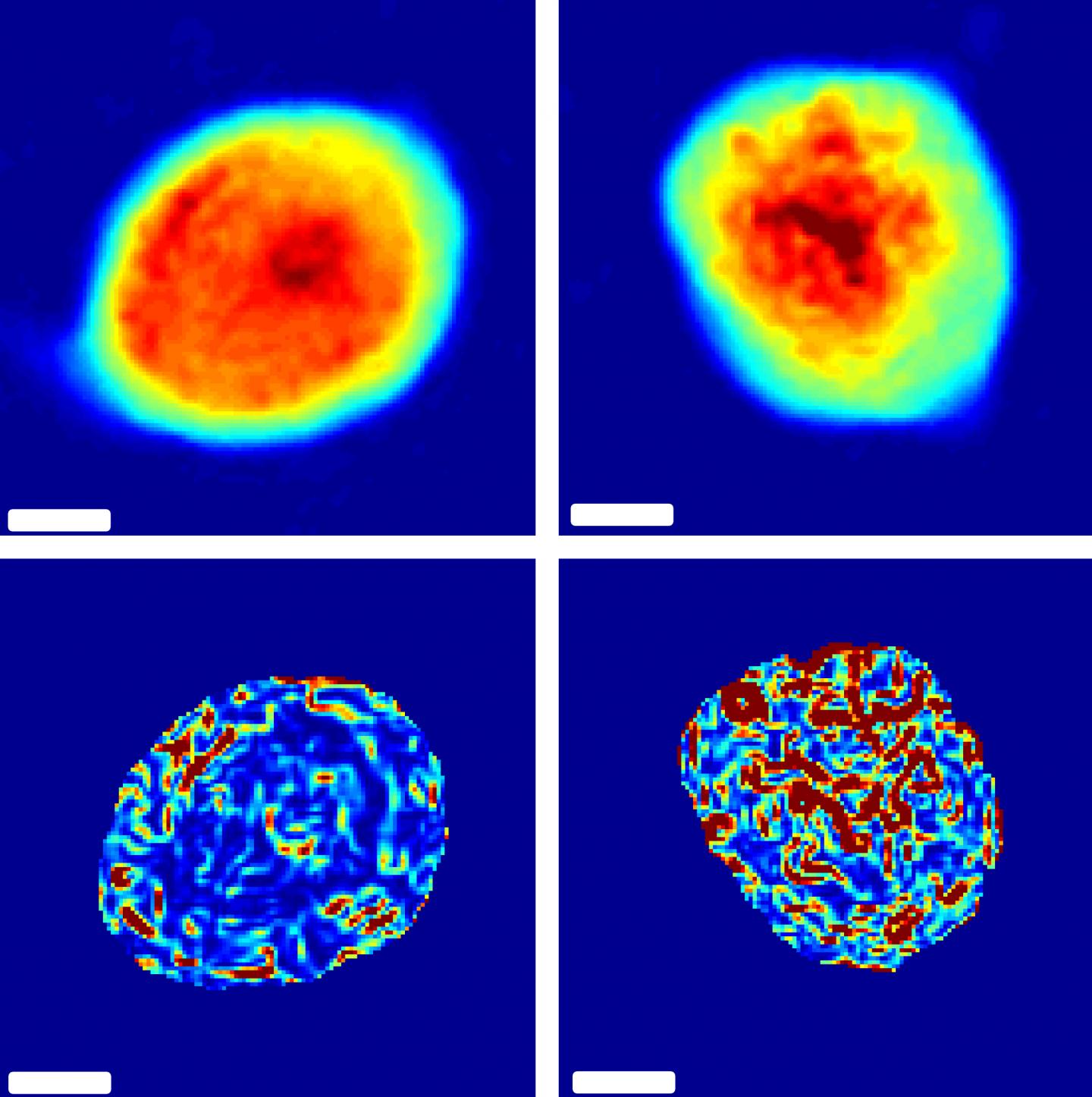
Images of cells are analyzed to calculate the level of disorder in their internal structures. The more orderly the cell, the stiffer it may be, possibly indicating cancer. (Credit: Adam Wax, Duke University)

Biomedical engineers at Duke University have discovered a way to detect signs of cancer on a cell-by-cell basis using two lasers and a camera.

Several medical devices currently in use and in clinical trials around the world look for increases in cellular stiffness as an indicator of cancerous tissue.

These devices, however, rely on readings from many cells clustered together within the body and cannot operate on a cellular level.

In a study published online Feb. 28 in the Biophysical Journal, researchers describe a technique for assessing an individual cell’s stiffness using patterns that appear within its internal structure. The results show that the more organized its innards, the stiffer the cell.

In previous work, Adam Wax, professor of biomedical engineering at Duke, showed that a cell’s internal structures shift as fluids flow around its exterior.

“Think of a cell as a large Jell-O mold with a lot of fruit suspended in it,” says Wax. “If you blow on it really hard with compressed air, everything is going to move in the direction of the air a little bit.”

Wax also showed that he could calculate cellular stiffness by measuring the amount of that shift. This discovery had many advantages over traditional methods of measuring the rigidity of a single cell. For example, no physical contact with the cell was required and measurements took much less time.

“Traditional approaches like atomic force microscopy take all day just to prepare a single sample,” says Will Eldridge, a PhD student in Wax’s lab and first author of the paper. “Using a moving liquid to measure shear flow only takes 30 to 40 minutes to image a group of cells.”

Still not satisfied with that timetable, Wax and Eldridge tried to find a visual metric that could do the same job in less time. In the new paper, they show that the amount of disorder found within a cell’s internal structures directly correlates to its stiffness.

To measure cellular disorder, the researchers shine a laser through a cell and compare it to a second, unobstructed beam. The differences in the amount of time it takes for the two lasers to travel through the sample are then analyzed to produce a picture, revealing just how disordered the cell’s internal structures are.

To prove their idea worked, the group measured these “phase disorders” in five different types of live cancer cells just before measuring their stiffness using the already proven “Jell-O mold” technique. As hoped, the two metrics were highly correlated.

“The speed of this technique is only limited by the size of your camera’s field of view,” says Eldridge. “You could potentially measure hundreds of individual cells in a matter of seconds.”

More work is needed to determine the exact relationship between the two measurements, but Wax is hopeful that the technique could be translated into a new biomedical device for cancer screening.

“It’s widely known that cellular stiffness is an indicator of cancer, but there’s no viable diagnostic tool that can use that knowledge on a cellular scale,” says Wax. “With this technique, I can see a path to creating a high-throughput system that could quickly and easily screen for cervical, esophageal or colon cancer — anywhere you could take a tissue scraping.”
Related Articles Read More >

A photo of Conexeu Sciences co-founder and Chief Scientific Officer Dr. Claudia Chavez-Munoz.
This tissue engineering scientist is bioprinting next-gen absorbable implants
An image of the September 2026 Medical Design & Outsourcing magazine featuring the Medtech Big 100 ranking of the world's largest medical device companies.
September 2026 issue: The MDO Medtech Big 100 breaks $500 billion
A photo of Capstan Medical CEO Maggie Nixon posing with the structural heart startup's robotic catheter delivery system.
Capstan Medical CEO Maggie Nixon’s career advice, travel tips and how she starts her day
The MDO Min-Vasive Medtech webinar series features medical device R&D experts from major OEMs and groundbreaking startups.
We’ve got a medtech legend, teleprocedures and autonomous robots for the 2026 MDO Min-Vasive Medtech webinar series
“mdo
EXPAND YOUR KNOWLEDGE AND STAY CONNECTED
Get the latest medical device business news, application and technology trends.

DeviceTalks Weekly

See More >

MDO Digital Edition

Digital Edition

Subscribe to Medical Design & Outsourcing. Bookmark, share and interact with the leading medical design engineering magazine today.

MEDTECH 100 INDEX

Medtech 100 logo
Market Summary > Current Price
The MedTech 100 is a financial index calculated using the BIG100 companies covered in Medical Design and Outsourcing.

New MedTech Resource

Medical Tubing

MassDevice

Mass Device

The Medical Device Business Journal. MassDevice is the leading medical device news business journal telling the stories of the devices that save lives.

Visit Website
MDO ad
Medical Design and Outsourcing
  • MassDevice
  • DeviceTalks
  • MedTech100 Index
  • Medical Tubing + Extrusion
  • Medical Design Sourcing
  • Drug Delivery Business News
  • Drug Discovery & Development
  • Pharmaceutical Processing World
  • R&D World
  • About Us/Contact
  • Advertise With Us
  • Subscribe to Print Magazine
  • Subscribe to our E-Newsletter
  • Listen to our Weekly Podcasts
  • Join our DeviceTalks Tuesdays Discussion

Copyright © 2026 Arrowfly, LLC. All Rights Reserved. The material on this site may not be reproduced, distributed, transmitted, cached or otherwise used, except with the prior written permission of Arrowfly LLC. Site Map | Privacy Policy | RSS

Search Medical Design & Outsourcing

  • Home
  • Medical Device Business
    • Mergers & Acquisitions
    • Financial
    • Regulatory
  • Applications
    • Cardiovascular
    • Devices
    • Imaging
    • Implantables
    • Medical Equipment
    • Orthopedic
    • Surgical
  • Technologies
    • Supplies and Components Index
    • Contract Manufacturing
    • Components
    • Electronics
    • Extrusions
    • Materials
    • Motion Control
    • Prototyping
    • Pumps
    • Tubing
  • MedTech Resources
    • Medtech Events in 2026
    • The 2025 Medtech Big 100
    • Medical Device Handbook
    • MedTech 100 Index
    • Subscribe to Print Magazine
    • DeviceTalks
    • Digital Editions
    • eBooks
    • Educational Assets
    • Manufacturer Search
    • Podcasts
    • Webinars / Digital Events
    • Whitepapers
    • Voices
    • Views
    • Video
  • 2026 Leadership
    • 2025 Winners
    • 2024 Winners
    • 2023 Winners
    • 2022 Winners
    • 2021 Winners
  • Women in Medtech
  • Advertise
  • Subscribe