Medical Design and Outsourcing

  • Home
  • Medical Device Business
    • Mergers & Acquisitions
    • Financial
    • Regulatory
  • Applications
    • Cardiovascular
    • Devices
    • Imaging
    • Implantables
    • Medical Equipment
    • Orthopedic
    • Surgical
  • Technologies
    • Supplies and Components Index
    • Contract Manufacturing
    • Components
    • Electronics
    • Extrusions
    • Materials
    • Motion Control
    • Prototyping
    • Pumps
    • Tubing
  • MedTech Resources
    • Medtech Events in 2026
    • The 2026 Medtech Big 100
    • Medical Device Handbook
    • MedTech 100 Index
    • Subscribe to Print Magazine
    • DeviceTalks
    • Digital Editions
    • eBooks
    • Educational Assets
    • Manufacturer Search
    • Podcasts
    • Webinars / Digital Events
    • Whitepapers
    • Voices
    • Views
    • Video
  • 2026 Leadership
    • 2025 Winners
    • 2024 Winners
    • 2023 Winners
    • 2022 Winners
    • 2021 Winners
  • Women in Medtech
  • Advertise
  • Subscribe

How Orthobond’s antimicrobial coating prevents contamination of medical devices

April 8, 2024 By Jim Hammerand

A scanning electron microscope image showing methicillin-sensitive Staphylococcus aureus (MSSA) bacteria being killed by Orthobond's Ostaguard antimicrobial coating.

This scanning electron microscope image shows Orthobond’s Ostaguard antimicrobial coating killing methicillin-sensitive Staphylococcus aureus (MSSA) bacteria. [Image courtesy of Orthobond]

A new antimicrobial coating could go a long way in keeping medical devices free of infection-causing microbes after winning FDA de novo approval for its first indications.

Device developer Orthobond says its proprietary Ostaguard antimicrobial coating offers a new defense against bacteria, viruses and fungi that could contaminate the surface of an implantable device before it’s placed inside a patient.

The first FDA approval was for Ostaguard-coated pedicle screws used in spinal fusions, followed by FDA de novo approval for an Ostaguard-coated oncology device from Onkos Surgical. Orthobond said it has other devices treated with the technology in various stages of the regulatory process.

Orthobond CEO David Nichols said the technology could eventually be used on a much wider range of orthopedic, oncology, neurovascular, plastic surgery and cardiac devices, or anywhere else infections are a concern.

In an exclusive interview with Medical Design & Outsourcing, Nichols — a former Zimmer Biomet executive — explained how Orthobond’s Ostaguard antimicrobial coating works and how other device developers might be able to take advantage.

A portrait of Orthobond CEO David Nichols.

Orthobond CEO David Nichols [Photo courtesy of Orthobond]

Now that it has FDA approval, Orthobond plans to scale up manufacturing to meet demand and to submit a master file with the FDA to accelerate regulatory review for other device developers who want to use the technology on their products.

How Orthobond’s Ostaguard antimicrobial coating prevents contamination

Orthobond was founded by Princeton University Chemistry Professor Emeritus Jeffrey Schwartz and the late Dr. Gregory Lutz. Schwartz was trying to use the ability to bond to the oxide layer for automotive tires and saw an opportunity for osteoconductivity.

While that application didn’t outperform existing options, their research yielded an incredibly strong covalent bond that could prevent quaternary ammonium molecules (also called quats) from eluting into a patient’s body.

Orthobond covalently bonds its antimicrobial, polycationic molecules to the surface of an implant before packaging and sterilization.

It’s a wet chemistry process in which a medical device such as a hip, knee or screw is dunked in a chemical bath and then heated in an oven. That bonds a phosphonic acid layer only 4 or 5 nanometers thick to the oxide on the surface of the implant. Then an approximately four-hour polymerization process attaches quaternary ammonium molecules with densely packed, positively charged nitrogen at the end of the chain.

[Image courtesy of Orthobond]

The resulting layer of positively charged, quaternary ammonium molecules on an implant’s surface measures only one-millionth of an inch and immobilizes, perforates and destablizes microbes.

“It’s like flypaper because bacteria is negatively charged and our surface is positively charged,” Nichols said. “It actually draws them to our surface, puts little pin pricks in the bacteria and starts the death process. As they try to move around, it breaks them apart and kills them.”

FDA records describe the coating as a 12-methacryloyloxydodecyl pyridinium bromide (C21H34BrNO2) compound.

An infographic showing how Orthobond Ostaguard antimicrobial coating works.

[Image courtesy of Orthobond]

Because the technology neutralizes microbes mechanically, it even works on antibiotic-resistant bacteria like the Mu50 strain of methicillin-resistant Staphylococcus aureus (MRSA), which has evolved efflux pumps to remove antibiotics from its cells and render them ineffective.

“Our surface will kill that,” Nichols said.

The Ostaguard antimicrobial coating kills common infection-causing microbes such as Staphylococcus aureus, Pseudomonas aeruginosa, E. coli, methicillin-resistant Staphylococcus aureus (MRSA), E. cloacae and C. acnes.

The coating technology has not been evaluated in human clinical trials, but Orthobond said it found no evidence of local or systemic toxicity in sheep, guinea pig and canine testing.

Antimicrobial coating know-how for device designer and engineers
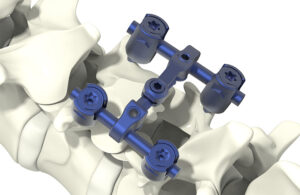
An image of SeaSpine Mariner pedicle screws coated with Orthobond's Ostaguard antimicrobial technology.

Orthobond won FDA de novo approval for its Ostaguard antimicrobial coating on SeaSpine Mariner pedicle screws. [Image courtesy of Orthobond]

The company plans to keep the technology inside its facility to maintain proprietary control instead of licensing it for device manufacturers to use on their own production lines. The process currently takes two or three days before the treated products are packed, sterilized and sent back to the manufacturer (or shipped directly to the manufacturer’s packaging and sterilization provider).

“It adds a step in the supply chain, but most of that’s outsourced anyway,” Nichols said. “You can imagine a major medical devicemaker would manufacture it, clean it, ship it to be treated, and then it goes to sterile packaging from there.”

Applications for the antimicrobial coating permanent include all sorts of implants, but also catheters, surgical instruments, and dialysis machines.

The coating is compatible with all medtech metals, including cobalt chrome, stainless steel, titanium. Orthobond has also experimented with the coating process for different materials, such as a product with silicone epoxy that required a lower temperature, and a spray method for electronics that can’t be dipped in a fluid bath.

“Anything with an oxide layer’s easy: titanium oxide, chromium oxide,” Nichols said. “For the epoxy, we had to put an oxide layer on, so we put a layer of zirconium oxide on and then we put our chemistry on, so we’ve figured out the epoxy and the silicone.”

Teflon — like you’d find on some heart valves, for instance — is still a challenge, “but my chemists love that,” he said. “They say they can do it, but we have not done that yet.”

Nichols said the Ostaguard antimicrobial coating “holds up really well to gamma” sterilization, but applying the coating to devices sterilized with ethylene oxide or steam requires some fine-tuning.
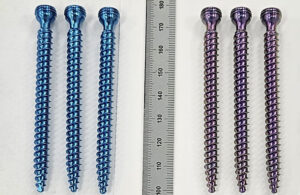
An image showing pedicle screws before and after being coated with Orthobond's Ostaguard antimicrobial technology.

Pedicle screws before (left) and after (right) being coated with Orthobond’s Ostaguard antimicrobial technology. [Photo courtesy of Orthobond]

Regulatory strategy is probably the biggest consideration for device engineers and designers who might want to use the antimicrobial coating, Nichols said. Using breast implants as an example, he said a devicemaker might want to start with a Class II breast tissue expander because the regulatory pathway would be easier than Class III breast implants.

Nichols said one area for improvement is application efficiency. Coating permanent implantables with a fluid bath results in a lot of waste, but the cost is insignificant if you’re using it for an artificial hip or knee joint. Orthobond will work to reduce the cost of application to make it a better fit for temporarily placed devices like catheters or reusable instruments.

“We’ve got to bring the price down probably tenfold, but it will work,” Nichols said.

Related: What are ethylene oxide alternatives for medical device sterilization?

This post was originally published on April 8, 2024, and updated on April 9 to include FDA de novo approval of the Onkos Surgical device.

About The Author

Jim Hammerand

Jim Hammerand is the managing editor of Arrowfly's Medical Design & Outsourcing, where he leads coverage of medtech innovation, design, engineering and manufacturing. He also reports breaking news at Arrowfly's MassDevice and contributes to our DeviceTalks podcasts and live events. Hammerand has more than two decades of journalism experience spanning newspapers, magazines, websites, live events, radio and TV news. For nearly a decade, Hammerand reported and edited business news for American City Business Journals as a reporter and digital editor at the Minneapolis/St. Paul Business Journal and then as managing editor of the Puget Sound Business Journal in Seattle. He holds degrees in journalism and management from the University of Minnesota and has won journalism awards from the Society of Professional Journalists, American Society of Business Publication Editors, and Trade, Association, Business Publications International. Connect with him on LinkedIn or by email at [email protected].

Related Articles Read More >

A photo of PTFE coating delamination.
Passing the tape test doesn’t mean your coating is reliable
An illustration showing Corcym's Memo 4D Curve's laser-cut nitinol core.
Laser-cut nitinol and a layered design let these cardiac implants flex
A clinician guides a needle and wire into the side of a patient's neck during a central venous catheter insertion.
New campaign targets fibrin sheath CVC complication
Smart Reactors names Backer McKenzie VP of business development
“mdo
EXPAND YOUR KNOWLEDGE AND STAY CONNECTED
Get the latest medical device business news, application and technology trends.

DeviceTalks Weekly

See More >

MDO Digital Edition

Digital Edition

Subscribe to Medical Design & Outsourcing. Bookmark, share and interact with the leading medical design engineering magazine today.

MEDTECH 100 INDEX

Medtech 100 logo
Market Summary > Current Price
The MedTech 100 is a financial index calculated using the BIG100 companies covered in Medical Design and Outsourcing.

New MedTech Resource

Medical Tubing

MassDevice

Mass Device

The Medical Device Business Journal. MassDevice is the leading medical device news business journal telling the stories of the devices that save lives.

Visit Website
MDO ad
Medical Design and Outsourcing
  • MassDevice
  • DeviceTalks
  • MedTech100 Index
  • Medical Tubing + Extrusion
  • Medical Design Sourcing
  • Drug Delivery Business News
  • Drug Discovery & Development
  • Pharmaceutical Processing World
  • R&D World
  • About Us/Contact
  • Advertise With Us
  • Subscribe to Print Magazine
  • Subscribe to our E-Newsletter
  • Listen to our Weekly Podcasts
  • Join our DeviceTalks Tuesdays Discussion

Copyright © 2026 Arrowfly, LLC. All Rights Reserved. The material on this site may not be reproduced, distributed, transmitted, cached or otherwise used, except with the prior written permission of Arrowfly LLC. Site Map | Privacy Policy | RSS

Search Medical Design & Outsourcing

  • Home
  • Medical Device Business
    • Mergers & Acquisitions
    • Financial
    • Regulatory
  • Applications
    • Cardiovascular
    • Devices
    • Imaging
    • Implantables
    • Medical Equipment
    • Orthopedic
    • Surgical
  • Technologies
    • Supplies and Components Index
    • Contract Manufacturing
    • Components
    • Electronics
    • Extrusions
    • Materials
    • Motion Control
    • Prototyping
    • Pumps
    • Tubing
  • MedTech Resources
    • Medtech Events in 2026
    • The 2026 Medtech Big 100
    • Medical Device Handbook
    • MedTech 100 Index
    • Subscribe to Print Magazine
    • DeviceTalks
    • Digital Editions
    • eBooks
    • Educational Assets
    • Manufacturer Search
    • Podcasts
    • Webinars / Digital Events
    • Whitepapers
    • Voices
    • Views
    • Video
  • 2026 Leadership
    • 2025 Winners
    • 2024 Winners
    • 2023 Winners
    • 2022 Winners
    • 2021 Winners
  • Women in Medtech
  • Advertise
  • Subscribe