Medical Design and Outsourcing

  • Home
  • Medical Device Business
    • Mergers & Acquisitions
    • Financial
    • Regulatory
  • Applications
    • Cardiovascular
    • Devices
    • Imaging
    • Implantables
    • Medical Equipment
    • Orthopedic
    • Surgical
  • Technologies
    • Supplies and Components Index
    • Contract Manufacturing
    • Components
    • Electronics
    • Extrusions
    • Materials
    • Motion Control
    • Prototyping
    • Pumps
    • Tubing
  • MedTech Resources
    • Medtech Events in 2026
    • The 2026 Medtech Big 100
    • Medical Device Handbook
    • MedTech 100 Index
    • Subscribe to Print Magazine
    • DeviceTalks
    • Digital Editions
    • eBooks
    • Educational Assets
    • Manufacturer Search
    • Podcasts
    • Webinars / Digital Events
    • Whitepapers
    • Voices
    • Views
    • Video
  • 2026 Leadership
    • 2025 Winners
    • 2024 Winners
    • 2023 Winners
    • 2022 Winners
    • 2021 Winners
  • Women in Medtech
  • Advertisers
    • Advertise
    • PR Submissions
    • Eblast Submissions
  • Subscribe

How Stryker is using 3D printing to advance orthopedics

August 12, 2021 By MDO Staff

Orthopedic device giant Stryker uses additive manufacturing to make porous geometries that wouldn’t otherwise be possible.
DeviceTalks

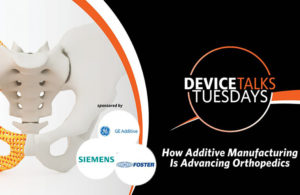
DeviceTalks Tuesdays additive manufacturing 3D printing Stryker3D printing, also called additive manufacturing, provides the ability to create new products and designs that are incredibly complex and hard to machine. For 20 years, Stryker has been on a journey to use additive manufacturing specifically to produce complex orthopedic implants. As a result, the company has made great strides when it comes to the way that orthopedic implants are designed and produced.

On a recent episode of our DeviceTalks Tuesdays webinar — sponsored by GE Additive, Foster, and Siemens — Stryker executive Naomi Murray detailed the company’s two-decade additive manufacturing journey. Murray, the company’s director of advanced operations for additive technology, described how innovations utilizing 3D printing make healthcare better.

Here are four takeaways on how additive manufacturing is advancing orthopedics:

1. 3D printing enables game-changing innovation

For Stryker, there were two main drivers behind pursuing additive manufacturing: design freedom and rapid concept development.

Design freedom makes it possible to create new products and designs that have complex, hard-to-machine geometries — including hybrid structures and implants with functionally located porosity. “It [employing 3D printing] was really freeing in that we could make new geometries that we couldn’t otherwise make,” Murray said.

Additive manufacturing also enables rapid concept development where it’s possible to quickly develop and iterate prototypes and implants. Murray observed that one of the benefits of additive manufacturing as both manufacturing technology and prototyping technology is using the same material properties and tolerances when testing as in final manufacturing. The result is that data gathered during testing is the same as the data and performance expected during actual manufacturing.

2. Much of Stryker’s focus in using additive manufacturing for orthopedics has been on porous design

Stryker orthopedics 3D printing 3D printed ortho implants DeviceTalks additive manufacturing

Stryker has been a pioneer in 3D printed orthopedic implants. [Image courtesy of Stryker]

Porous implants are important in orthopedics because they help promote biologic fixation, which gives as much space as possible for the bone to interdigitate. However, historically it has been challenging to manufacture porous implant designs using traditional methods. In working on porous structures for more than 15 years and then using the power of additive manufacturing, Stryker has become a world leader in metal 3D printing of porous implants. Murray was delighted to share a photo that showed bone growth through a porous structure produced using additive manufacturing.

One crucial decision by Stryker, explained Murray, was maintaining complete control of the 3D printing technology, including strict and extreme control of the porosity structure. “Additive manufacturing allows that control for us to be able to use the technology to give us the features that we need,” Murray said.

3. SOMA is pushing the boundaries of ortho implant design

SOMA—Stryker Orthopaedics Modeling & Analytics—provides an evidence-based design approach. The foundation for SOMA is a comprehensive database of CT scans of bones, referred to by Murray as “the bone database.”

The database and software tools customized specifically for Stryker provide data for modeling and designing custom implants. The software suite, as part of SOMA, facilitates measuring, fitting and optimizing implants. Murray commented that these tools transform the design process. In conjunction with the designs created through SOMA, Stryker uses additive manufacturing to “deliver industry-leading implants fit to our customers,” according to Murray.

4. Multiple tools used in combination will create what’s next

In the future, Murray envisions the use of multiple tools in concert. Specifically, she sees the SOMA database used in conjunction with 3D printing and robotic surgery tools that enable surgeons to plan and place implants more accurately.

According to Murray, “When you put [these tools] together—revolutionizing design . . . and then a procedural innovation . . . it makes an exciting future for additive manufacturing in the orthopedic space.”

5. Additive manufacturing has sustainability advantages — but more progress is needed

Murray is of the view that sustainability is part of the additive manufacturing story. Already, 3D printing is more sustainable than some other technologies. Still, Murray sees it as a corporate and industry responsibility to ensure that additive manufacturing becomes even more sustainable. Therefore, she challenged the industry to look at ways to minimize post-processing from 3D printing.

Provided to Medical Design & Outsourcing by BullsEye Resources.
Related Articles Read More >

Reactive xPEI polymer enables high-temperature SLS printing
UltiMaker and Bioactivx advance on-demand 3D-printed wound care
A photo of Conexeu Sciences co-founder and Chief Scientific Officer Dr. Claudia Chavez-Munoz.
This tissue engineering scientist is bioprinting next-gen absorbable implants
A photo of liver tissue bioprinted in space by Auxilium Biotechnologies.
Auxilium bioprints kidney and liver tissues in space for the first time
“mdo
EXPAND YOUR KNOWLEDGE AND STAY CONNECTED
Get the latest medical device business news, application and technology trends.

DeviceTalks Weekly

See More >

MDO Digital Edition

Digital Edition

Subscribe to Medical Design & Outsourcing. Bookmark, share and interact with the leading medical design engineering magazine today.

MEDTECH 100 INDEX

Medtech 100 logo
Market Summary > Current Price
The MedTech 100 is a financial index calculated using the BIG100 companies covered in Medical Design and Outsourcing.

New MedTech Resource

Medical Tubing

MassDevice

Mass Device

The Medical Device Business Journal. MassDevice is the leading medical device news business journal telling the stories of the devices that save lives.

Visit Website
MDO ad
Medical Design and Outsourcing
  • MassDevice
  • DeviceTalks
  • MedTech100 Index
  • Medical Tubing + Extrusion
  • Medical Design Sourcing
  • Drug Delivery Business News
  • Drug Discovery & Development
  • Pharmaceutical Processing World
  • R&D World
  • About Us/Contact
  • Advertise With Us
  • Subscribe to Print Magazine
  • Subscribe to our E-Newsletter
  • Listen to our Weekly Podcasts
  • Join our DeviceTalks Tuesdays Discussion

Copyright © 2026 Arrowfly, LLC. All Rights Reserved. The material on this site may not be reproduced, distributed, transmitted, cached or otherwise used, except with the prior written permission of Arrowfly LLC. Site Map | Privacy Policy | RSS

Search Medical Design & Outsourcing

  • Home
  • Medical Device Business
    • Mergers & Acquisitions
    • Financial
    • Regulatory
  • Applications
    • Cardiovascular
    • Devices
    • Imaging
    • Implantables
    • Medical Equipment
    • Orthopedic
    • Surgical
  • Technologies
    • Supplies and Components Index
    • Contract Manufacturing
    • Components
    • Electronics
    • Extrusions
    • Materials
    • Motion Control
    • Prototyping
    • Pumps
    • Tubing
  • MedTech Resources
    • Medtech Events in 2026
    • The 2026 Medtech Big 100
    • Medical Device Handbook
    • MedTech 100 Index
    • Subscribe to Print Magazine
    • DeviceTalks
    • Digital Editions
    • eBooks
    • Educational Assets
    • Manufacturer Search
    • Podcasts
    • Webinars / Digital Events
    • Whitepapers
    • Voices
    • Views
    • Video
  • 2026 Leadership
    • 2025 Winners
    • 2024 Winners
    • 2023 Winners
    • 2022 Winners
    • 2021 Winners
  • Women in Medtech
  • Advertisers
    • Advertise
    • PR Submissions
    • Eblast Submissions
  • Subscribe