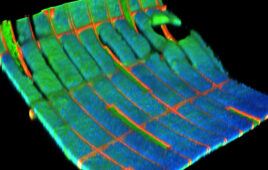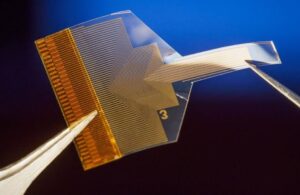
When placed on the surface of the brain, this thin, flexible implant enables researchers to capture high-resolution information about neural activity deep inside the brain without damaging its delicate tissue. [Image courtesy of David Baillot/UC San Diego Jacobs School of Engineering]
The UCSD team used a thin, transparent and flexible polymer strip packed with a dense array of graphene electrodes. They tested the technology in transgenic mice and say it brings them a step closer to building a minimally invasive brain-computer interface (BCI) that provides high-resolution deep neural activity data by using recordings from the brain surface.
“We are expanding the spatial reach of neural recordings with this technology,” said study senior author Duygu Kuzum, a professor in the Department of Electrical and Computer Engineering at the UC San Diego Jacobs School of Engineering. “Even though our implant resides on the brain’s surface, its design goes beyond the limits of physical sensing in that it can infer neural activity from deeper layers.”
According to the researchers, they found their technology can overcome the limitations of current neural implant technologies. Existing surface arrays are minimally invasive but remain unable to capture information beyond the brain’s outer layers, UCSD says. Electrode arrays with thin needles that penetrate the brain can probe the deep layers. However, the team says those often lead to inflammation and scarring, compromising signal over time.
Related: UCSD team develops new sensor manufacturing method for deep brain activity.
The team at UCSD says the neural implant they developed “offers the best of both worlds.” It conforms to the brain’s surface with its circular graphene electrodes, each 20 micrometers in diameter. A micrometers-thin graphene wire connects each electrode to a circuit board.
In transgenec mice testing, the implant helped capture high-resolution information about two types of neural activity (electrical and calcium activity) at the same time. When placed on the surface of the brain, it recorded electrical signals from neurons in the outer layers. The researchers used a two-photon microscope to shine laser light through the implant at the same time. This enabled the imaging of calcium spikes from neurons as deep as 250 micrometers below the surface.
The researchers found a correlation between surface electrical signals and calcium spikes in deeper layers. This led to the use of surface signals to train neural networks to predict calcium activity at various depths.
“The neural network model is trained to learn the relationship between the surface electrical recordings and the calcium ion activity of the neurons at depth,” said Kuzum. “Once it learns that relationship, we can use the model to predict the depth activity from the surface.”
The team says that predicting calcium activity overcomes the limitations of imaging experiments.
“Since electrical recordings do not have these limitations, our technology makes it possible to conduct longer duration experiments in which the subject is free to move around and perform complex behavioral tasks,” said study co-first author Mehrdad Ramezani, an electrical and computer engineering Ph.D. student in Kuzum’s lab. “This can provide a more comprehensive understanding of neural activity in dynamic, real-world scenarios.”
The team utilized transparency and high electrode density to design the implant in combination with machine learning. Traditional implants use opaque metal materials for electrodes and wires, according to the researchers. These can block the view of neurons beneath the electrodes during imaging experiments. Graphene implants are transparent, providing a clear field of view for a microscope during imaging.
In order to create a single layer of graphene as a thin, long wire for this purpose, the team had to fabricate the wires as a double layer doped with nitric acid in the middle. Any defect renders the wire nonfunctional, they said, so two layers allows for the masking of any defects, creating a fully functional wire with improved conductivity.
The team says this marks the most densely packed transparent electrode array on a surface-sitting neural implant to date. To create the small graphene electrodes that comprise the density, Kuzum’s lab developed a microfabrication technique for depositing platinum nanoparticles onto the electrodes. This significantly improved electron flow while the electrodes stayed tiny and transparent.
“This new generation of transparent graphene electrodes embedded at high density enables us to sample neural activity with higher spatial resolution,” said Kuzum. “As a result, the quality of signals improves significantly. What makes this technology even more remarkable is the integration of machine learning methods, which make it possible to predict deep neural activity from surface signals.”
Next, the team plans to test the technology in different animal models, aiming for human testing in the future. Kuzum’s lab also wants to use the technology to advance fundamental neuroscience research. They shared the technology with labs in the U.S. and Europe to help understand the coupling of vascular activity and electrical activity in the brain.
“This technology can be used for so many different fundamental neuroscience investigations, and we are eager to do our part to accelerate progress in better understanding the human brain,” said Kuzum.