Fifty percent survivability has long been considered “the best we can do” for the more than 120,000 patients per year who suffer from an intracerebral hemorrhage – bleeding in the brain caused by a ruptured or leaking blood vessel. Of the 50% who survive, only 20% recover to the level of independent living. Most others are left significantly disabled in speech, motor skills and cognitive functions.
The barrier to raising this number of survivors has been having the right technology to safely access this kind of stroke early, before the blood becomes toxic to the brain, and to remove the clot without causing more bleeding or more damage to the patient than the stroke itself.
For decades, this deadliest, most costly and debilitating form of stroke was approached through medical management of the bleed – watch-and-wait treatment without surgery was the only option for these patients. Once the stroke occurred and patients arrived at the hospital as emergent cases, more than 95% were managed in the ICU, spending weeks or months in the most expensive real estate in the hospital – at a cost of about $3,600 per day, or $13 billion annually, to handle patient care, recovery and rehabilitation.
Only a small fraction of these patients are able to return to normal life when discharged.
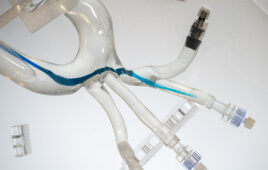
Three years ago, NICO Corporation commercialized an access tool called BrainPath, a rocket-shaped introducer with a precisely engineered conical tip and a clear plastic sheath, that’s designed to provide access and navigation of the brain’s delicate folds and fiber tracks. BrainPath allowed for a new surgical approach to improve clinical care by uniquely accessing the brain in a non-invasive way through natural openings and folds called sulci. Rather than cutting through brain fiber tracts, the device gently displaces brain tissue as it creates a corridor to the tumor or clot.
“It was very important to us that we provide a technology that gives appropriate patients hope for a better outcome, and that hospitals could [use to] provide a new standardized surgical approach to treating these deadly strokes,” said president & CEO Jim Pearson. “Many families are forced to withdraw care due to the cost and poor odds of a full recovery no matter how long they stay in the hospital. In more ways than one, this is a devastating type of stroke.”
BrainPath offers the patient and doctor an immediate surgical option for addressing intracerebral hemorrhage, with the ability to manage the bleeding vessel without causing further damage or trauma to the brain. The approach has been shown to improve patient outcomes and reduce healthcare costs by slashing the average ICU stay from 12 to 5 days.
These documented patient outcomes were presented at the International Stroke Conference last year and showed “statistically significant” improvement in patients’ neurological state after early intervention of clot evacuation using BrainPath – with 89% clot evacuation, no new deficits or mortalities, and no re-bleeds. Evidence showing BrainPath’s economic advantages is said to be forthcoming, with research findings slated for publication in the next two months.
“By safely accessing the deepest parts of the brain, BrainPath has changed the way surgeons contemplate treating appropriate patients,” Pearson explains. “Its technology that can positively impact the masses, because any neurosurgeon can be trained on how to use it so their patient population can benefit. We have leveled the playing field and everyone can participate, from small rural hospitals to large academic centers.”
How BrainPath works
BrainPath is used as a systems approach to neurosurgery, integrated with other advanced technologies to achieve the best possible outcome. A neurosurgical team begins with advanced imaging to map in detail the location of the tumor or clot, as well as the surrounding tissue and fiber tracts. Imaging is then combined with a navigation system to select the best path to the subcortical tumor or blood clot.
The neurosurgeon uses BrainPath to create a minimally disruptive pathway to the tumor or clot through the dense and sensitive white matter tracts and neural networks of the brain. Once the device reaches its intended target, the inner obturator is removed, leaving the clear sheath in place to maintain a protective pathway to the target. Then, using high-powered optics, the neurosurgeon can begin removing the clot or tumor via the plastic tube.
There’s no other FDA-cleared technology on the market today that allows for atraumatic access within the brain using a trans-sulcal surgical approach. Clinical data for the BrainPath procedure demonstrates it’s not only safe, but can be used anywhere that access is a challenge to the removal of brain abnormalities.
NICO says it’s found a way to address an unmet clinical need in the market and reduce the cost of care. So far, more than 3,000 procedures have been completed using the BrainPath approach.
In January, the company announced a randomized controlled trial evaluating the clinical effectiveness of early surgical intervention using BrainPath following spontaneous intracerbral hemorrhage. Two of Atlanta’s comprehensive stroke centers at the Emory University School of Medicine will lead the trial, ultimately comparing prospective data between early intervention using atraumatic access with BrainPath for fluid evacuation and a medically managed cohort.