Medical Design and Outsourcing

  • Home
  • Medical Device Business
    • Mergers & Acquisitions
    • Financial
    • Regulatory
  • Applications
    • Cardiovascular
    • Devices
    • Imaging
    • Implantables
    • Medical Equipment
    • Orthopedic
    • Surgical
  • Technologies
    • Supplies and Components Index
    • Contract Manufacturing
    • Components
    • Electronics
    • Extrusions
    • Materials
    • Motion Control
    • Prototyping
    • Pumps
    • Tubing
  • MedTech Resources
    • Medtech Events in 2026
    • The 2026 Medtech Big 100
    • Medical Device Handbook
    • MedTech 100 Index
    • Subscribe to Print Magazine
    • DeviceTalks
    • Digital Editions
    • eBooks
    • Educational Assets
    • Manufacturer Search
    • Podcasts
    • Webinars / Digital Events
    • Whitepapers
    • Voices
    • Views
    • Video
  • 2026 Leadership
    • 2025 Winners
    • 2024 Winners
    • 2023 Winners
    • 2022 Winners
    • 2021 Winners
  • Women in Medtech
  • Advertise
  • Subscribe

Novel Nanoscale Detection of Real-Time DNA Amplification Holds Promise for Diagnostics

September 7, 2016 By Nagoya University

Research team led by Nagoya University develop a label-free method for detecting DNA amplification in real time based on refractive index changes in diffracted light.

Polymerase chain reaction (PCR) is a simple and ubiquitous method in molecular biology for amplifying DNA segments into millions of copies. This is important not only for basic research, but also in diagnostics, forensics, and medical applications. Quantitative real-time PCR is a modified version that incorporates fluorescence labeling to cumulatively measure DNA amplification, rather than monitoring it at the end of the process, as in conventional PCR. Real-time PCR therefore enables sensitive quantification of the amount of the initial DNA template. However, current techniques may introduce bias through sequence errors, pipetting inaccuracies, or unequal binding of fluorescent probes (hybridization).

A research team centered on Nagoya University has now developed a novel method of measuring real-time DNA amplification that is label-free, thus avoiding the bias issues associated with other procedures. The research and its outcomes were reported in Scientific Reports.
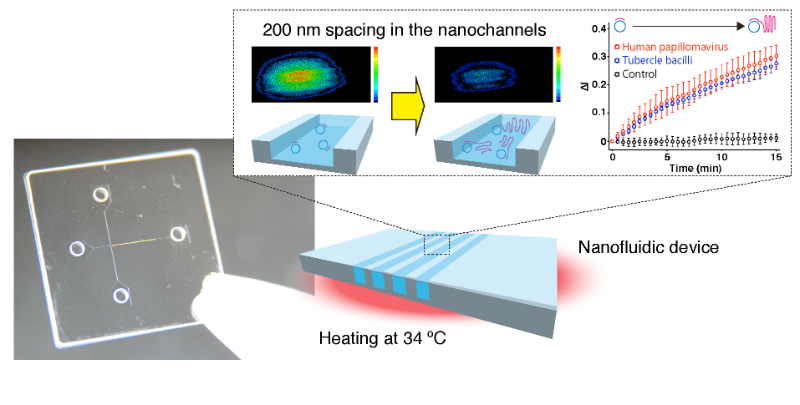
A photo and a schematic illustration for a nanofluidic diffraction grating. Label-free signals based on a diffraction intensity change were attributed to amplification of DNA molecules, such as human papillomavirus and tubercle bacilli. (Credit: Copyright Takao Yasui)

Existing label-free detection systems rely on surface immobilization of target molecules, which is expensive, laborious, and ineffective over time. This new method also introduces an element of hybridization bias because of complementary probe binding. The new technique instead detects changes in the intensity of diffracted light from a laser beam passing through miniscule 200 nm (0.0002 mm)-wide nanochannels filled with analytical sample liquids. The 532-nm laser beam is focused by a lens and then diffracted by passing through the nanochannel and detected by a photodiode. Silica substrates were used to make the nanochannels, and the larger the difference between refractive indices of sample liquids and silica, the smaller is the change in diffracted light intensity, and vice versa.

“We used this technique to provide the first label-free detection of human papillomavirus and the bacteria responsible for tuberculosis,” first author Takao Yasui says. “The method is highly sensitive, and allows quantification of a wide range of initial DNA concentrations, from 1 fM to 1 pM (a 1,000-fold range), so is superior to existing fluorescence-based detection systems.”

“Our system also measures DNA amplification at the relatively low temperature of 34°C and without the need for thermal cycles,” coauthor Noritada Kaji says. “Because it has the potential to be constructed as a single chip and can detect sample volumes as small as 1 µl, which is 100–1,000 times less than conventional detectors are capable of, it is particularly suited to development as a miniaturized form of diagnostics and microbe detection.”

(Source: AlphaGalileo)

Related Articles Read More >

The most innovative medical devices of 2026
An illustration showing Corcym's Memo 4D Curve's laser-cut nitinol core.
Laser-cut nitinol and a layered design let these cardiac implants flex
Reconstructed 3D fluorescence image of the stained biohybrid mesh-tissue integration. The red, green, and blue colors correspond to the mesh, F-actin, and nuclei, respectively.
Researchers mesh electronics with human cells to develop living battery
A photo of the Paradromics Connexus brain-computer interface on a fingertip.
How Paradromics designed its Connexus brain-computer interface system
“mdo
EXPAND YOUR KNOWLEDGE AND STAY CONNECTED
Get the latest medical device business news, application and technology trends.

DeviceTalks Weekly

See More >

MDO Digital Edition

Digital Edition

Subscribe to Medical Design & Outsourcing. Bookmark, share and interact with the leading medical design engineering magazine today.

MEDTECH 100 INDEX

Medtech 100 logo
Market Summary > Current Price
The MedTech 100 is a financial index calculated using the BIG100 companies covered in Medical Design and Outsourcing.

New MedTech Resource

Medical Tubing

MassDevice

Mass Device

The Medical Device Business Journal. MassDevice is the leading medical device news business journal telling the stories of the devices that save lives.

Visit Website
MDO ad
Medical Design and Outsourcing
  • MassDevice
  • DeviceTalks
  • MedTech100 Index
  • Medical Tubing + Extrusion
  • Medical Design Sourcing
  • Drug Delivery Business News
  • Drug Discovery & Development
  • Pharmaceutical Processing World
  • R&D World
  • About Us/Contact
  • Advertise With Us
  • Subscribe to Print Magazine
  • Subscribe to our E-Newsletter
  • Listen to our Weekly Podcasts
  • Join our DeviceTalks Tuesdays Discussion

Copyright © 2026 Arrowfly, LLC. All Rights Reserved. The material on this site may not be reproduced, distributed, transmitted, cached or otherwise used, except with the prior written permission of Arrowfly LLC. Site Map | Privacy Policy | RSS

Search Medical Design & Outsourcing

  • Home
  • Medical Device Business
    • Mergers & Acquisitions
    • Financial
    • Regulatory
  • Applications
    • Cardiovascular
    • Devices
    • Imaging
    • Implantables
    • Medical Equipment
    • Orthopedic
    • Surgical
  • Technologies
    • Supplies and Components Index
    • Contract Manufacturing
    • Components
    • Electronics
    • Extrusions
    • Materials
    • Motion Control
    • Prototyping
    • Pumps
    • Tubing
  • MedTech Resources
    • Medtech Events in 2026
    • The 2026 Medtech Big 100
    • Medical Device Handbook
    • MedTech 100 Index
    • Subscribe to Print Magazine
    • DeviceTalks
    • Digital Editions
    • eBooks
    • Educational Assets
    • Manufacturer Search
    • Podcasts
    • Webinars / Digital Events
    • Whitepapers
    • Voices
    • Views
    • Video
  • 2026 Leadership
    • 2025 Winners
    • 2024 Winners
    • 2023 Winners
    • 2022 Winners
    • 2021 Winners
  • Women in Medtech
  • Advertise
  • Subscribe


