How Peytant Solutions combined proven materials to yield a first-of-a-kind stent.
By John Schorgl, Peytant Solutions

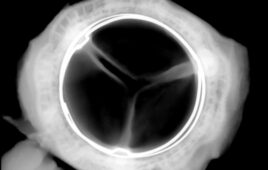
The AMStent System is the first and only covered stent leveraging a decellularized human amnionic membrane (DCAM).[Photo courtesy of Peytant Solutions]
To address the problem, our team at Peytant Solutions developed the proprietary AMStent Tracheobronchial Covered Stent System, the first and only stent covered with a decellularized human amniotic membrane (DCAM).
Amnion, the foundation of the AMStent’s DCAM, contains naturally occurring proteins such as collagen, keratin, fibronectins, and laminins, instead of thermoplastic polyurethanes (TPUs) or synthetic “forever chemicals” such as expanded polytetrafluoroethylene (ePTFE), which are the foundation of other commercial stent coverings. Peytant converts amnion to DCAM for our implantable airway prosthesis through a proprietary process.
The AMStent device is an expandable tubular device made of nitinol covered in DCAM. We harnessed the synergy between the self-expanding stent and the precisely secured DCAM covering, and expect the innovation to fundamentally transform the treatment of luminal diseases, starting with patients suffering from pulmonary obstructions caused by lung cancer.
The system underwent extensive testing to secure FDA De Novo marketing authorization. It is indicated for use in the treatment of tracheobronchial strictures produced by malignant neoplasms (cancer) in adult patients.
The unmet need: Restoring patency in malignant obstructions
The leading cancer cause of pulmonary obstructions are respiratory cancers, with 252,950 cases reported in the U.S. in 2024. Cancers can block airflow in the trachea and bronchi causing a central airway obstruction (CAO). COA is a common complication with approximately 60,000 COAs caused each year by lung cancers alone. Other cancers, including colorectal, breast, liver, and prostate, can cause COAs as well. If untreated, CAO can lead to life-threatening respiratory failure. Management of the condition includes airway stenting to improve airflow and relieve symptoms.
Stents often induce the body’s natural defense mechanisms to a foreign object. In the airway, stents can trigger inflammation, leading to granuloma formation, stent migration, infections, and mucus buildup. Published studies have shown issues with marketed synthetic-covered stents in the airway: clinically significant granuloma formation as high as 35%, mucus accumulation as high as 37%, and stent migration as high as 35%.
These reactions, driven by the body’s identification of the implant as a foreign object, can require additional procedures and/or potential removal or replacement of the stents, which have additional known complications.
The need for a stent that minimizes the body’s natural reaction to foreign implants has been Peytant’s key focus for increasing the long-term efficacy and safety of stenting.
Compared to a synthetic covered stent, the AMStent device significantly reduced complications such as granuloma formation, migration, and mucus accumulation in Peytant’s pre-clinical studies that supported its FDA submission. The results from the study were recently presented by Dr. Roy Cho. from the University of Minnesota at the 8th Annual Conference of the American Association of Bronchology and Interventional Pulmonology.

[Image courtesy of Peytant Solutions]
The technical solution
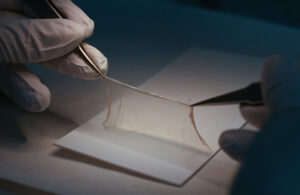
The AMStent System combines a minimally invasive delivery catheter with a self-expanding nitinol stent covered in a decellularized human amnionic membrane (DCAM). The DCAM, primarily composed of extracellular matrix (ECM) common to all human tissue, is intended to minimize the body’s natural foreign body response. [Photo courtesy of Peytant Solutions]
The AMStent, delivered via a minimally invasive catheter system, is designed to reduce the foreign body response and the likelihood of resulting complications.
The realization that combining a metallic stent with an amnion-derived covering could address the complications of existing stents was a pivotal moment for the Peytant team. The combination of mechanical support with this novel biomaterial may open new avenues for treating luminal diseases more effectively and with fewer complications in the future.
Given that the human body comprises numerous tubular structures, the potential for medical devices covered in DCAM extends to vascular, gastrointestinal, neurological, and urological systems.
Design, development and manufacturing challenges

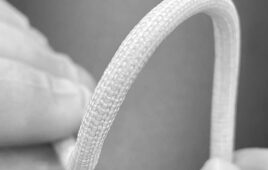
Developed with interventional pulmonologists and thoracic surgeons, the AMStent System (shown here during assembly) is engineered to treat tracheobronchial obstructions from cancers. [Photo courtesy of Peytant Solutions]
This process uses a technique in biomedical engineering where cells are removed from a tissue or organ, leaving behind the extracellular matrix (ECM) membrane scaffold. Using decellularized tissue scaffolds may offer several advantages over synthetic materials by supporting the natural tissue environment by retaining some of the tissue’s original structure and function.
The DCAM covering is made from material sourced from accredited and select tissue banks that provide donor screening and traceability processes to provide high-quality, ethically sourced material. This supply chain will enable Peytant to scale the product into the future.
On the manufacturing side, we decided to make the AMStent system in-house, building a team of highly skilled assembly specialists to work with the DCAM material to produce the final product. Our precise process ensures the membrane is secured to the stent, covering the entire surface of the metal scaffold.
We are scaling manufacturing to meet demand as we plan our commercial launch in the U.S. later this year.
Innovation lessons from the team

Peytant Solutions co-founder, CEO, President and Chair John Schorgl [Photo courtesy of Peytant Solutions]
We encourage other innovators to expect setbacks and build resilience into their plans. Perfection is elusive. We navigate the challenges by staying committed to our continuous improvement.
Innovation doesn’t always mean inventing something from scratch. Sometimes, it means combining what already works in a newly inventive way.
John Schorgl co‑founded Peytant Solutions in 2008 and serves as CEO, president, and chair, guiding the company through critical development and commercialization milestones. He has more than 35 years of executive leadership at Pfizer, Boston Scientific. Baxter International, and superDimension.
Read more MDO Contributions and learn how to submit your own
The opinions expressed in this blog post are the author’s only and do not necessarily reflect those of Medical Design & Outsourcing or its employees.