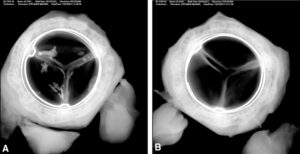
Radiographic imaging shows an Edwards Lifesciences valve with Resilia tissue (right) with significantly less leaflet calcification compared to a control valve (left). [Image courtesy of Edwards Lifesciences]
The anti-calcification tech’s 10-year results are “mind-boggling,” says one of the novel tissue technology’s co-inventors, Edwards Lifesciences R&D SVP Greg Wright.
“If I was asked at 10 years in a clinical trial what would I be happy with, I’d have been happy with better than 90% freedom from structural valve deterioration,” he said in a Medical Design & Outsourcing interview. “We were almost at 98%.”
Made from bovine pericardial tissue, Resilia was first implanted in a human in 2011 and commercially launched in 2016. It’s just one R&D project from the industry’s pioneer of transcatheter aortic valve replacement (TAVR), but it’s an example of how R&D drives growth at the world’s largest medical device companies.
Medtech Big 100: Join MDO editors for a discussion of the top movers and trends in our upcoming ranking of the world’s largest medical device companies
Over the last decade, Edwards has nearly tripled its revenue to $6.1 billion while growing R&D spending 182% to $1.1 billion.
At the same time, the company has increased R&D spending as a share of total sales from 15% to 18%.
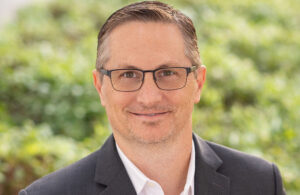
Resilia co-inventor and Edwards Lifesciences R&D SVP Greg Wright [Photo courtesy of Edwards Lifesciences]
To date, more than 500,000 patients have received Edwards surgical and transcatheter valve implants with Resilia tissue technology. Nearly all patients in the company’s Commence aortic valve trial have avoided reoperation due to structural valve deterioration (SVD) at 10 years.
“As patients live longer and expect to remain active, structural heart therapies must be designed with lifetime care in mind,” Edwards Lifesciences CEO Bernard Zovighian said while announcing the 10-year results, calling the study “the latest addition to our breadth of long-term data reflecting our commitment to advancing durable valve technologies through continuous evidence development.”
The quest for the holy grail of valve tissue
Anti-calcification technology was the “holy grail” of next-generation tissue technology when Edwards started on the journey, says Dr. Joseph Bavaria, a paid Edwards consultant who has performed more than 11,500 open-heart surgeries and led IDE trials studying TAVR and other cardiac innovations.
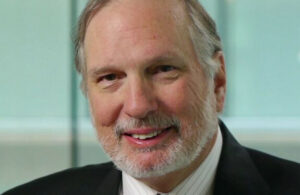
Edwards consultant and cardiac surgeon Dr. Joseph Bavaria [Photo courtesy of The American Association of Thoracic Surgery]
Then came Resilia.
“We want to provide solutions for our patients that don’t exist today, and that’s all we care about,” Wright said. “When we were focused on Resilia, we were looking at two different paths: improving the durability by reducing the calcification … and creating a situation where we could store the valve dry.”
Resilia tissue introduced a novel preservation technology that resists calcification and allows for valve dry storage by incorporating a stable-capping anti-calcification process that blocks residual aldehyde groups known to bind with calcium.
“This was brand new chemistry, brand new concepts, brand new scientific thought,” said Bavaria, who led the five-year Resilia study as lead author.
Related: Edwards Lifesciences makes a simple change for a first-of-its-kind tricuspid valve
Developing a dry storage solution
Wright joined Edwards in 2005, working with a team focused on next-generation tissue technology.
“We wanted to learn what the competition did, what is the industry doing to address this, what have they done well, and what can we learn from it and even make it better,” he said.
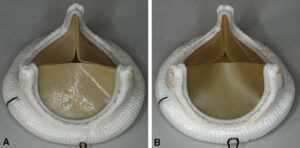
The valve on the right was treated with Edwards’ novel tissue preservation technology, and the valve on the left is the control valve prepared without the dry storage enabling tech. [Photos courtesy of Edwards Lifesciences]
“When you leave behind these residual aldehydes, they eventually go down a path where their chemistry changes, they eventually begin to attract calcium, and calcification begins to start at some of those spots,” Wright said. “ … The technology we developed to reduce calcification was really focused on residual aldehydes in the tissue that are left behind after we cross-link the tissue in glutaraldehyde [and decided] if we’re going to use a chemistry that effectively blocks these aldehyde groups, we don’t want to go back to glutaraldehyde.”
Edwards needed the technology for the Konect aortic valved conduit it was developing at the time. Konect’s aortic root graft, attached to the system’s artificial aortic valve, can’t be submerged in solution.
So Wright and his team developed a glycerolization process to treat valves with a glycerol and ethanol mix. The mix displaces most of the water present in the pericardial tissue and replaces the liquid with glycerol, mitigating calcium-attracting glutaraldehyde residuals and allowing for dry storage.
Related: Q&A with Darshin Patel, who led the Edwards Lifesciences Sapien M3 TMVR system’s development
Reducing calcification with a proprietary capping technology
During their research, Wright’s team learned competitors were implementing capping technology, which blocks a chemical reaction to avoid generating by-products, but it wasn’t stable.
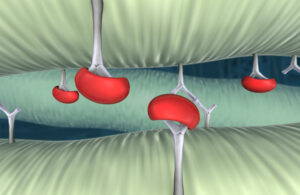
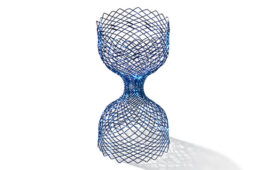
Edwards’ proprietary stable-capping technology permanently blocks free aldehydes to prevent calcium binding within the tissue. [Illustration courtesy of Edwards Lifesciences]
Wright and his team eventually developed a proprietary stable-capping process that not only blocked calcium but also enabled better blood flow.
“We noticed that the motion of the leaflets was better,” he said. “We were getting better opening, better leaflet kinematics. Not only are you now getting a reduction in calcification and increased durability, you’re getting better hemodynamics for the patients.”
Wright said Edwards is seeing durability and increased hemodynamic function across surgical valves and transcatheter valves like the Edwards Sapien 3 Ultra Resilia valve. But there’s room for improvement and more innovation.
“As successful as Resilia has been, you’re going to have a patient that doesn’t last as long as another patient, and that has a lot to do with the patient factors,” he said. “That’s what we’re thinking about in terms of what the next steps for our next generation of Resilia are. Maybe there are patient factors that we can focus on.”
Watch on-demand: The 2026 MDO Min-Vasive Medtech webinar series
Looking forward with Resilia
Resilia’s 10-year data is “better than we’ve ever had before,” said Bavaria, who’s already looking forward to longer-term results.
“Durability for tissue valves is going to be continuing to understand the science, the deep science about what actually happens to these leaflets,” he said. “We’ll get better and better — which we have been — at designing leaflets from an engineering standpoint: making the valves more hemodynamic, making them cleaner, making them have less gradients, making them close faster, open faster, all that kind of stuff is in the engineering realm, and that’s being done. At this stage it’s pretty innovative.”
He continued, “But just like Resilia, we need another … really big step in our understanding of the actual chemistry and biology of heart valve failure.”
Editor’s note: This post was corrected after publication to note that it has been 15 years since Resilia’s 2011 first-in-human and clarified to say reoperative data came from the Commence trial.