Medical Design and Outsourcing

  • Home
  • Medical Device Business
    • Mergers & Acquisitions
    • Financial
    • Regulatory
  • Applications
    • Cardiovascular
    • Devices
    • Imaging
    • Implantables
    • Medical Equipment
    • Orthopedic
    • Surgical
  • Technologies
    • Supplies and Components Index
    • Contract Manufacturing
    • Components
    • Electronics
    • Extrusions
    • Materials
    • Motion Control
    • Prototyping
    • Pumps
    • Tubing
  • MedTech Resources
    • Medtech Events in 2026
    • The 2025 Medtech Big 100
    • Medical Device Handbook
    • MedTech 100 Index
    • Subscribe to Print Magazine
    • DeviceTalks
    • Digital Editions
    • eBooks
    • Educational Assets
    • Manufacturer Search
    • Podcasts
    • Webinars / Digital Events
    • Whitepapers
    • Voices
    • Views
    • Video
  • 2026 Leadership
    • 2025 Winners
    • 2024 Winners
    • 2023 Winners
    • 2022 Winners
    • 2021 Winners
  • Women in Medtech
  • Advertise
  • Subscribe

Your Brain Reveals Who Your Friends Are

January 30, 2018 By Dartmouth College

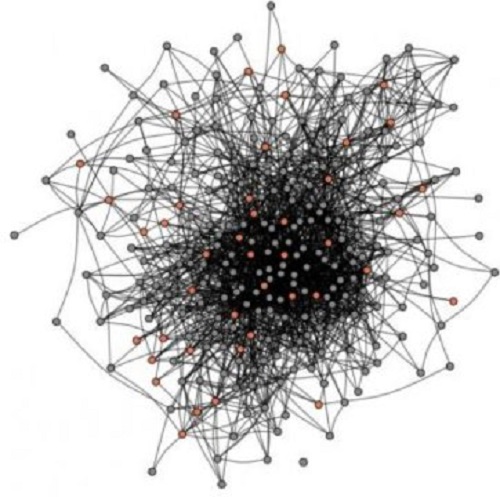
Credit: Image by Carolyn Parkinson.

You may perceive the world the way your friends do, according to a Dartmouth study finding that friends have similar neural responses to real-world stimuli and these similarities can be used to predict who your friends are.

The researchers found that you can predict who people are friends with just by looking at how their brains respond to video clips. Friends had the most similar neural activity patterns, followed by friends-of-friends who, in turn, had more similar neural activity than people three degrees removed (friends-of-friends-of-friends).

Published in Nature Communications, the study is the first of its kind to examine the connections between the neural activity of people within a real-world social network, as they responded to real-world stimuli, which in this case was watching the same set of videos. 

“Neural responses to dynamic, naturalistic stimuli, like videos, can give us a window into people’s unconstrained, spontaneous thought processes as they unfold. Our results suggest that friends process the world around them in exceptionally similar ways,” says lead author Carolyn Parkinson, who was a postdoctoral fellow in psychological and brain sciences at Dartmouth at the time of the study and is currently an assistant professor of psychology and director of the Computational Social Neuroscience Lab at the University of California, Los Angeles.

The study analyzed the friendships or social ties within a cohort of nearly 280 graduate students. The researchers estimated the social distance between pairs of individuals based on mutually reported social ties. Forty-two of the students were asked to watch a range of videos while their neural activity was recorded in a functional magnetic resonance imaging (fMRI) scanner. The videos spanned a range of topics and genres, including politics, science, comedy and music videos, for which a range of responses was expected. Each participant watched the same videos in the same order, with the same instructions. The researchers then compared the neural responses pairwise across the set of students to determine if pairs of students who were friends had more similar brain activity than pairs further removed from each other in their social network.

The findings revealed that neural response similarity was strongest among friends, and this pattern appeared to manifest across brain regions involved in emotional responding, directing one’s attention and high-level reasoning. Even when the researchers controlled for variables, including left-handed- or right-handedness, age, gender, ethnicity, and nationality, the similarity in neural activity among friends was still evident. The team also found that fMRI response similarities could be used to predict not only if a pair were friends but also the social distance between the two.

“We are a social species and live our lives connected to everybody else. If we want to understand how the human brain works, then we need to understand how brains work in combination — how minds shape each other,” explains senior author Thalia Wheatley, an associate professor of psychological and brain sciences at Dartmouth, and principal investigator of the Dartmouth Social Systems Laboratory.

For the study, the researchers were building on their earlier work, which found that as soon as you see someone you know, your brain immediately tells you how important or influential they are and the position they hold in your social network.

The research team plans to explore if we naturally gravitate toward people who see the world the same way we do, if we become more similar once we share experiences or if both dynamics reinforce each other.
Related Articles Read More >

A photo of the Paradromics Connexus brain-computer interface on a fingertip.
How Paradromics designed its Connexus brain-computer interface system
An illustration of HITMAN operating in glioblastoma cells.
MIT researchers develop injectable nanodevices that remotely kill brain tumor cells
An illustration of CSF flow through the brain.
MIT researchers find pink noise can encourage CSF flow during sleep
A photo of Kitea Health's Kitea Sensor with fingers for scale.
Intracranial sensor maker says automated testing slashed firmware development time
“mdo
EXPAND YOUR KNOWLEDGE AND STAY CONNECTED
Get the latest medical device business news, application and technology trends.

DeviceTalks Weekly

See More >

MDO Digital Edition

Digital Edition

Subscribe to Medical Design & Outsourcing. Bookmark, share and interact with the leading medical design engineering magazine today.

MEDTECH 100 INDEX

Medtech 100 logo
Market Summary > Current Price
The MedTech 100 is a financial index calculated using the BIG100 companies covered in Medical Design and Outsourcing.

New MedTech Resource

Medical Tubing

MassDevice

Mass Device

The Medical Device Business Journal. MassDevice is the leading medical device news business journal telling the stories of the devices that save lives.

Visit Website
MDO ad
Medical Design and Outsourcing
  • MassDevice
  • DeviceTalks
  • MedTech100 Index
  • Medical Tubing + Extrusion
  • Medical Design Sourcing
  • Drug Delivery Business News
  • Drug Discovery & Development
  • Pharmaceutical Processing World
  • R&D World
  • About Us/Contact
  • Advertise With Us
  • Subscribe to Print Magazine
  • Subscribe to our E-Newsletter
  • Listen to our Weekly Podcasts
  • Join our DeviceTalks Tuesdays Discussion

Copyright © 2026 Arrowfly, LLC. All Rights Reserved. The material on this site may not be reproduced, distributed, transmitted, cached or otherwise used, except with the prior written permission of Arrowfly LLC. Site Map | Privacy Policy | RSS

Search Medical Design & Outsourcing

  • Home
  • Medical Device Business
    • Mergers & Acquisitions
    • Financial
    • Regulatory
  • Applications
    • Cardiovascular
    • Devices
    • Imaging
    • Implantables
    • Medical Equipment
    • Orthopedic
    • Surgical
  • Technologies
    • Supplies and Components Index
    • Contract Manufacturing
    • Components
    • Electronics
    • Extrusions
    • Materials
    • Motion Control
    • Prototyping
    • Pumps
    • Tubing
  • MedTech Resources
    • Medtech Events in 2026
    • The 2025 Medtech Big 100
    • Medical Device Handbook
    • MedTech 100 Index
    • Subscribe to Print Magazine
    • DeviceTalks
    • Digital Editions
    • eBooks
    • Educational Assets
    • Manufacturer Search
    • Podcasts
    • Webinars / Digital Events
    • Whitepapers
    • Voices
    • Views
    • Video
  • 2026 Leadership
    • 2025 Winners
    • 2024 Winners
    • 2023 Winners
    • 2022 Winners
    • 2021 Winners
  • Women in Medtech
  • Advertise
  • Subscribe