Medical Design and Outsourcing

  • Home
  • Medical Device Business
    • Mergers & Acquisitions
    • Financial
    • Regulatory
  • Applications
    • Cardiovascular
    • Devices
    • Imaging
    • Implantables
    • Medical Equipment
    • Orthopedic
    • Surgical
  • Technologies
    • Supplies and Components Index
    • Contract Manufacturing
    • Components
    • Electronics
    • Extrusions
    • Materials
    • Motion Control
    • Prototyping
    • Pumps
    • Tubing
  • MedTech Resources
    • Medtech Events in 2026
    • The 2025 Medtech Big 100
    • Medical Device Handbook
    • MedTech 100 Index
    • Subscribe to Print Magazine
    • DeviceTalks
    • Digital Editions
    • eBooks
    • Educational Assets
    • Manufacturer Search
    • Podcasts
    • Webinars / Digital Events
    • Whitepapers
    • Voices
    • Views
    • Video
  • 2026 Leadership
    • 2025 Winners
    • 2024 Winners
    • 2023 Winners
    • 2022 Winners
    • 2021 Winners
  • Women in Medtech
  • Advertise
  • Subscribe

3 inevitable innovations in materials for 3D printing orthopedics

January 24, 2024 By Jim Hammerand

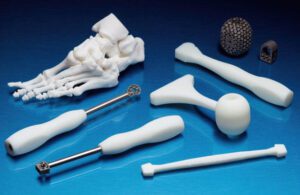
A photo of Restor3d 3D-printed orthopedic implants, anatomical models and surgical tools and guides.

Restor3d uses metal and polymer 3D printing for orthopedic implants, anatomical models and surgical tools and guides. [Photo courtesy of Formlabs]

3D printing for orthopedics is one of the most promising applications of additive manufacturing for medical devices.

3D printing is already used to manufacture orthopedic implants and tools by device developers as large as Stryker — the world’s biggest orthopedics manufacturer — and startups like Restor3d.

A few key innovations in 3D printing materials will enable even better orthopedic devices in the future.

And it’s not a matter of if, but when, said Restor3d SVP of Product Development Nathan Evans, who identified three next-generation materials advances he’s looking forward to for 3D printing orthopedics.

“I think they’re all going to happen,” he said in an interview with Medical Design & Outsourcing. “It’s just: Is it going to happen in 5 years or 15 years?”

1. Biodegradables

Biodegradable material is a hot topic in orthopedics that may have faded a bit since interest peaked about a decade ago.

“We get a lot of surgeons that say, ‘Wouldn’t it be so cool if you could print a biodegradable?'” Evans said.

Particularly in soft tissue repair — ligaments, tendons, etc. — biodegradable materials could allow an implant to be absorbed by the body after that soft tissue has healed.

2. Drug delivery

Drug-eluting or drug-delivering materials could enable composites or 3D-printed material to utilize antibiotics to prevent infections or oncology drugs to fight cancer.

Researchers at startups like FabRx are developing 3D printing technology for pharmaceuticals. Fabrx sells equipment that can 3D print personalized medicines, allowing for custom shapes, textures and flavors, or combine multiple medications into a single pill.

But developing materials for 3D-printed orthopedic implants that can elute or deliver drugs locally is another matter. Challenges include limitations of current 3D printing technology, finding a sterilization method for devices that won’t inactivate the drug, and regulatory hurdles (more on that below).

3. Implantable polymers

A photo of Nathan Evans, SVP of product development at Restor3d.

Restor3d SVP of Product Development Nathan Evans [Photo courtesy of Restor3d]

While device manufacturers like Restor3d use polymers to 3D print orthopedic tools like trials, cut guides and impactors, there’s a need for polymers that are validated for implantable use. Even biocompatible polymers are mostly intended for short-term, temporary skin contact or dental use.

“There are very, very few 3D-printed polymers for long-term implantables,” Evans said. “There are some — PEEK is one that people have done a few things with on printed implantables.”

3D printing orthopedic implants with polymers would retain some of the benefits of 3D printing orthopedic implants with metal, such as surface porosity and patient-specific customization.

But polymers might offer advantages over metal for implantable devices. One such advantage is the relative reduction in imaging artifacts from polymers compared to metals. Another is that polymers are less stiff than metals, which is a factor in stress shielding.

“When [a metal] implant takes all the load because it’s so strong, the bone around it actually resorbs because it’s no longer under loading,” Evans said. “But a polymer more closely matches the strength and the modulus or the stiffness of the native bone, so you get better co-sharing of load. There’s some data out there that says for certain applications, polymer may be actually better.”

What’s new in 3D printing: medical devices, research, innovation, automation and partnerships

About The Author

Jim Hammerand

Jim Hammerand is the managing editor of Arrowfly's Medical Design & Outsourcing, where he leads coverage of medtech innovation, design, engineering and manufacturing. He also reports breaking news at Arrowfly's MassDevice and contributes to our DeviceTalks podcasts and live events. Hammerand has more than two decades of journalism experience spanning newspapers, magazines, websites, live events, radio and TV news. For nearly a decade, Hammerand reported and edited business news for American City Business Journals as a reporter and digital editor at the Minneapolis/St. Paul Business Journal and then as managing editor of the Puget Sound Business Journal in Seattle. He holds degrees in journalism and management from the University of Minnesota and has won journalism awards from the Society of Professional Journalists, American Society of Business Publication Editors, and Trade, Association, Business Publications International. Connect with him on LinkedIn or by email at [email protected].

Related Articles Read More >

UltiMaker and Bioactivx advance on-demand 3D-printed wound care
A photo of Conexeu Sciences co-founder and Chief Scientific Officer Dr. Claudia Chavez-Munoz.
This tissue engineering scientist is bioprinting next-gen absorbable implants
A photo of liver tissue bioprinted in space by Auxilium Biotechnologies.
Auxilium bioprints kidney and liver tissues in space for the first time
MIT Triaxial Emitters_
MIT researchers develop 3D-printed electronic nozzles for precise drug delivery
“mdo
EXPAND YOUR KNOWLEDGE AND STAY CONNECTED
Get the latest medical device business news, application and technology trends.

DeviceTalks Weekly

See More >

MDO Digital Edition

Digital Edition

Subscribe to Medical Design & Outsourcing. Bookmark, share and interact with the leading medical design engineering magazine today.

MEDTECH 100 INDEX

Medtech 100 logo
Market Summary > Current Price
The MedTech 100 is a financial index calculated using the BIG100 companies covered in Medical Design and Outsourcing.

New MedTech Resource

Medical Tubing

MassDevice

Mass Device

The Medical Device Business Journal. MassDevice is the leading medical device news business journal telling the stories of the devices that save lives.

Visit Website
MDO ad
Medical Design and Outsourcing
  • MassDevice
  • DeviceTalks
  • MedTech100 Index
  • Medical Tubing + Extrusion
  • Medical Design Sourcing
  • Drug Delivery Business News
  • Drug Discovery & Development
  • Pharmaceutical Processing World
  • R&D World
  • About Us/Contact
  • Advertise With Us
  • Subscribe to Print Magazine
  • Subscribe to our E-Newsletter
  • Listen to our Weekly Podcasts
  • Join our DeviceTalks Tuesdays Discussion

Copyright © 2026 Arrowfly, LLC. All Rights Reserved. The material on this site may not be reproduced, distributed, transmitted, cached or otherwise used, except with the prior written permission of Arrowfly LLC. Site Map | Privacy Policy | RSS

Search Medical Design & Outsourcing

  • Home
  • Medical Device Business
    • Mergers & Acquisitions
    • Financial
    • Regulatory
  • Applications
    • Cardiovascular
    • Devices
    • Imaging
    • Implantables
    • Medical Equipment
    • Orthopedic
    • Surgical
  • Technologies
    • Supplies and Components Index
    • Contract Manufacturing
    • Components
    • Electronics
    • Extrusions
    • Materials
    • Motion Control
    • Prototyping
    • Pumps
    • Tubing
  • MedTech Resources
    • Medtech Events in 2026
    • The 2025 Medtech Big 100
    • Medical Device Handbook
    • MedTech 100 Index
    • Subscribe to Print Magazine
    • DeviceTalks
    • Digital Editions
    • eBooks
    • Educational Assets
    • Manufacturer Search
    • Podcasts
    • Webinars / Digital Events
    • Whitepapers
    • Voices
    • Views
    • Video
  • 2026 Leadership
    • 2025 Winners
    • 2024 Winners
    • 2023 Winners
    • 2022 Winners
    • 2021 Winners
  • Women in Medtech
  • Advertise
  • Subscribe