Medical Design and Outsourcing

  • Home
  • Medical Device Business
    • Mergers & Acquisitions
    • Financial
    • Regulatory
  • Applications
    • Cardiovascular
    • Devices
    • Imaging
    • Implantables
    • Medical Equipment
    • Orthopedic
    • Surgical
  • Technologies
    • Supplies and Components Index
    • Contract Manufacturing
    • Components
    • Electronics
    • Extrusions
    • Materials
    • Motion Control
    • Prototyping
    • Pumps
    • Tubing
  • MedTech Resources
    • Medtech Events in 2026
    • The 2025 Medtech Big 100
    • Medical Device Handbook
    • MedTech 100 Index
    • Subscribe to Print Magazine
    • DeviceTalks
    • Digital Editions
    • eBooks
    • Educational Assets
    • Manufacturer Search
    • Podcasts
    • Webinars / Digital Events
    • Whitepapers
    • Voices
    • Views
    • Video
  • 2026 Leadership
    • 2025 Winners
    • 2024 Winners
    • 2023 Winners
    • 2022 Winners
    • 2021 Winners
  • Women in Medtech
  • Advertise
  • Subscribe

Ability Neurotech says its BCI system’s electrodes and speed set it apart

December 18, 2025 By Sean Whooley

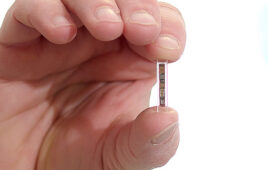
An image of the Ability Neurotech brain-computer interface.

Ability Neurotech spun out of the Wyss Center with its brain-computer interface. Ability stands for Active Brain Implant Live Information sYstem. [Photo courtesy of the Wyss Center]

Brain-computer interfaces (BCIs) have made their mark on medtech and Ability Neurotech’s leaders hope their minimally invasive platform’s unique features propel it forward.

In 2025, the company spun out from the Wyss Center for Bio and Neuroengineering, a Swiss nonprofit research organization, with a total investment of $50 million. As a standalone company, Ability Neurotech wants to be a major player in the still-young BCI market, for which analysts have suggested a potential $400 billion opportunity.

Big names are backing big competitors like Neuralink and Synchron, but Ability believes it has a place at the table with first-in-human studies in sight. (Read more about the company’s outlook on its spot in the BCI market at MassDevice.)

Ability Neurotech’s implantable ABILITY system (which stands for Active Brain Implant Live Information sYstem) includes electrodes, the implant itself and an external wearable device. The company says its technology has a highly advanced ability to record, transmit, analyze, and stimulate the brain. The company seeks to restore fundamental functions and improve the quality of life for patients.

Ability Neurotech CEO Rotem Kopel and Chief Business Officer Craig Cook explained how this all comes together in a Medical Design and Outsourcing interview. The following has been lightly edited for space and clarity.

MDO: What are the components of the ABILITY device?

A photo of Ability Neurotech Chief Business Officer Craig Cook.

Ability Neurotech Chief Business Officer Craig Cook [Photo courtesy of the Wyss Center]

Cook: “There are three components: the electrodes, the implant itself and the wearable. The initial access is through a very small borehole. Electrodes sit on the cortex, on the surface of the brain. The implant is placed on the skull and the skin is closed over the skull, because the thin form factor is opened in the wearable docks by magnets that are kept in place. Then, the data transfer is 50 megabits per second (Mbps) via the laser-based system that we’ve developed over the past eight years.

“The key thing here is 5 mm thickness. Anything more than 5 mm, you need to host it externally or have a chest-mounted implant. We wanted to make sure we could keep it below 5 mm. Then, it could be placed on the skull without any need for bone work, then the skin can be closed over.”

Kopel: “On the topic of safety and patient simplicity, we chose not to have a battery in the implant. The battery has a coil and the implant is really being powered by the external device, inducing power to the implant. By [doing] that, we can supply more power to the implant to do everything we need. Also, sometimes you need to change your battery and on the pacemaker at the beginning, it was something that was recurring very fast. It’s a full-brain surgery. You can’t just replace the battery back. It means you have to open the brain again, take out the electrodes and implant them back. … Our choice was to avoid that risk of replacing the battery.”

MDO: What does Ability’s technology do?

An illustration depicting the Ability Neurotech BCI system's wearable on a patient's skull.

The Ability Neurotech BCI system’s external wearable powers the implant beneath it. [Illustration courtesy of Ability Neurotech]

Kopel: “We are recording data from the brain. Most of the translation and decoding application is done externally. In order to have the maximum capacity that we could have, to have the best decoding, to have the most flexibility on designing today’s application and tomorrow’s application, to understand the brain better to understand the disease better, the intention of ABILITY was to extract all the data we record. By doing that, we are recording raw data like everyone else that we are also extracting from the brain, from the implant, to the brain-computer interface.”

MDO: How does it achieve this?

Kopel: “You have many channels. Your information is the brain. We work at a very high pace in order to do what we do. We speak, we move, we have so much different sensing information that goes in. All of that is happening super fast. It’s not only that you have many channels, but the information is being conducted in the brain at a very high pace. To extract that out, you cannot use a common communication system like Bluetooth or RF. All that is not enough to extract our data. To maintain all those principles, we have developed an optical communication. We have a laser from the implant to the wearable and the principle is that when you’re shooting light via skin, it doesn’t show very well, but light is actually transferring very well over the skin. So when you have a laser within the implants and you’re modulating the information on top of a laser, an external device that actually captures it could send high-speed data and a lot of capacity over that link. Our technology is extracting the raw data of our brain recording. That allows us to not compromise. It allows us to have the full information of everything we record.”

An image of the Ability system's field programable gate array (FPGA).

The ABILITY system’s field programable gate array (FPGA) at the center of this image reads neural data from the patient, manages power and communicates with the implant and the wearable components. [Photo courtesy of the Wyss Center]

MDO: Were there any significant challenges in the design process at Ability?

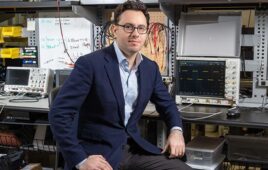
A photo of Ability Neurotech CEO Rotem Kopel.

Ability Neurotech CEO Rotem Kopel [Photo courtesy of Ability Neurotech]

Kopel: “From the principle of understanding that we need to extract everything through how we designed the system, having that communication and supporting that with a brain implant, that is a very challenging task for a medical device. It’s not a router that sits on the table and you could have as much power [as you’d like] and you don’t care for the heat. You have to think about power, you have to think about the temperature and you have to think about putting all that in less than a 5 mm-thick device. That’s a complex task.

“What do we do different is we believe in raw data that allows us to have the full system, from recording to how we communicate out to how we define our decoding. … We don’t discriminate any information, and that’s unique. The device itself is set to have full safety for patients with the electrodes sitting on the surface of the brain. They’re not penetrating the brain. When you are penetrating the brain with electrodes — and some companies are doing that — you’re risking a different reaction between the brain and those electrodes. Most of the time, you lose the quality of data. Over even one year, you dramatically lose the amount of data you have because of scarring around the tissue.”

“The wearable sits on top of the brain. It’s 5 mm thick, so patients do not look funny. They don’t have something coming out, they don’t have wires running through the chest. The flexibility and the robustness of the device are there for the patient for a long time. As a concept, data and patient safety really guided us through all the design choices we made.”

MDO: What are the key differences between your technology and the competition?

An illustration depicting the Ability BCI implant's electrodes on a patient's brain.

This illustration depicts the Ability implant’s electrodes on a patient’s brain. [Illustration courtesy of Ability Neurotech]

Kopel: “Because each one of us took such a different approach to BCI by the way we designed the system, even though we target the same population it created a very different solution. In the end, we have chosen to use surface electrodes to get a very wide coverage of different areas. … For the patient, it’s less invasive. It will be stable for a long duration of time, because we know that the electrode could stay [working] for 10 years or more. When we look at long-term implantation, it ticks all the boxes.

“Second … we don’t transmit at 1 Mbps. We transmit at 50 Mbps. The real secret is what a 50 Mbps transmission allows us to transmit. The brain is super efficient. … You have to develop a very unique communication system that would run 50 Mbps and up in order to extract everything. With ABILITY at 50 Mbps, it allows us to transmit movement, sight, speech, everything. When we are looking at what we can offer from the electrodes, the network analysis that we could have the durability of the electrodes, the placement of the implant, and the communication system that extracts raw data. All that is a full package.”

MDO Min-Vasive Medtech: Download our free 72-page special report featuring interviews with minimally invasive device development experts and engineers at major OEMs and groundbreaking startups


About The Author

Avatar photo
Sean Whooley

Sean Whooley is an associate editor who mainly produces work for MassDevice, Medical Design & Outsourcing and Drug Delivery Business News. He received a bachelor's degree in multiplatform journalism from the University of Maryland, College Park. You can connect with him on LinkedIn or email him at [email protected].

Related Articles Read More >

An illustration of CSF flow through the brain.
MIT researchers find pink noise can encourage CSF flow during sleep
A photo of Kitea Health's Kitea Sensor with fingers for scale.
Intracranial sensor maker says automated testing slashed firmware development time
A photo of Institute of Bioelectronic Medicine at the Feinstein Institutes professor and leader of the vagus nerve project Dr. Stavros Zanos.
This researcher’s development could inspire new and next-gen neuromod technologies
Feinstein Institutes' research on the vagus nerve under a microscope.
Researchers complete first-of-its-kind vagus nerve anatomical map
“mdo
EXPAND YOUR KNOWLEDGE AND STAY CONNECTED
Get the latest medical device business news, application and technology trends.

DeviceTalks Weekly

See More >

MDO Digital Edition

Digital Edition

Subscribe to Medical Design & Outsourcing. Bookmark, share and interact with the leading medical design engineering magazine today.

MEDTECH 100 INDEX

Medtech 100 logo
Market Summary > Current Price
The MedTech 100 is a financial index calculated using the BIG100 companies covered in Medical Design and Outsourcing.

New MedTech Resource

Medical Tubing

MassDevice

Mass Device

The Medical Device Business Journal. MassDevice is the leading medical device news business journal telling the stories of the devices that save lives.

Visit Website
MDO ad
Medical Design and Outsourcing
  • MassDevice
  • DeviceTalks
  • MedTech100 Index
  • Medical Tubing + Extrusion
  • Medical Design Sourcing
  • Drug Delivery Business News
  • Drug Discovery & Development
  • Pharmaceutical Processing World
  • R&D World
  • About Us/Contact
  • Advertise With Us
  • Subscribe to Print Magazine
  • Subscribe to our E-Newsletter
  • Listen to our Weekly Podcasts
  • Join our DeviceTalks Tuesdays Discussion

Copyright © 2026 Arrowfly, LLC. All Rights Reserved. The material on this site may not be reproduced, distributed, transmitted, cached or otherwise used, except with the prior written permission of Arrowfly LLC. Site Map | Privacy Policy | RSS

Search Medical Design & Outsourcing

  • Home
  • Medical Device Business
    • Mergers & Acquisitions
    • Financial
    • Regulatory
  • Applications
    • Cardiovascular
    • Devices
    • Imaging
    • Implantables
    • Medical Equipment
    • Orthopedic
    • Surgical
  • Technologies
    • Supplies and Components Index
    • Contract Manufacturing
    • Components
    • Electronics
    • Extrusions
    • Materials
    • Motion Control
    • Prototyping
    • Pumps
    • Tubing
  • MedTech Resources
    • Medtech Events in 2026
    • The 2025 Medtech Big 100
    • Medical Device Handbook
    • MedTech 100 Index
    • Subscribe to Print Magazine
    • DeviceTalks
    • Digital Editions
    • eBooks
    • Educational Assets
    • Manufacturer Search
    • Podcasts
    • Webinars / Digital Events
    • Whitepapers
    • Voices
    • Views
    • Video
  • 2026 Leadership
    • 2025 Winners
    • 2024 Winners
    • 2023 Winners
    • 2022 Winners
    • 2021 Winners
  • Women in Medtech
  • Advertise
  • Subscribe