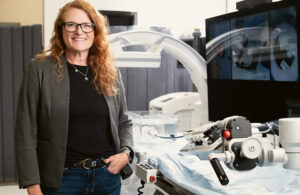
Capstan Medical CEO Maggie Nixon posing with the structural heart startup’s robotic catheter delivery system for heart valve implants. [Photo courtesy of Capstan Medical]
She’s the CEO of Intuitive-backed heart valve implant and robotics developer Capstan Medical and has spoken often with Medical Design & Outsourcing to offer updates on the technology and advice for other device developers.
For the first interview in our new MDO Medtech Career ProFiles series, we interviewed Nixon to learn more about how she built her medtech career, what her job is like at the Santa Cruz, California startup, and lessons others could learn from her career.
The following has been lightly edited for space and clarity.
MDO: How did you get into medtech?
Nixon: “When I started at Stanford University, I thought I wanted to be a doctor. You hear a lot of folks in medtech say that. The summer after my freshman year, I had taken a bunch of the pre-med classes and went back home. My family had all moved during my first year of college to Neenah, Wisconsin, so I went to a place I’d never been before and got a job at the local hardware store. A neighbor came over to my parents’ house and said, ‘Hey, I’m a perfusionist and my perfusionist assistant just went into pre-term labor.’ We’re in a small town in Wisconsin. There’s not a lot of folks that are trained up. And she said, ‘I heard from your parents that you’re in pre-med and I’ve got this opportunity until I get a final placement. If you want to get certified for this role, you could come be in the cardiac OR with me.’ So of course, I moved my hardware job to the evenings and she handed me eight binders. I took the tests on Monday, and on Tuesday I was her help in in the cardiac suite for open-heart surgeries: aneurysms and bypasses and valve surgeries. That was my introduction. I was an 18-year-old in the cardiac suite looking at all of the incredible technology serving those patients. I had always been a tinkerer and I very quickly realized I want to be working on these devices — not necessarily being the user — and thought about how many more patients you can impact by bringing a tool to those clinicians. I went back to school and pivoted with a design-your-own-major in medical device design called biomechanical engineering. The day after I got out of university, I took a job at Intuitive.”
What was that first job?
Nixon: “I was an instrument design engineer focusing on cardiac surgery instrumentation for my first several years at Intuitive.”
How did you get into Intuitive?
Nixon: “I went to college on a track and field scholarship, and you have to be very careful about the jobs you can take as a scholarship athlete. My big source of shampoo money was babysitting. I worked at Stanford Sierra Camp during the summers working with kids and babysat on the side during the year. When I got into my senior year, I realized I didn’t have a network to get an engineering job, so I sent my resume to all of the families I was babysitting for. Sure enough, one of the families sent my resume to his graduating class from business school that happened to be a VC for Intuitive. The same resume stuck with me at Intuitive for the whole time, the one-pager with my parents’ address at the top. When I took this job as CEO, I sent the resume to my CTO — Dan Wallace, who was my first boss at Intuitive — and said, ‘Can you believe you hired me?’ And he was laughing because it was his handwriting at the bottom of my resume to give me a screening call back in the day when I was still a senior in college.”

Capstan Medical founder and Chief Technology Officer Dan Wallace and CEO Maggie Nixon [Photo courtesy of Capstan Medical]
What were your track and field events?
Nixon: “Shot put, discus and hammer. I threw heavy metal objects for a living.”
What are the keys to success in medtech? Any advice for people trying to break into medtech or make it in medtech?
Nixon: “Being really passionate about what you’re working on is important. That comes from two places. It’s the people you’re working with and the products you’re going to be working on, no matter what. Don’t be picky about what that role is, because you’re going to learn something from any role. If you like the people and you like the product and you connect with the mission, take a role. Especially these fast-moving companies, they’re evolving so quickly. There are so many different opportunities and that only strengthens the company, because you’ve got people that understand the business from so many different directions. That feeds into how you think about growth. You don’t have to grow in only one vertical. Yes, I was an engineer or an engineering manager for my first decade, but you can take an engineering framework and mindset to problem-solve anywhere in a business: org design or financial modelings or failure mode, all of that can use engineering-structured thinking. It still serves me well. I still get out a whiteboard whether I’m mapping our next funding or thinking about our business model or an org design. Get out a whiteboard, put down the problem statement, and think about different ways to tackle it.”
The 2026 MDO Medtech Startups Special Report: Technical tips and actionable advice for device startups
Are there any mantras, mottos or phrases that you often find yourself thinking or saying when working with your team or trying to keep yourself moving forward?
Nixon: “When somebody comes and asks about something or is dealing with an issue, my first question is always, ‘What’s the impact to our patients?’ And I have a sign at my desk that’s a quote: ‘I would rather have questions that can’t be answered than answers which can’t be questioned.'”
What’s an average workday like for you?

Capstan Medical CEO Maggie Nixon and the structural heart robotics startup’s testing fixture for its system [Photo courtesy of Capstan Medical]
When are you usually heading back home?
Nixon: “It depends. I’ve been traveling a bunch, so I try to be as present as possible in the office when I’m not on the road, so probably I’m back home around seven.”
Any travel tips?
Nixon: “I covet plane time. Wi-Fi always sucks on a plane and your phone can’t ring, so I go into my flight time with things that I need to read, focused drafting time or editing time, things where I don’t need a million monitors. I have a ‘plane work’ meeting on my calendar with the actions that I’m trying to get done in that window. Sometimes it can be some of the best focus time out there. And I have music blasting in my headphones, cranking on the plane. … Usually, if I’m trying to think, I’m a music person, and that’s how I put myself in my own little bubble.”
Do you read a lot for work?
Nixon: “I’m always reading. The book we read within Capstan last year is called ‘The Geek Way,’ about thinking about the right things, bringing the right people into the room, having the right discussions, challenging each other in the right way. It was a great book to think through that. But it doesn’t have to be a business book to be valuable. The No.1 book on my list — because I always have a top 10 running — is called ‘A More Beautiful Question.’ It’s all about if you don’t ask the right question, you’re never going to get the right answer, so have you thought through the question itself? And that can be applicable to business and applicable to life.”
What frustrates you the most in your medtech job?

Capstan Medical is developing novel mitral and tricuspid heart valves, as well as robot-assisted catheter delivery technology for minimally invasive implantation. [Photo courtesy of Capstan Medical]
And what brings you the most joy?
Nixon: “It’s being out in the clinic and seeing the product impact a patient. Without question, that is what hits home every single time. If it has been a good amount of time since I’ve been out at a hospital or in a clinic, it feels like I’m missing something. That’s why we get into medtech.”
We’ll have more Medtech Career ProFiles interviews with medical device innovators and leaders in this series in the coming months. Sign up for our free twice-weekly newsletter so you don’t miss the next one.