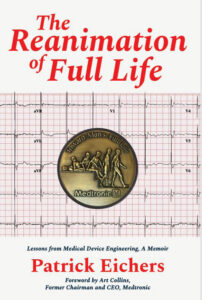
“The Reanimation of Full Life” is a memoir by retired medical device engineer Patrick Eichers with a foreward by former Chairman and CEO, Medtronic Art Collins. [Image courtesy of Forest Floor Publishing]
I’ll be the first to admit that an engineering memoir may not sound like a page-turning thriller, but there’s an adage in the medical device industry: “Not documented, not done.”
With that in mind, I did not want many of the remarkable events I witnessed to fade into oblivion.
My new memoir, The Reanimation of Full Life, presents my experiences at Medtronic, first as a reliability engineer and later as quality manager. This work aims to capture what happens at the lower levels of an organization during the development and post-market surveillance of medical devices. And it’s all based on true events.
A different perspective
I worked in engineering for 41 years, having recently retired from my second corporation. Over those years, I read several books by executives who detailed their climb to the top. However, I was less interested in what they accomplished and more interested in understanding how they did it and what they could recommend as wisdom for others. This, someone told me, is the distinction between being successful and being significant.
Thus, in my memoir, I will take you inside my world for over three decades. You’ll share my missteps along the way, the problems I encountered, and how others — and a little luck —allowed me to extricate myself from these predicaments. It’s not what I did, but the lessons I learned that make this book more entertaining and rewarding.
The challenges of medical device engineering, and the Medtronic Mission

Former medical device engineer Patrick Eichers is retired from both Medtronic and Johnson & Johnson MedTech. [Photo courtesy of Forest Floor Publishing]
I think there’s something unique about medical device engineering, especially when a project addresses an unmet medical need. It requires trust in others and faith in your purpose; creative problem-solving; and risk-based decision-making.
As a reliability engineer, I often had to predict future performance based on incomplete information. How do you convert lab data to effective in vivo functionality? When is good, good enough? When do random events stop being random?
Two critical workplace values influenced me throughout my career. Foremost is the Medtronic Mission, a six-point statement that — as corny as it sounds — brought out the best of the organization. The third point urged employees to “strive without reserve” for the highest levels of quality and reliability in our products. As someone in the frontline trenches, I used this statement in all sorts of debates and disagreements. Inevitably, when you side with a customer’s best interests, you hold the high ground.
Another inspiration was the words of Medtronic co-founder Earl Bakken. He described the occasional need for a “ready, fire, aim” attitude when confounding circumstances halt your progress.
Lessons learned
So instead of rattling on about these events and what we did, I organized my observations into thirty-two lessons. These include: belonging, involvement and empowerment, whatever it takes, asking deep questions, avoiding complacency, competence, confidence, reputation, leadership, inspiring others, and gratitude.
Nothing is instructional. My recollections only provide examples. I fully believe everyone will find solutions to their situations in their own hearts and minds.
An excerpt from The Reanimation of Full Life:
A career in quality has many benefits, such as offering a panoramic view of one’s workplace, provided the local culture tolerates you putting your nose in places where it may or may not be welcome. Some groups, like Technical Services, welcomed me with open arms. Other functions greeted me as if I were a bedwetting orphan.
Among the former, I developed a growing curiosity in the process of investigating customer complaints. There was something intriguing about allegations involving malfunctioning products, or the questionable techniques of an implanting physician, or the implausible claims cited by a patient. It made for a good mystery, like a game of Clue. Each week, I looked forward to the complaints review meeting, trying to solve the whodunit behind every adverse outcome allegedly caused by poor quality, misuse, or random failure.
The disturbing reports with elements of alleged harm haunted me the most. The subject matter was both private and sensitive. You had to be careful with them even in the confines of your manager’s office. One time, I was reiterating a complaint to Gary about a patient suffering a heart attack when Gary interrupted me.
“If you say the word suffered around me again, I’ll teach you the meaning of that word.”
I leaned forward to show him the exact wording in the complaint file. Gary shook his head.
“Experienced,” he said. “The word you are looking for is ‘experienced’.”
At the next complaint meeting, the team reviewed a reported issue involving a Minix IPG recently implanted in Canada. Apparently, the patient with our newest device was experiencing intermittent issues, as if it had the hiccups. The doctor and local rep asked for technical assistance.
“I’ll go,” I heard myself say. The prospect of helping customers and patients excited me, but I was quite certain that, as a relatively new quality guy on the team, no one would be listening. Wrong again.
Patrick Eichers is retired from both Medtronic and Johnson & Jonhnson MedTech. He holds degrees in electrical engineering and english, four ASQ certifications, is a veteran of the USAF, and taught as an adjunct instructor at a community college. His book, The Reanimation of Full Life, is available online at Amazon.com, BarnesandNoble.com, ThriftBooks.com, and at forestfloorpublishing.com.
Read more MDO Contributions and learn how to submit your own.
The opinions expressed in this blog post are the author’s only and do not necessarily reflect those of Medical Design & Outsourcing or its employees.




Tell Us What You Think!
You must be logged in to post a comment.