Medical Design and Outsourcing

  • Home
  • Medical Device Business
    • Mergers & Acquisitions
    • Financial
    • Regulatory
  • Applications
    • Cardiovascular
    • Devices
    • Imaging
    • Implantables
    • Medical Equipment
    • Orthopedic
    • Surgical
  • Technologies
    • Supplies and Components Index
    • Contract Manufacturing
    • Components
    • Electronics
    • Extrusions
    • Materials
    • Motion Control
    • Prototyping
    • Pumps
    • Tubing
  • MedTech Resources
    • Medtech Events in 2026
    • The 2026 Medtech Big 100
    • Medical Device Handbook
    • MedTech 100 Index
    • Subscribe to Print Magazine
    • DeviceTalks
    • Digital Editions
    • eBooks
    • Educational Assets
    • Manufacturer Search
    • Podcasts
    • Webinars / Digital Events
    • Whitepapers
    • Voices
    • Views
    • Video
  • 2026 Leadership
    • 2025 Winners
    • 2024 Winners
    • 2023 Winners
    • 2022 Winners
    • 2021 Winners
  • Women in Medtech
  • Advertise
  • Subscribe

This de novo minimally invasive system was designed for safer hysterectomies

The new safety feature makes uterus extraction simpler and faster.

September 8, 2026 By Julia Rock-Torcivia

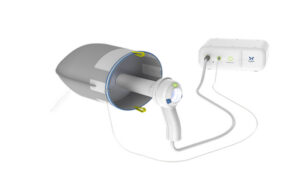
An image of Claria's system for minimally invasive hysterectomies.

Claria Medical designed its minimally invasive system for hysterectomies to minimize patient risk and procedure time. [Image courtesy of Claria Medical]

Claria Medical won FDA de novo classification in July 2026 for its minimally invasive system for hysterectomy.

Hysterectomies are among the most common surgeries for women, but “many current approaches fall short,” the Mountain View, California-based company says at its website.

“High container breach rates risk hidden cancer spread or bowel injury,” the company said. “Significant abdominal incisions leave scars and cause unnecessary hospital readmissions [and] procedure times are highly variable.”

Claria Medical describes its new option as “an intelligent system designed for safe extraction of an enlarged uterus using a vaginal approach with no mini-laparotomy, minimizing patient risk, recovery and scarring.”

Watch on-demand: The 2026 MDO Min-Vasive Medtech webinar series

In 2023, Claria Medical secured a strategic investment from Organon in a deal that gave the publicly traded device developer the option to acquire Claria Medical. Caria also says it has won grants from the National Science Foundation and National Institute of Health to “develop products to improve hysterectomy, myomectomy and other surgical procedures.”

How the minimally invasive Claria system works

The Claria system is indicated for “contained cutting, coring and extraction of tissue during laparoscopic hysterectomy,” according to the FDA classification order. The device was accepted into the FDA’s Safer Technologies Program (STeP), which is designed to expedite review for devices that could improve the safety of treatment or diagnostics.
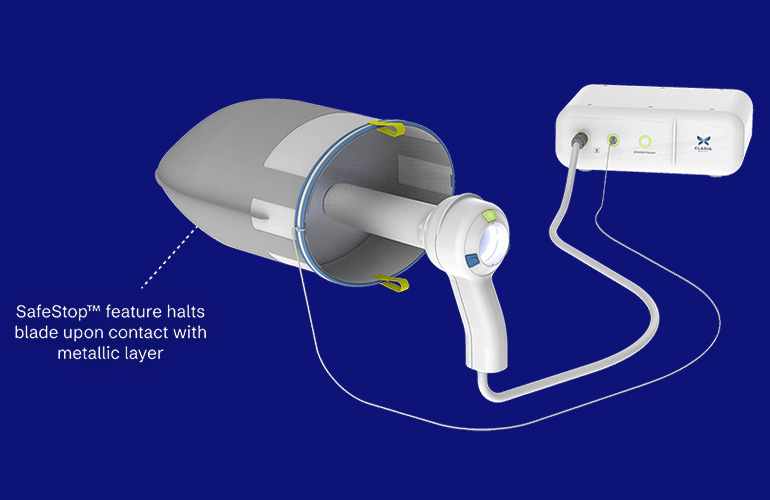
This illustration of the Claria Medical system for minimally invasive hysterectomies highlights the SafeStop feature.

This illustration of the Claria Medical system for minimally invasive hysterectomies highlights the SafeStop feature. [Image courtesy of Claria Medical]

The FDA’s de novo classification for the Class II device created a new generic device type called “gynecologic power morcellator and containment system.”

The FDA defined that kind of device as “a prescription device consisting of an integrated power morcellator and a containment method that are intended to contain, reduce and remove gynecologic tissue that is not suspected to contain malignancy during minimally invasive surgery.”

The Claria system consists of three components: a handpiece, a container and a console that allows for communication between the two.

The handpiece has integrated lighting and a rotating cutter with a 34 mm cutting blade.
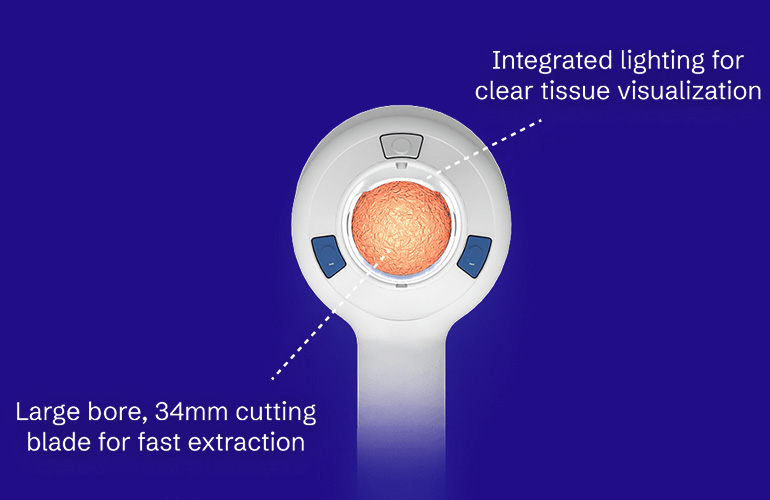
The Claria system’s handpiece [Image courtesy of Claria]

The container has a triple-layer design with a metallic cloth layer to prevent damage. The system’s SafeStop feature stops the blade rotation upon contact with the metallic layer of the container using electronic communication between the container and the handpiece, a feature designed to prevent organ injury and tissue spread.

To perform a hysterectomy with the system, the uterus is first detached from the body laparoscopically. Then the container is inserted through the vagina into the abdominal cavity and the uterus is placed into the container.
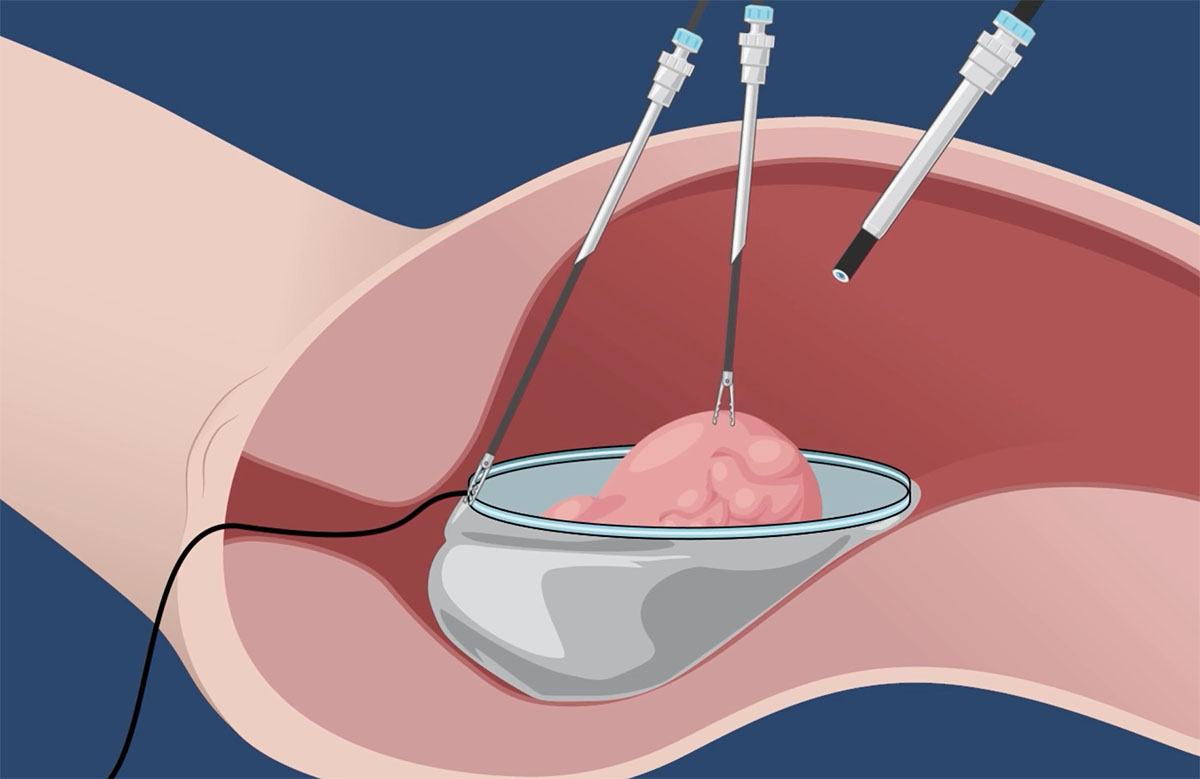
An illustration depicting the first step of a minimally invasive hysterectomy using Claria Medical's system.

For a hysterectomy with Claria Medical’s system, the uterus is laparoscopically deteched from the patient’s body and placed into the Claria system’s container inside the abdominal cavity. [Image courtesy of Claria Medical]
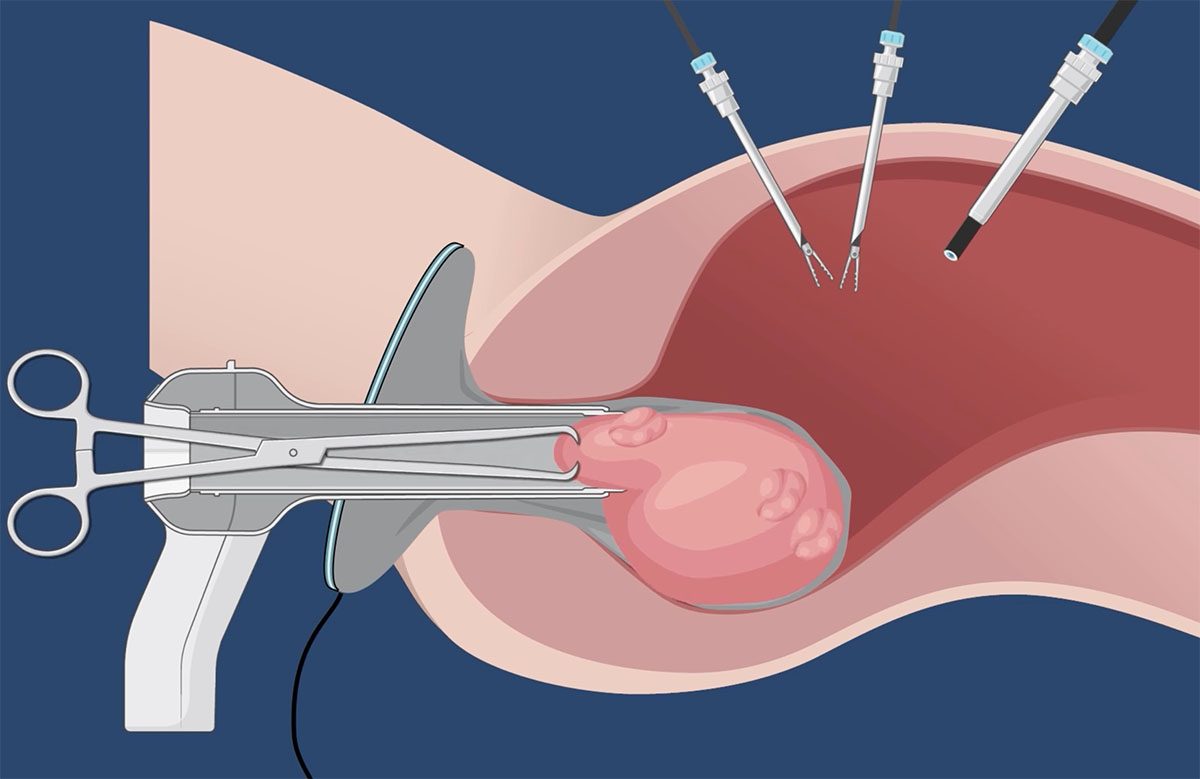
The rim of the container is then externalized, and the handpiece is inserted into the container. A tenaculum is inserted through the handpiece to grasp the tissue. The blade begins tissue reduction and when the tissue is sufficiently reduced, the handpiece and the container (with any remaining portion of the uterus) are removed.

An illustration depicting the extraction of a uterus using the minimally invasive Claria Medical system.

After the uterus is placed in the container, its rim is pulled outside of the patient for tissue reduction and removal using the handpiece, through which a tenaculum can grasp the tissue. To prevent organ damage or tissue spread, the handpiece’s blade automatically stops cutting if it contacts the container. [Image courtesy of Claria Medical]

The FDA added a requirement for the device’s labeling to include a contraindication for use in gynecologic surgery in which the tissue to be morcellated is known or suspected to contain malignancy.

There is also a contraindication for the removal of uterine tissue containing suspected fibroids in patients who are post-menopausal, over the age of 50 or candidates for en bloc tissue removal through the vagina or via a mini-laparotomy incision. The FDA left room for this contraindication to be lifted if clinical data supports it.

When used in women with fibroids, the system is indicated for women who are premenopausal and under age 50.

The FDA also required the labeling to carry a boxed warning identifying the risk of unsuspected cancer, the potential for dissemination and that use of this device has not been clinically demonstrated to reduce that risk.

You can learn more about the system and watch a video depicting the procedure at Claria Medical’s website.

Related Articles Read More >

Feminai's breast sensor patch
AdvaMed and MedTech Innovator name 2026 prize winners and finalists
The SNAP test detects concussions in 90 seconds [Photo courtesy of Oculogica]
Medtronic, Recor, Oculogica and more make Time’s best inventions list
The most innovative medical devices of 2026
An illustration showing Corcym's Memo 4D Curve's laser-cut nitinol core.
Laser-cut nitinol and a layered design let these cardiac implants flex
“mdo
EXPAND YOUR KNOWLEDGE AND STAY CONNECTED
Get the latest medical device business news, application and technology trends.

DeviceTalks Weekly

See More >

MDO Digital Edition

Digital Edition

Subscribe to Medical Design & Outsourcing. Bookmark, share and interact with the leading medical design engineering magazine today.

MEDTECH 100 INDEX

Medtech 100 logo
Market Summary > Current Price
The MedTech 100 is a financial index calculated using the BIG100 companies covered in Medical Design and Outsourcing.

New MedTech Resource

Medical Tubing

MassDevice

Mass Device

The Medical Device Business Journal. MassDevice is the leading medical device news business journal telling the stories of the devices that save lives.

Visit Website
MDO ad
Medical Design and Outsourcing
  • MassDevice
  • DeviceTalks
  • MedTech100 Index
  • Medical Tubing + Extrusion
  • Medical Design Sourcing
  • Drug Delivery Business News
  • Drug Discovery & Development
  • Pharmaceutical Processing World
  • R&D World
  • About Us/Contact
  • Advertise With Us
  • Subscribe to Print Magazine
  • Subscribe to our E-Newsletter
  • Listen to our Weekly Podcasts
  • Join our DeviceTalks Tuesdays Discussion

Copyright © 2026 Arrowfly, LLC. All Rights Reserved. The material on this site may not be reproduced, distributed, transmitted, cached or otherwise used, except with the prior written permission of Arrowfly LLC. Site Map | Privacy Policy | RSS

Search Medical Design & Outsourcing

  • Home
  • Medical Device Business
    • Mergers & Acquisitions
    • Financial
    • Regulatory
  • Applications
    • Cardiovascular
    • Devices
    • Imaging
    • Implantables
    • Medical Equipment
    • Orthopedic
    • Surgical
  • Technologies
    • Supplies and Components Index
    • Contract Manufacturing
    • Components
    • Electronics
    • Extrusions
    • Materials
    • Motion Control
    • Prototyping
    • Pumps
    • Tubing
  • MedTech Resources
    • Medtech Events in 2026
    • The 2026 Medtech Big 100
    • Medical Device Handbook
    • MedTech 100 Index
    • Subscribe to Print Magazine
    • DeviceTalks
    • Digital Editions
    • eBooks
    • Educational Assets
    • Manufacturer Search
    • Podcasts
    • Webinars / Digital Events
    • Whitepapers
    • Voices
    • Views
    • Video
  • 2026 Leadership
    • 2025 Winners
    • 2024 Winners
    • 2023 Winners
    • 2022 Winners
    • 2021 Winners
  • Women in Medtech
  • Advertise
  • Subscribe

