Medical Design and Outsourcing

  • Home
  • Medical Device Business
    • Mergers & Acquisitions
    • Financial
    • Regulatory
  • Applications
    • Cardiovascular
    • Devices
    • Imaging
    • Implantables
    • Medical Equipment
    • Orthopedic
    • Surgical
  • Technologies
    • Supplies and Components Index
    • Contract Manufacturing
    • Components
    • Electronics
    • Extrusions
    • Materials
    • Motion Control
    • Prototyping
    • Pumps
    • Tubing
  • MedTech Resources
    • Medtech Events in 2026
    • The 2025 Medtech Big 100
    • Medical Device Handbook
    • MedTech 100 Index
    • Subscribe to Print Magazine
    • DeviceTalks
    • Digital Editions
    • eBooks
    • Educational Assets
    • Manufacturer Search
    • Podcasts
    • Webinars / Digital Events
    • Whitepapers
    • Voices
    • Views
    • Video
  • 2026 Leadership
    • 2025 Winners
    • 2024 Winners
    • 2023 Winners
    • 2022 Winners
    • 2021 Winners
  • Women in Medtech
  • Advertise
  • Subscribe

Researchers develop first wearable for continuous monitoring of body sounds

November 20, 2023 By Jim Hammerand

A photo of a body sounds monitor on a baby.

This soft, wireless device prototype can continuously monitor the body sounds inside and outside of a patient, including premature babies. [Photo courtesy of Northwestern University]

Northwestern University researchers have developed wearable devices for continuously monitoring the sounds made by a patient’s body, such as breathing, heartbeats and digestion.

The soft devices stick to a patient’s skin and use two high-performance, digital microphones to listen to sounds inside and outside the body. One of the microphones faces inside the patient, while the other faces outward and an algorithm separates external and internal sounds.

“Lungs don’t produce enough sound for a normal person to hear,” Northwestern Medicine thoracic surgeon Dr. Ankit Bharat said in a post at the university’s website. “They just aren’t loud enough, and hospitals can be noisy places. When there are people talking nearby or machines beeping, it can be incredibly difficult. An important aspect of our technology is that it can correct for those ambient sounds.”

Bharat led the team’s clinical research in 55 adult subjects, including 20 with chronic lung diseases. The researchers also tested their devices on 15 premature babies with respiratory and intestinal motility disorders.

“Lungs can make all sorts of sounds, including crackling, wheezing, rippling and howling,” Bharat said. “It’s a fascinating microenvironment. By continuously monitoring these sounds in real-time, we can determine if lung health is getting better or worse and evaluate how well a patient is responding to a particular medication or treatment. Then we can personalize treatments to individual patients.”

The researchers said their devices delivered clinical-grade accuracy and entirely new functions.

“Currently, there are no existing methods for continuously monitoring and spatially mapping body sounds at home or in hospital settings,” said Northwestern professor John Rogers, who led the device’s development. “Physicians have to put a conventional, or a digital, stethoscope on different parts of the chest and back to listen to the lungs in a point-by-point fashion. In close collaborations with our clinical teams, we set out to develop a new strategy for monitoring patients in real-time on a continuous basis and without encumbrances associated with rigid, wired, bulky technology.”

The team developed the devices “to provide highly accurate, continuous evaluation of patient health and then make clinical decisions in the clinics or when patients are admitted to the hospital or attached to ventilators,” Bharat said.

“A key advantage of this device is to be able to simultaneously listen and compare different regions of the lungs,” he said. “Simply put, it’s like up to 13 highly trained doctors listening to different regions of the lungs simultaneously with their stethoscopes, and their minds are synced to create a continuous and a dynamic assessment of the lung health that is translated into a movie on a real-life computer screen.”

The body sounds monitor device design
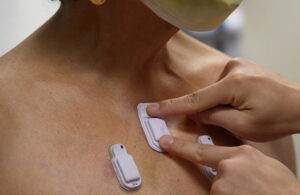
A photo of a wireless, wearable device that has microphones to monitor body sounds inside of a patient.

This wireless, wearable device has microphones that monitor body sounds inside of a patient. [Photo courtesy of Northwestern University]

The devices are 40 mm long, 20 mm wide and 8 mm thick. They’re encapsulated in soft silicone and contain a flash memory drive, battery, Bluetooth components, accelerometers and miniaturized microphones.

These components work together to map the flow of air in, through and out of the lungs; how cardiac rhythm changes when a patient is active or at rest; and how food, gas and fluids move through the intestines.

The devices are placed on babies just below the suprasternal notch at the base of their throats, or on the right and left chest.

“When placed on the suprasternal notch, the enhanced ability to detect and classify apneas could lead to more targeted and personalized care, improved outcomes and reduced length of hospitalization and costs,” paper co-author Dr. Wissam Shalish, a neonatologist at the Montreal Children’s Hospital. “When placed on the right and left chest of critically ill babies, the real-time feedback transmitted whenever the air entry is diminished on one side relative to the other could promptly alert clinicians of a possible pathology necessitating immediate intervention.”

When placed on a baby’s abdomen, the devices can listen for digestion issues, intestinal dysmotility and potential obstructions.

The devices also monitor and record noise levels around babies, which “offers immediate opportunities to address any sources of stressful or potentially compromising auditory stimuli,” Shalish said.

These noninvasive, continuous monitors can also collect data without disturbing the babies, many of which are smaller than a stethoscope and already technically challenging to monitor, said co-author Dr. Debra Weese-Mayer, chief of autonomic medicine at Ann & Robert H. Lurie Children’s Hospital of Chicago.

” These acoustic wearables provide the opportunity to safely and non-obtrusively determine each infant’s ‘signature’ pertinent to their air movement (in and out of airway and lungs), heart sounds and intestinal motility day and night, with attention to circadian rhythmicity,” she said. “And these wearables simultaneously monitor ambient noise that might affect the internal acoustic ‘signature’ and/or introduce other stimuli that might affect healthy growth and development.”

Read more from the researchers in their study in the journal Nature Medicine.

About The Author

Jim Hammerand

Jim Hammerand is the managing editor of Arrowfly's Medical Design & Outsourcing, where he leads coverage of medtech innovation, design, engineering and manufacturing. He also reports breaking news at Arrowfly's MassDevice and contributes to our DeviceTalks podcasts and live events. Hammerand has more than two decades of journalism experience spanning newspapers, magazines, websites, live events, radio and TV news. For nearly a decade, Hammerand reported and edited business news for American City Business Journals as a reporter and digital editor at the Minneapolis/St. Paul Business Journal and then as managing editor of the Puget Sound Business Journal in Seattle. He holds degrees in journalism and management from the University of Minnesota and has won journalism awards from the Society of Professional Journalists, American Society of Business Publication Editors, and Trade, Association, Business Publications International. Connect with him on LinkedIn or by email at [email protected].

Related Articles Read More >

A photo of an Oura Ring 5.
Oura discloses pay packages for top executives ahead of IPO
MIT researchers create breathable hydrogel for less irritation and longer wear 
Engineers create smart ring that tracks biomarkers in finger sweat  
A photo of Becton, Dickinson and Co. Advanced Patient Monitoring Worldwide President Tim Patz.
A continuous monitoring medtech vet charts the course to a less-invasive future
“mdo
EXPAND YOUR KNOWLEDGE AND STAY CONNECTED
Get the latest medical device business news, application and technology trends.

DeviceTalks Weekly

See More >

MDO Digital Edition

Digital Edition

Subscribe to Medical Design & Outsourcing. Bookmark, share and interact with the leading medical design engineering magazine today.

MEDTECH 100 INDEX

Medtech 100 logo
Market Summary > Current Price
The MedTech 100 is a financial index calculated using the BIG100 companies covered in Medical Design and Outsourcing.

New MedTech Resource

Medical Tubing

MassDevice

Mass Device

The Medical Device Business Journal. MassDevice is the leading medical device news business journal telling the stories of the devices that save lives.

Visit Website
MDO ad
Medical Design and Outsourcing
  • MassDevice
  • DeviceTalks
  • MedTech100 Index
  • Medical Tubing + Extrusion
  • Medical Design Sourcing
  • Drug Delivery Business News
  • Drug Discovery & Development
  • Pharmaceutical Processing World
  • R&D World
  • About Us/Contact
  • Advertise With Us
  • Subscribe to Print Magazine
  • Subscribe to our E-Newsletter
  • Listen to our Weekly Podcasts
  • Join our DeviceTalks Tuesdays Discussion

Copyright © 2026 Arrowfly, LLC. All Rights Reserved. The material on this site may not be reproduced, distributed, transmitted, cached or otherwise used, except with the prior written permission of Arrowfly LLC. Site Map | Privacy Policy | RSS

Search Medical Design & Outsourcing

  • Home
  • Medical Device Business
    • Mergers & Acquisitions
    • Financial
    • Regulatory
  • Applications
    • Cardiovascular
    • Devices
    • Imaging
    • Implantables
    • Medical Equipment
    • Orthopedic
    • Surgical
  • Technologies
    • Supplies and Components Index
    • Contract Manufacturing
    • Components
    • Electronics
    • Extrusions
    • Materials
    • Motion Control
    • Prototyping
    • Pumps
    • Tubing
  • MedTech Resources
    • Medtech Events in 2026
    • The 2025 Medtech Big 100
    • Medical Device Handbook
    • MedTech 100 Index
    • Subscribe to Print Magazine
    • DeviceTalks
    • Digital Editions
    • eBooks
    • Educational Assets
    • Manufacturer Search
    • Podcasts
    • Webinars / Digital Events
    • Whitepapers
    • Voices
    • Views
    • Video
  • 2026 Leadership
    • 2025 Winners
    • 2024 Winners
    • 2023 Winners
    • 2022 Winners
    • 2021 Winners
  • Women in Medtech
  • Advertise
  • Subscribe