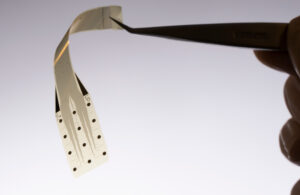
The InBrain Neuroelectronics cortical brain-computer interface system uses graphene to sense brain signals and deliver therapeutic energy. [Photo courtesy of InBrain Neuroelectronics]
Hosted by me — Editorial Director Tom Salemi — these sessions will provide a deep look into materials being developed by three innovative startups.
Each discussion starts at noon Eastern time. Live attendees will be able to get questions answered, but the discussions are available on-demand as well.
Our series sponsors are Boker’s Inc., Forj Medical, Jabil, Mitsubishi Chemical Group, PSN Labs, and Sekisui.
You can register at DeviceTalks.com or use the specific links below.
How Graphene Is Positioned to Drive The Future of Brain-Computer Interface Technology (Tuesday, Nov. 18)

InBrain Neuroelectronics co-founder and CEO Carolina Aguilar [Photo courtesy of InBrain Neuroelectronics]
Inbrain is tapping Graphene’s conductivity, flexibility and biocompatibility to enable safer, more durable neural connections and clearer signals.
Aguilar will explain how Inbrain’s semiconductor-based, patented graphene platform supports scalable, sustainable neural therapies. The material’s high-resolution, flexible structure allows for more precise interfaces and more effective treatments.
We’ll also discuss Inbrain’s recent news that it entered into a strategic collaboration with Microsoft to explore AI in neurology. The companies aim to explore the use of agentic AI, powered by Microsoft’s cloud and data infrastructure, to advance real-time precision neurology and next-generation BCI therapeutics.
Register here.
Reinventing Heart Valves: Driving Innovation with LifePolymer and Robotic Manufacturing (Wednesday, Nov. 19)

Foldax says the LifePolymer material used in its heart valves is biocompatible and resists calcification, making it an ideal replacement for animal tissue. [Image courtesy of Foldax]
Ryan Stanfield, VP of engineering and operations, will give a detailed presentation about LifePolymer, the company’s breakthrough material engineered to withstand the mechanical demands that often limit traditional tissue valves. The material is designed to increase durability while reducing calcification and the need for lifelong anticoagulation.
In addition to new materials, Stanfield will also demonstrate how Foldax uses computational modeling and robotic manufacturing to consistently produce valves with exceptional precision. This approach minimizes variability, enhances quality and supports true scalability.
Register here.
Next-Generation Absorbable Materials: Innovative Manufacturing for the Future of Orthopedic Care (Thursday, Nov. 20)

Bioretec’s Activa implants are made with PLGA, a self-reinforcing biopolymer. [Image courtesy of Bioretec]
RemeOS is composed of magnesium-based absorbable metal alloy. Bioretec shapes the bioactive material into fixation screws that are designed to promote natural bone healing without requiring removal surgery.
Activa is made of poly L-lactide-co-glycolide copolymer (PLGA 85/15), a self-reinforcing biopolymer. PLGA is a material with a longstanding history in medical applications. The ActivaPin material is gradually replaced by bone in approximately two years, eliminating the need for removal surgery.
Lehtonen’s discussion will show how Bioretec pursued proof of safety and efficacy before setting regulatory and commercial strategies. Its products are approved for sale in the U.S. and Europe.
Register here.