DeviceTalks Editorial Director Tom Salemi takes Intuitive’s da Vinci 5 for a spin and talks telesurgery with Chief Digital Officer Brian Miller.
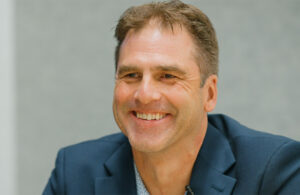
Intuitive Surgical EVP and Chief Digital Officer Brian Miller [Photo by Cole Kistler for Medical Design & Outsourcing]
Brian Miller, then a young software engineer at Zeus maker Computer Motion, witnessed that first spark, known as the Lindbergh operation.
“It really was exciting,” recalls Miller. “At the time when I started, we were just bringing together technology with surgery. It’s what attracted me to this field. But seeing the ability to project expertise across distances was exciting.”
Two years later, surgical robotics pioneer Intuitive would acquire Computer Motion, putting Miller in a position to fulfill the promise of that day. He has risen through Intuitive to become the EVP and chief digital officer at what is now the dominant soft-tissue robotic surgery company.
For the first time in over two decades, wonder over telesurgery is building again. Advances in technology — including telecom, robotics, AI, and imaging — have enabled a handful of surgical robotics companies, such as India-based SS Innovations and MicroPort Scientific Corp. of Shanghai, to perform successful telesurgery procedures in recent months.
Next week, surgical robotics industry executives and surgeons will gather at the Society of Robotic Surgery’s annual meeting in Strasbourg, France, where the 68-year-old patient in the Lindbergh operation rested on a surgical table while surgeons 3,800 miles away removed her gallbladder. The news of the procedures and advances in technology ensures that telesurgery will be widely talked about.
But what happens after the meeting? Are the surgical and medtech communities ready for the broader adoption of telesurgery? Miller, a veteran of two decades of fighting for surgical robotics’ adoption and legitimacy within healthcare, raises some concerns in an interview with DeviceTalks and Medical Design & Outsourcing.

DeviceTalks Editorial Director Tom Salemi operating an Intuitive Surgical da Vinci 5 to perform tasks that demonstrate the surgical robotics system’s capabilities. [Photo by Cole Kistler for Medical Design & Outsourcing]
The operation went incredibly smoothly. The surgical robotic instruments in Sunnyvale seemingly responded immediately to the lever-twisting and button-pushing in Atlanta. The 3D visibility in the console was sharp, as was the audio from Curet, who talked us through a simple exercise of placing rubber rings on small, rubber points.
The experience underlines Miller’s central point: We have the technology to perform telesurgery procedures, but do we have clearly defined user needs that surgical robotics companies can respond to?
Below is a transcript of a 20-minute interview with Miller. The questions and answers have been edited slightly for brevity and clarity.
MDO: How do you view the opportunities in telesurgery?
Miller: “There’s an opportunity in being able to connect remote individuals to collaborate in surgery. And that’s been an important aspect for us for a while. We’ve invested in telepresence, which is audio, video and visuals. There’s opportunity. If you look back to where it started in 2001, the technology building blocks are there.”
You were at the Lindbergh operation. Did you think then that we’d be further along?
Miller: “Hard to say. What we did in 2001 is demonstrate what is possible. But a number of things would have to occur. For example, the [surgical robotics] technology was there, but the access to telecom lines wasn’t. Broadly, of course. So you look over the years and you can start to see that [telecom networks now] reach more places. But you also have to look at the adoption of robotic surgery systems. At that point in time, it wasn’t a proven technology to deliver better outcomes. It was in its infancy. There is now a body of work over the past 25-plus years that has really shown that robotics could deliver better care. So now you dovetail [communication] technology advancement with proven robotics and you’re where we’re at today.”
Where are we today? What do we have available to us that will make telesurgery possible and beneficial?

“The operation went incredibly smoothly,” DeviceTalks Editorial Director Tom Salemi said of his DV5 demo. “The surgical robotic instruments in Sunnyvale seemingly responded immediately to the lever-twisting and button-pushing in Atlanta.” [Photo by Cole Kistler for Medical Design & Outsourcing]
What are the use cases for telesurgery procedures?
Miller: “We separate them into two categories. The first is more collaborative surgery. So the configuration that we have prototyped and are pursuing is our dual-console configuration. You have the patient side cart and you have the vision cart. This configuration, you just take one console and put it in a remote location. You’ve got two surgeons that are collaborating for either a training situation, where a more experienced surgeon is helping to drive best practices and technique improvement to another surgeon, or you could have two different specialties that are collaborating together to perform a procedure on a patient. You have a surgeon in the operating room who is responsible for the patient.”
What’s the second use case?
Miller: “This is when the remote surgeon is the one performing the procedure, which is what we’ve heard a lot about in some of the events that have been done. The technology is very similar to enable that with regard to the robotic system and the networks. But you have a different set of challenges beyond the technology that you have to address, such as what is the hospital safety protocol if you’ve got a remote surgeon that can’t physically get into the operating room during a procedure.”
Let’s talk about the collaborative cases. Where are we today with being able to have two surgeons collaborate remotely?
Miller: “Today we have telepresence, which allows one remote surgeon and one in the operating room with the patient to see the same surgical view. They can communicate. You can point to things. There is a level of guidance and mentoring that can be provided with technology today. With telesurgery capability, the ability now not only to see, hear and point, but the ability to control instruments or control the camera for the field of view is a natural extension to that collaboration. We have those capabilities today. And then as this technology goes through its development pathway, we will enable more capabilities as far as interacting so that continuum makes sense. And even when telesurgery is there, you may have situations where a surgeon just needs a quick second opinion. They don’t need to go in and control instruments, they just need to see the video. And then there will be other situations where being able to sit down and collaborate together during the procedure, each at a console, will be valuable. So that’s what we’re looking to enable.”
What is the timeline for allowing this to happen? When can users of the da Vinci 5 be able to perform this?
Miller: “I’m not going to talk about timelines. We work closely with customers to make sure that as we’re iterating on the design, they come in, they test it out, they provide feedback. That’s how we have found it to be effective to develop a product that meets customer needs.”
Will the da Vinci 5 be able to support collaborative cases?
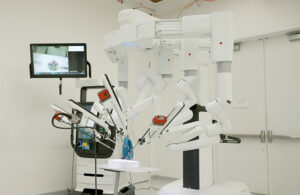
Intuitive’s da Vinci 5 surgical robotics system demonstrator in Atlanta [Photo by Cole Kistler for Medical Design & Outsourcing]
What about the second user case of surgeon and patient in different locations?
Miller: “First, start with the technology. Can somebody in a remote location control the instruments and do what they need to do? That is a common set of capabilities as collaborative surgery. So that’s there. But we are looking at an aspect called situational awareness. We know that a surgeon in a remote location can’t pick up their head and communicate with the OR staff. We’re spending a lot of time really understanding what information that remote surgeon needs to have to be effective in doing the procedure. And I think there’s some work that needs to be done to really understand what it’s like when you don’t have another surgeon in the operating room with you to consult. There’s some work there in what we call situational awareness, which could be user interface. It could be, ‘What views do you need of the operating room?’ Things of that nature. But those are solvable problems.”
What other challenges are there?
Miller: “Look at all of the things that are outside of the technology. Look at licensing, training, start to look at the regulatory pathway for that use case. Regulatory clearance is not about a technology. It’s about a use case in your application. Those are not questions that have been answered, and they’re definitely not questions that have been answered to make it routine use and to do it at scale. Also, what are the economics around it? Having the telecom link in between is going to add cost to a procedure. [We] need to really make sure that the use cases add value such that it makes sense and it can be a durable solution.”
When you hear of the cases being done and being talked about in the headlines, do you have any concerns that we’re putting the cart before the horse a bit or setting expectations higher than they should be?
Miller: “At this point, I really can’t comment on just what those companies are thinking and how they’re going about doing it. … I do think, though, ‘What does the industry need?’ It is really understanding the use cases, the value and then what are all of the obstacles you need to knock down to enable that use case. I think that’s where the focus needs to be. Then at that point in time you can start to say, ‘OK, are there any technology gaps? Where are the policy gaps and regulatory gaps?’ So we’re stepping back and saying, ‘It’s not important to be the first company to market.’ What’s important is to make sure that when we get there, it’s done right, it’s safe, and it satisfies the customer’s needs. It’s similar to all the innovation that we’ve been doing for the past 30 years.”
Looking forward 10 or 20 years, how big a part is telesurgery in surgical robotics?
Miller: “We’ll see what use cases it enables. Even with significant advancements in telecom, there are still large parts of the world where it remains a challenge. When performing a case in an underserved region, you still need highly skilled individuals in the operating room, along with infrastructure that can support telecom communication. You need to pave the roads first. It’s like EV technology — you need the infrastructure to charge the cars before you can achieve widespread adoption. There’s still work to be done. We believe telesurgery will fit into the broader telecollaboration continuum. It will be enabling, but we’ll see how the use cases evolve. I’m just as excited to see what it looks like in 10 years.”