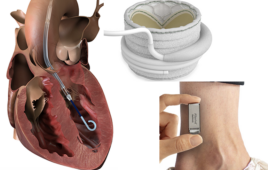
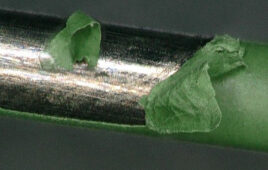
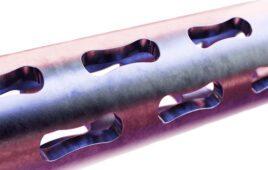
Maximize your chances of coverage with attention-grabbing visuals that will make your story more attractive and engaging.

Former LVAD patient Kyree Miller holds an Abbott HeartMate 3 at our DeviceTalks Boston show in May 2023. [Photo by Jeff Pinette for Medical Design & Outsourcing/DeviceTalks]
But what sort of visuals work best to inform, educate and engage our audience of medical device professionals — and are most likely to encourage one of our editors to move forward with your pitch? Here’s a guide to help you put your best foot forward and expedite publication online and in our award-winning magazine.
Photo specifications
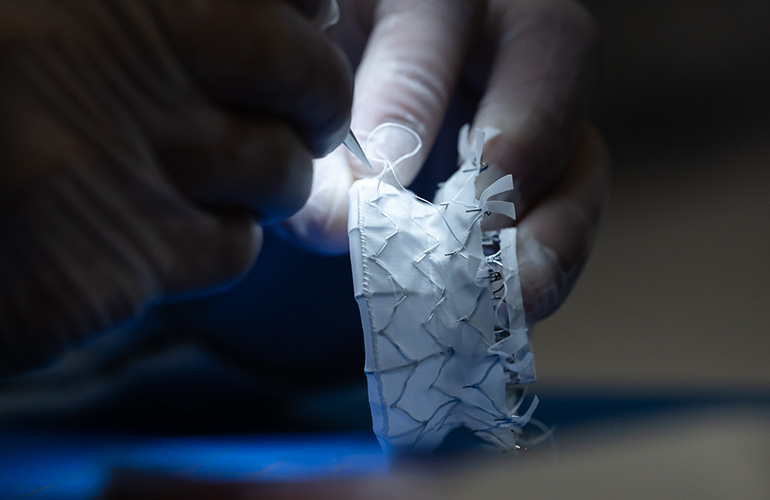
We love to see — and show — how innovative medical devices and components are designed, how they’re made and how they work. [Photo courtesy of Capstan Medical]
If you’re not sure, look at the file size. Anything larger than 500 KB will usually work online and in print. But bigger is better and allows us to blow up details or run the photo across an entire page or even the magazine cover.
We prioritize crisp, focused photos that are well composed, and tend to publish images in the landscape (horizontal) orientation rather than portrait (vertical).
The most common file formats are jpg/jpeg, png and tiff, though we are happy to work with vector art, Photoshop files and raw photo formats.
It’s best to send images as email attachments, but if you have larger images, you can also email them as a compressed ZIP file or share them via a cloud service like Dropbox or Google Drive. Please don’t embed them in a text document or a PDF, as that can downgrade image quality.
We like to include a headshot for all interviews and MDO Contributions, and the same photo specs apply. Larger photos with more room around the person will give us the ability to feature the portrait on a full page — or even the magazine cover.
Images that pop
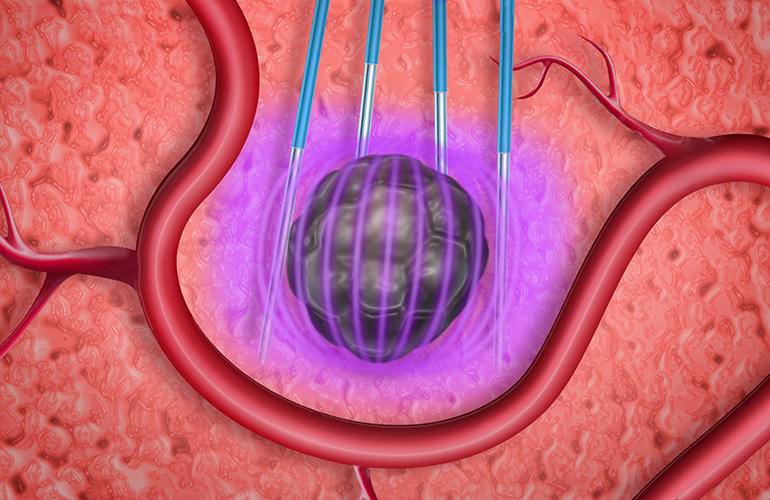
This illustration helps explain how pulsed-field ablation uses electronic fields to kill cells through irreversible electroporation. [Illustration courtesy of Minnetronix]
Maybe that’s a simple photo or computer rendering of a first-of-its-kind device. It could be a close-up of an innovative feature, photos of a surgeon using a system in the operating room for a first-in-human procedure, or images that help explain how an advanced manufacturing process works.
Sometimes it’s medical imaging or an illustration showing where and how a technology does what it does, or a chart or infographic to help readers better understand the topic.
Our target audience includes device designers, engineers and other technical pros, so try to think what they might be excited to see and how it would help them better understand what’s special about your work.

This illustration of the Endogenex ReCET system shows the catheter that delivers nonthermal pulsed electric field energy to duodenal tissue. [Illustration courtesy of Endogenex]
We have stock libraries that we can pull from if needed, but stock photography is a last resort. Stock licenses usually aren’t transferable, so we can’t use stock photos you’ve purchased.
And we don’t publish AI-generated images (except for decorative purposes like a logo) due to the various risks of using large language models, including inaccuracies that could cause real harm to patients.
We can sometimes grab still frames from high-definition videos hosted on YouTube or Vimeo, or video files that you share directly with us.
Captions and credits

If your photo includes a person and a medical device or component, please share the person’s name and title and the name of the device like so: Abbott EVP and Medical Devices Group President Lisa Earnhardt with a FreeStyle Libre 3 sensor [Photo courtesy of Abbott]
Our style for names and job titles in captions is Company Title Name: Medtronic CEO and Chair Geoff Martha, for example.
We include alternate text for accessibility and searchability, and for that all you need to do is briefly describe the image.
We’ll also need to credit the photo to the organization that’s providing it, which might be your company or a partner or another organization like a university or government agency. And we’re happy to credit photographers or illustrators by name when requested.
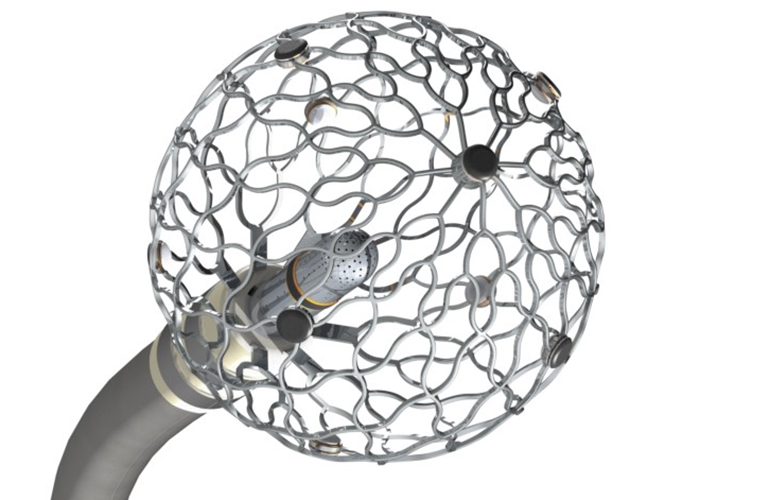
We love detailed device images with white or transparent backgrounds. [Photo courtesy of Medtronic]
Images shared via news releases or by government agencies can usually be used without permission. Let us know if you’re not sure, and we can figure it out or err on the side of caution.
Need help with photos?

Medtronic Chief Technology and Innovation Officer Ken Washington (left) and Medtronic Endoscopy Chief AI Officer Ha Hong pose in a Medical Design & Outsourcing cover shoot. [Photo by Hardy Wilson for Medical Design & Outsourcing]
We’ve done this for device developers ranging from small startups to the world’s largest medtech company, but we ask that companies cover the photography costs.
Because our editorial independence is critical to earning and maintaining the trust of our audience, this isn’t a way to buy editorial coverage. That’s not for sale and never will be.
But to maximize your chances of getting covered or having your news release published, remember to include the kind of attention-grabbing visuals that will make your pitch more attractive to our editors and readers.