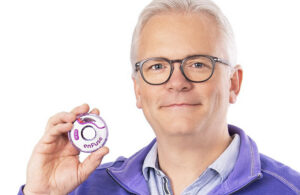
Enable Injections EVP and Chief Commercial Officer Matt Huddleston poses with the enFuse device. [Photo courtesy of Enable Injections]
“I don’t think a lot of people realize this, but we were going to be a small-volume, painless vaccine delivery company,” said Huddleston, who previously served as chief technical officer and led the company’s R&D efforts.
In a Medical Design & Outsourcing interview, Huddleston offered advice for other device developers and discussed the on-body injector’s R&D journey, including the failed painless vaccine effort.
“We realized a couple things,” he said. “No. 1: Nothing’s painless. Everyone has a different level of pain [and when I injected myself] I can barely feel the needle, but I can feel it. Pain is very subjective. And No. 2: Unfortunately, there’s not a big market for vaccine delivery.”
After two years, they stopped their work and worried it was the end of the road.
“You think that people invest in technology, but what you find out is really good investors invest in people,” he said. “One of our board members said, ‘We invest in people. You guys are the right people. You’ll figure it out.’ Six months later, we turned that company from a painless, small-volume vaccine delivery company to a large-volume biologic wearable technology. We learned all these things in those previous two years and we reconfigured that to what you see today with enFuse.”
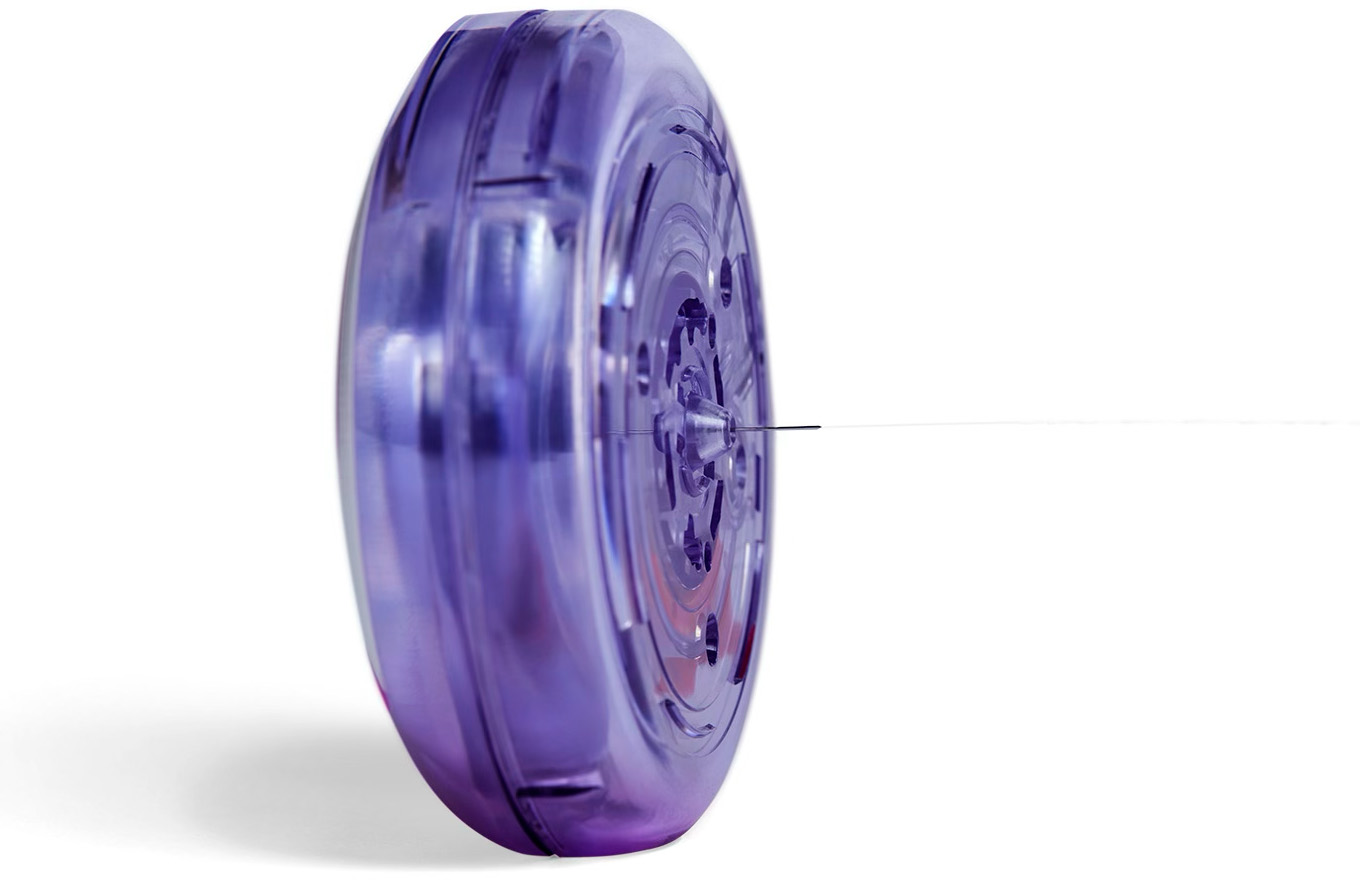
The Enable Injections enFuse on-body injector has a thin, retractable needle for subcutaneous drug delivery. [Photo courtesy of Enable Injections]
“We both had medical device experience but not drug delivery,” Huddleston said. “That really was an advantage for us because we didn’t have the knowledge — or I’ll say the baggage — of how other companies were delivering drugs.”
Most large-volume drug delivery products are “modeled after some derivative of insulin delivery,” he said.
“They have a custom container closure packaged with a battery or a spring that’s moving a plunger and … they’re trying to adapt that technology to a larger volume,” he continued. “When you start getting into 10 mL, 15 mL, 20 mL, all those components get sized so big that you develop something you can’t wear. So when we started, we had a clean sheet of paper figuratively and literally, and we said, ‘Let’s design the best device to be worn.'”

The Enable Injections enFuse is worn on a patient’s stomach for large-volume, subcutaneous drug delivery. The on-body injector’s initial combination product FDA approval was in 2023 for adults with paroxysmal nocturnal hemoglobinuria, a rare blood disorder. [Photo courtesy of Enable Injections]
“We were a bunch of mechanical engineers,” Huddleston said. “We didn’t have a chance of designing anything that had any electronics in it.”
Medtech startups: Download MDO’s free special report with technical tips and strategic advice for medical device startups
Design simplicity was the toughest challenge, but it’s even more important when device users are patients administering an oncolytic at home rather than doctors or nurses in clinical settings.
“It’s something that is saving their life,” Huddleston said. “For the burden of usability and making sure that device does exactly what it needs to do — because it’s critical the patient get that therapy — the bar is raised significantly.”
He looks back on the years when the company had prototypes but no revenue from pharmaceutical customers as the “best time in the company.”
“We would prototype something every single day, get it out in front of someone to watch them use it with simple features like safety strips and buttons and indicators,” he said. “We had hundreds of iterations, making sure that it met every single requirement and could be used by your mom or my mom or my grandmother.”
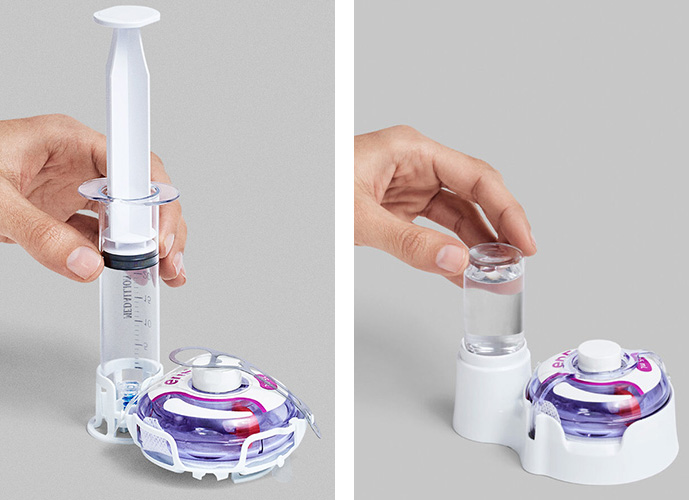
The Enable Injections enFuse on-body injector can be filled with drugs from vials with a syringe (left) or an automated system. [Photos courtesy of Enable Injections]
“The value that we’re bringing is drug companies spend so much time on the formulation side, so let’s take that lyophilized product in a vial and get right to market as fast as possible,” he said.
Asked what he wishes he knew from the beginning, Huddleston said he didn’t expect the journey to take so long.
“You’re hoping to be on the market in 2019 and then 2020 and then 2021, and it’s not a failure. That’s what it takes. You’ve got to go down a lot of wrong paths before you figure out the right path,” he said. “It’s OK to fail. It’s not a bad thing. That’s how you learn. Fail, fail often, and fail fast, and be relentless. Outwork everybody else. I’m not the smartest guy in the room, but I’ll outwork everybody in the room. That’s how we got to where we’re at today.”
Read the first part of our interview here, where Huddleston discusses the enFuse system and its features.





Tell Us What You Think!
You must be logged in to post a comment.